
Best diesel cars 2026: Top 10 diesels for driving range and Real MPG
| Written by: Keith WR Jones | Last updated: 2nd April 2026 |
Once championed as the low-emission, low-tax mobility solution for everyone, diesel cars are now perceived as a minority interest on the automotive scene. Yet for savvy consumers — particularly private buyers who frequently drive long distances — they are sound choices.
Diesel-powered cars have been on quite the journey within the annals of automotive history. It’s 90 years since the Mercedes Type 260D became the first diesel car to be sold in the UK but their appeal remained limited until the late-1980s when turbocharged versions became more widespread, combining economy and performance.
Top picks at a glance
- Best overall: Skoda Octavia Estate
- Best for family life: Volkswagen Multivan
- Best for luxury: Range Rover
- Best for sportiness: Mercedes CLE
- Best for value: Citroen Berlingo
- See the full top 10
Boosted by tax breaks from the 1990s because of their lower CO2 emissions than petrol engines, diesels' dominance has since been eroded by hybrids and — more recently — fully electric cars. These have seen significant growth in demand, particularly among larger fleets and company car drivers.
Poring over new car sales data suggests demand for diesels simply isn’t there any more. Of the 2,020,520 new cars registered in 2025, just 5.1% of them were diesel-powered, representing a 15.6% fall compared with the previous 12 months.
Numbers alone only tell part of the story, of course. In reality, demand is being artificially stymied by an ever-reducing assortment of cars sold with diesel engines. Among the top 10 best-selling cars of 2025 only two are still available with diesel power, while four others have seen that option disappear from the price lists.
Yet excellent choices remain on sale from which we’ve rounded up our top 10 diesel cars across a variety of sizes, bodystyles and prices, all of which prove there’s plenty of appeal in models filled from the black pump.
- Find out how we test diesel cars at HonestJohn.co.uk
1. Skoda Octavia Estate: best diesel car for overall excellence

Why buy it
- There’s a strong argument that this is all the car you’ll ever need
Why avoid it
- The automotive equivalent of a plain ham sandwich
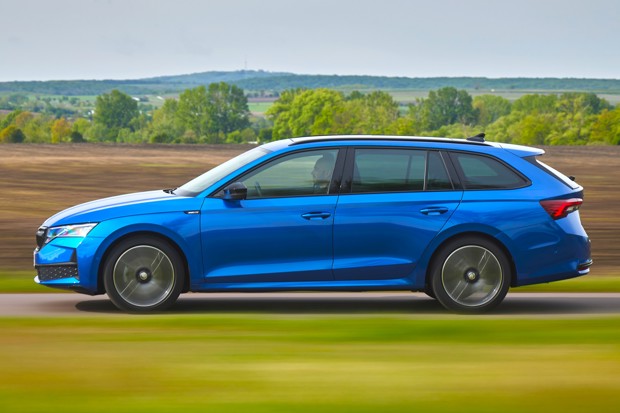
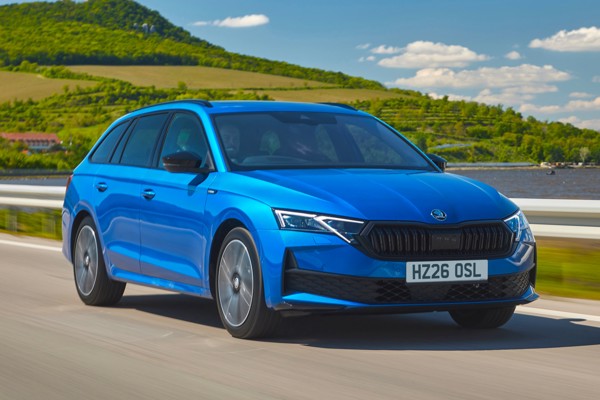
If one car can effectively make all others redundant, we reckon the Skoda Octavia Estate is it. Its cavernous cabin relative to its modest exterior dimensions is giving Russell T Davies sleepless nights pondering whether to trade-in the Tardis ahead of the 15th Doctor’s appearance. Yet unlike the reconstituted police box, the Skoda’s both surprisingly plush and luxuriantly comfortable to travel in. Our readers’ real-world experiences suggest it’s built to last judging by their 9.4 out of 10 reliability rating.
Today’s Octavia Estate line-up hasn’t got the diesely breadth it once did, with a pair of 2.0-litre TDIs being your lot, in 116PS manual and 150PS DSG automatic guises. We’ve picked the former for its superior official fuel efficiency figures – a best of 64.3mpg versus 61.6mpg. You can eke more from a tankful with the hatchback-bodied Skoda Octavia at 65.8mpg, but we think the wagon’s 145 litres of extra boot space is too big a deal to miss out on.
We found the 116PS Octavia Estate TDI’s driving experience is far from exciting, especially so since the diesel Octavia vRS was withdrawn from sale, but we doubt we’re alone in revelling in its unpretentious ordinariness — just like the Skoda, there’s much to be said for indulging in a reassuring sliver or two of Wiltshire’s finest pork betwixt a couple of soft slices of Lurpak-laden white bread. All that wholesomeness for just £31,520.
Real MPG v Official MPG
Honest John’s readers have positive experiences with the fuel efficiency of their Skoda Octavia Estates. While there’s not yet a sufficient pool of data for the 2.0 TDI 116PS version, the punchier 150PS automatic returns a Real MPG that’s an excellent 104% of the official figure at 63.3mpg.
Read our full Skoda Octavia Estate review.
2. Range Rover: best diesel car for go-anywhere luxury

Why buy it
- Luxury in the grand manner that’s about the size of a grand manor
Why avoid it
- Eye-watering depreciation and reliability legacy
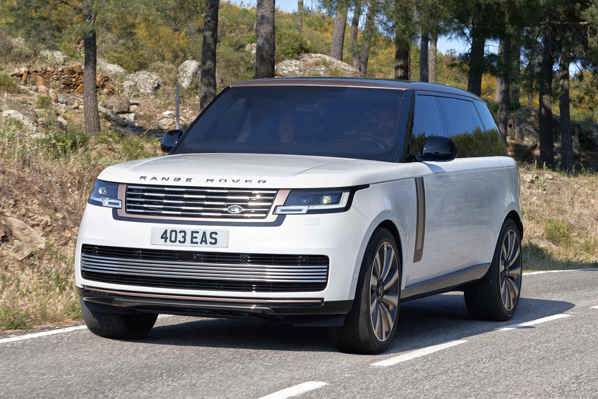
Don’t be fooled by the fact that the Range Rover is blessed with one of the most sumptuously exquisite interiors available or that fact that its imposing bodywork is reminiscent of a stately home, this latest incarnation of the OG luxury SUV is equally and effortlessly capable of traversing fields with lambs in the boot during the day as it is parking kerbside at a Knightsbridge residence in the evening. We wouldn’t say the same of the BMW X7 or the Mercedes GLS.
We think the diesel-engined full-size Range Rovers make the most sense, particularly in entry-level, mild hybrid-assisted D300 form. Our testers loved its combination of sprightly performance and impressive fuel efficiency, both of which benefit from the car’s lightweight aluminium construction — it rather makes the pricier D350 superfluous.
Not that Land Rover’s iconic flagship is inexpensive, you understand, where this least costly version is approaching £106k — and that’s without plundering the massive array of extras you’ll inevitably be tempted with. While Range Rovers haven’t traditionally been paragons of bulletproof reliability, indications are that huge strides have been made in this regard. Time — and the Honest John Satisfaction Index — will tell.
Real MPG v Official MPG
Our Range Rover-owning readers have shared their fuel efficiency experiences revealing that the more powerful D350 version is typically returning a Real MPG figure of 35.7mpg – that’s 97% of the official claim. Given the D300 is a little slower, we expect it to be even better when the numbers roll in.
Read our full Range Rover review.
3. Volkswagen Golf: best diesel car for compact convenience

Why buy it
- A lack of diesel small cars makes the Golf’s compactness advantageous
Why avoid it
- The gulf between VW and Skoda interior quality is conspicuous by its absence
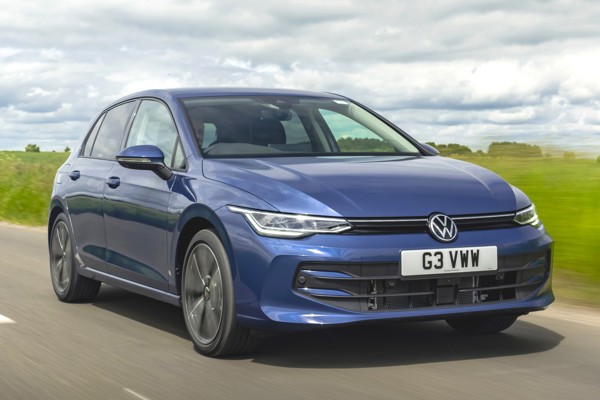
Such is the world we live in that the Volkswagen Golf, a comfortable family-sized hatchback, is now the smallest diesel car on sale. Measuring just 4282mm bumper-to-bumper, we think its relative shortness could be a key criterium if parking space is at a premium.
In most other respects, this VW staple feels significantly more upmarket than the now petrol-only Volkswagen Polo, so no small car vibes here, but we’d suggest that if you’re regularly going to carry adult passengers in the back, they might be better-served in the closely related Skoda Octavia.
While we rate the VW’s rich-feeling interior — and we’re appeased by the much improved multimedia touchscreen system ushered-in with the Golf’s 2024 facelift — the Octavia’s cabin doesn’t feel significantly less downmarket. The VW’s also slightly behind in the reliability stakes according to HJ readers who’ve voted it a 9.0 out of 10 choice.
As with the Skoda, we’ve also gone for the VW’s lower-powered 2.0-litre TDI engine, rated here at 115PS. We found its performance adequate — the 0-62mph benchmark takes 10.2 seconds — but the reward is an official claim of 64.2mpg, a 2.1mpg advantage over the 150PS alternative. That equates to 20 miles of extra mileage per 45-litre tankful.
Real MPG v Official MPG
Well, here’s a thing. As much as we were impressed by the 115PS VW Golf TDI’s official fuel consumption figures and our experiences while testing its diesel miserliness, Honest John’s readers are extracting even more from it. According to their submitted Real MPG data the Golf’s returning an astonishing 109% of the claimed economy at 67.3mpg.
Read our full Volkswagen Golf review.
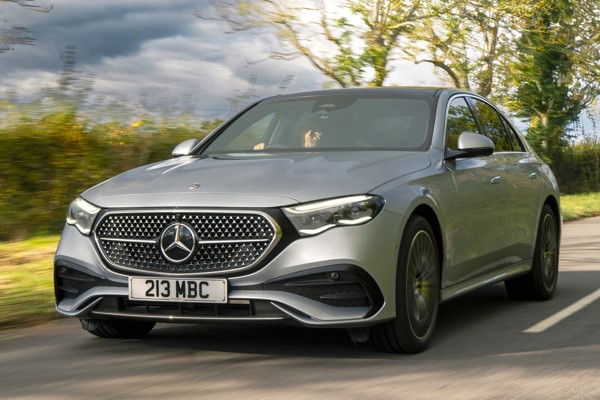
4. Mercedes E-Class: best diesel car for traditionalists

Why buy it
- It’s so good you’ll need to remind yourself you’re not in an S-Class
Why avoid it
- It may be affordable to run, but it remains an expensive car to buy
For many buyers of upmarket four-door saloons, only one with a three-pointed star upon its prow will do, but that only partially explains the long-lasting popularity of the Mercedes E-Class and its forebears.
We rate it as one of the best cars available full stop, with lashings of technology and ample prestige to wonder whether the latest iteration has encroached too far into the territory previously reserved for the lavish Mercedes S-Class. The E-Class is astonishingly good, although the ride quality lacks the polish we expect, unless you plump for a pricier version equipped with air suspension, while its dashboard is an exercise in razzmatazz rather than Mercedes’ previous restraint.
Don’t assume that the E-Class’s perennial appeal is someway indicative of it being bought simply because it’s a Mercedes. It isn’t, but for diesel fanciers the choice among cars of this type is now limited to this and the Audi A6. You’ve missed the boat if you’d planned on buy a BMW 5 Series diesel.
Mild hybrid-assistance is standard fare on the E220d, which is our pick for its real-world performance and economy balance — a 7.6-second 0-62mph benchmark with a claimed best of 58.9mpg — but also available are the E450d 4Matic and the plug-in hybrid-powered E300de. As has been the case for nearly 50 years, there’s also a capacious Mercedes E-Class Estate alternative, yielding a claimed 56.5mpg, for those into ferrying labradors and antiques around.
Real MPG v Official MPG
This-generation E-Class-owning HJ readers have yet to pool sufficient data to validate the Real MPG credentials of this Mercedes, but we found the E220d to be astonishingly good on test, returning over 50mpg even when driven enthusiastically.
Read our full Mercedes E-Class review.
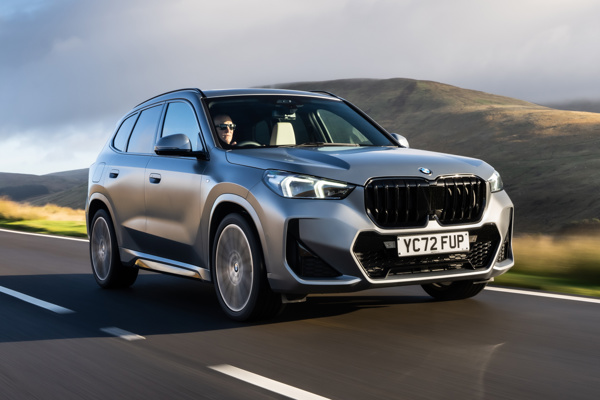
5. BMW X1: best diesel car for fun-to-drive family transport

Why buy it
- Deeply appealing blend of practicality, comfort and enjoyable handling
Why avoid it
- Options and higher specifications soon make its price rocket
You can’t tell from how the BMW X1 looks, but it’s one of those cars which makes you wonder if your life up to this point was all a petrol fumes-induced fever dream. Don’t worry, it wasn’t — because yes, just a few years ago a list such as this which didn’t include a BMW 320d at or near the top wasn’t worth your time reading.
Instead of that archetypal rear-wheel drive saloon, here’s an SUV that only has its front wheels powered. At least it does in the case of the sDrive18d we tested, with all-wheel grip the reserve of the xDrive23d.
That engine choice also helps keep the BMW X1’s price modest, relatively speaking — the sales executive may well advise you consider the most expensive trim level for healthier resale values. That’s sound advice, but note that if you do, the sDrive18d M Sport is less than £1000 cheaper than the xDrive23d xLine above it.
Is this progress? Well, that’s kinda irrelevant here given car buyers’ appetite for SUVs as the default family car format and among such machines, this is our favourite. Not only does it knock the Audi Q3, the Mercedes GLA and everything else of this ilk into the proverbial cocked hat, we love its roomy, upmarket interior and the fact that it’s both comfy and nimble to drive, just as you’d want from a BMW.
Real MPG v Official MPG
As impressive as the official fuel consumption claims are for the BMW X1 sDrive18d are, how efficient this family SUV is in the real-world is of greater importance. Well, here’s a welcome serving of good news – according to our X1-owning readers, you can expect an average of 60.4mpg from this engine choice, representing a Real MPG figure of 105% of the lab test’s claim.
Read our full BMW X1 review.
You may also like
- Looking for an efficient diesel alternative? These are the 10 best hybrids on sale
- Fancy a load-hauler that's not SUV-shaped? Here are the 10 best estate cars available
- Looking for a super-spacious family ferry? These van-derived MPVs will ace the job
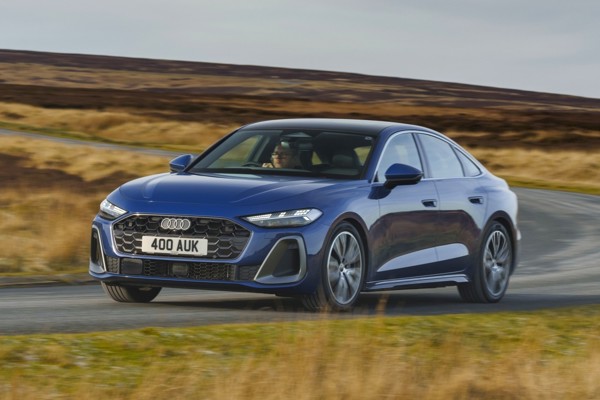
6. Audi A5: best diesel car for making light of motorways

Why buy it
- Refined, comfortable and economical cruiser with a practicality secret
Why avoid it
- Space is at a premium in the back, technofest dashboard is overwrought
Yes, you’re right, the Audi A5 line-up used to be the slinkier, form-before-function alter ego of the more practical Audi A4 range, but now the two ranges have been merged, adopting the higher number for reasons we won’t bore you with just now as that plan has since been binned. Aimed squarely at the BMW 3 Series and the Mercedes C-Class, the Audi A5 Saloon is not exactly as it seems because… It’s really a hatchback.
Not since the forgettable Daihatsu Applause [the what? Exactly…] has a tailgate bustle performed such a convincing impression of a conventional boot lid, but for what end? Well, we found it makes the Audi significantly more practical than its direct rivals, which we applaud, but if such convenience was of great importance, perhaps the estate-bodied Audi A5 Avant might be more worthwhile?
Either way, rear legroom’s tighter than ideal in both, plus the A5 hatchloon is more economical in front-wheel drive TDI 204PS guise with a best of 59.0mpg versus the Avant’s 57.9mpg claim. You can also specific this engine with quattro all-wheel drive, but we would advise most people to instead consider the regular version and a set of winter tyres for superior grip.
Audi’s build standards remain as impressive as ever, although the glitzy, screen-heavy dashboard won’t be to everyone’s taste. We think that the TDI’s smooth refinement’s more of a winner, as is the A5’s comfort and ability to economically eat up mile-after-mile of driving with ease.
Real MPG v Official MPG
What can you expect in the real world from the Audi A5 Saloon TDI 204PS? There’s plenty of performance on offer, but once you’ve learned to temper your right foot’s keenness to exploit it, 55.0mpg is a sensible minimum expectation.
Read our full Audi A5 Saloon review.
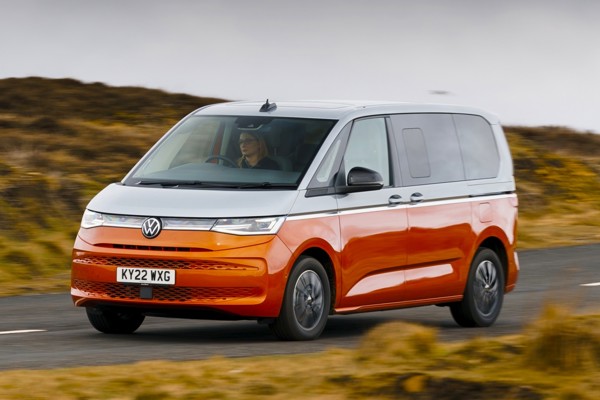
7. Volkswagen Multivan: best diesel car for large families

Why buy it
- Not van-based, despite its styling, so it handles like a conventional car
Why avoid it
- If not a van, why so van-shaped?
If the Volkswagen Multivan had feelings, we would feel sorry for it. It goes against the grain by being an excellent MPV, rather than a seven-seater SUV, yet its moment in the sun is spoilt by the shadow cast by its cooler, yet less spacious and flexible VW ID.Buzz sibling.
Proper MPVs based on car platforms — a stretched version of the Golf’s is beneath the Multivan — are incredibly rare these days, yet VW’s chosen to make it look… Van-ish. Yes, ‘van’ is in its name, it was developed by Volkswagen Commercial Vehicles, but there is no van version of the Multivan. Unless VW’s about to resurrect its music artist-associated limited edition series with a Multivan Morrison, of course...
No, it’s van-shaped because that maximises interior space meaning up to seven adults and all manner of their paraphernalia can be ferried about in fine comfort. In fact, we’d recommend that you have the seats filled at every possible opportunity as we found the Multivan to be bouncy across undulating roads with only the driver on board.
A solitary diesel engine’s available, namely VW’s tried and trusted 2.0-litre TDI in 150PS form. Given the Multivan’s blessed with aerodynamics similar to a warehouse, its 43.5mpg claim doesn’t initially seem that special, but it’s comfortably less thirsty than the 39.8mpg best of the van-derived Volkswagen Transporter Shuttle with a measly 110PS play with. Price-wise? Expect to pay upwards of £50k for a new one.
Real MPG v Official MPG
It’s unlikely that you’ll feel inclined to hurry the Volkswagen Multivan along too often – not only does its handling favour gentler, more considered driving, your passengers will doubtless also prefer you to be less gung-ho. Driven that way, you should realistically expect to see a return of 38mpg.
Read our full Volkswagen Multivan review.
8. Mazda CX-80: best diesel car for long-distance family hauling

Why buy it
- Beautifully finessed interior showcases the importance of physical controls
Why avoid it
- Other seven-seater SUVs are more flexible for family life
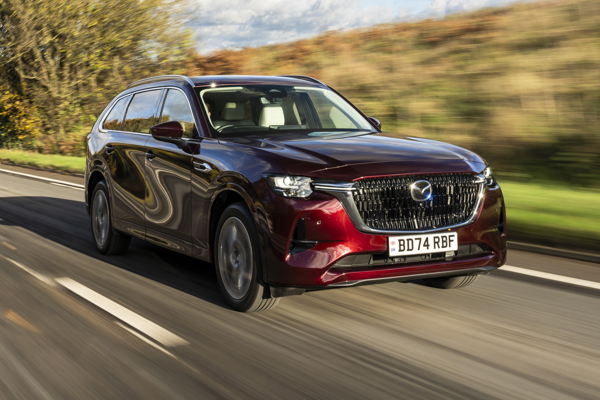
Despite our praise of the VW Multivan, we also recognise that many family car buyers are willing to sacrifice outright practicality in a seven-seater in order to have one that’s SUV-shaped, as per this Mazda CX-80. Its rear seating configurations aren’t the most flexible of a car of this type, but offers something the likes of the Land Rover Discovery Sport and Volkswagen Tayron can’t — a really long driving range.
How long are we talking? Well, take your CX-80 in the least costly Exclusive-Line specification and you’re looking at a theoretical range of up to 807 miles between fill-ups, aided and abetted by a 49.6mpg official average and a voluminous 74-litre fuel tank. For reference, that’s nine litres more than the Land Rover’s and 19 litres up on the VW’s.
Even more impressive is the Mazda’s fuel-sipping credentials come courtesy of a mild hybrid-assisted 3.3-litre engine producing 327PS and with all-wheel drive as standard. Its potent enough to propel this family holdall from 0-62mph in a hot hatch-like 8.4 seconds.
Our testers loved the Mazda’s superbly built, tastefully finished cabin, the dashboard of which is festooned with physical buttons and controls, something we’ve come to love while running a CX-80 – albeit a PHEV petrol version – on long-term test.
Real MPG v Official MPG
What can you expect from the Mazda CX-80 3.3 e-Skyactiv D in the real world? It will be notably more economical on longer runs where 45mpg is likely to be easily achieved, but if you don’t need its seven seats and can manage with only 200PS of power, the smaller Mazda CX-60 is essentially a shrunken version of the same car, with an official claim of 56.5mpg.
Read our full Mazda CX-80 review.
9. Mercedes CLE: best diesel car for making a statement

Why buy it
- As near to a diesel-engined sports car as you can find
Why avoid it
- Coupes aren’t famous for practicality, but need it be so inflexible?
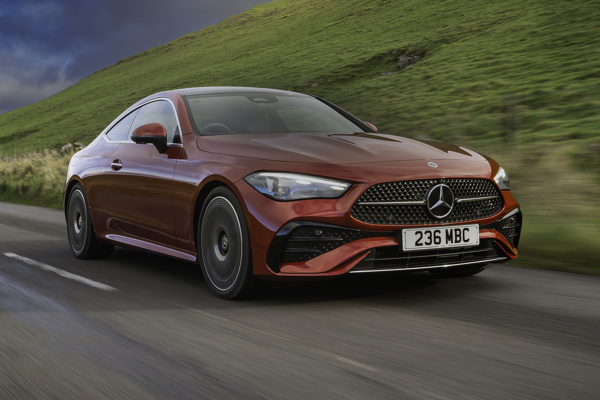
Would Janis Joplin, Michael McClure and Bob Neuwirth have felt so inclined to plead for divine intervention in the purchasing of a car if it was a diesel-engined Mercedes CLE? We doubt that, but we applaud the fact that it exists — very few companies sell slinky two-door coupes any more and of those which do, this is the only diesel one.
Is it a sports car? No, not in the strictest sense, but it is a sportier take on the Mercedes C-Class with which it shares much of its platform and enormous touchscreen-dominated dashboard. Rear seat space is tight, as is access to them, while the conventional boot lid restricts its practicality in a way a large tailgate wouldn’t have. Sure, people don’t buy two-door cars because they crave convenience, but more than the CLE has wouldn’t have gone amiss in our minds.
Only available in CLE 220d form, the coupe has an official economy figure of 60.1mpg, which places it among the top 10 most fuel efficient diesels on sale. If you’re prepared to sacrifice 2.4mpg of that frugality and spend an extra £6k on top of the coupe’s £50,000 asking price, the diesel-powered, soft-top Mercedes CLE Cabriolet is also available. It’s tempting, but the rear seats and boot space are even more compromised, so unless you’re willing to go roofless on every dry day, we’d stick with the hard-top CLE Coupe.
Real MPG v Official MPG
How economical is the Mercedes CLE diesel in the real world? That’s going to depend on how you use it. While it’s not the quickest of coupes its 7.5-second 0-62mph time confirms it isn’t a slouch, but the more performance you exploit, the thirstier it will be. Driven with a touch more delicacy, you should see 50mpg, if not higher.
Read our full Mercedes CLE Coupe review.
10. Citroen Berlingo: best diesel car for value

Why buy it
- So much practical car for not so much money
Why avoid it
- There’s no denying that you are driving a literal van with windows
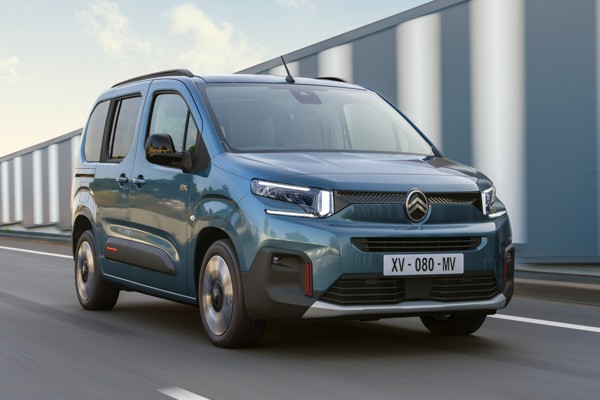
Vans are so good at carrying stuff because their upright bodywork maximises the space inside. Suffice to say, what’s true for all manner of cargo is also correct for people and their belongings, which is why the Citroen Berlingo is one of the most practical and accommodating cars you can buy. But, there’s no hiding its ungainly commercial vehicle origins inside or out.
Before you dismiss it from having a place on your diesel car shortlist, consider some of the reasons its on ours. Its sliding doors and three abreast Isofix child seat-mounting points, plus a seemingly never-ending array of storage options and tough interior plastics make it perfect for the rigours of family life. Factor in an official best of 54.8mpg from the 100PS engine and that under £25k it’s cheapest diesel on sale, with a £3500 step to the next on the list, suddenly it’s not such a silly idea, is it?
Okay, the Citroen’s performance might be a bit too leisurely for some, so consider there’s a slightly brisker 130PS alternative with an automatic gearbox that averages 51.8mpg for an extra £2600. Or for £900 more you can upgrade both to the seven-seater Berlingo XL. As a driving experience it’s nothing exciting, but it’s a more charming mode of conveyance for you and your littlies than you'll expect.
Real MPG v Official MPG
Not helping the Citroen Berlingo’s appetite for diesel is the fact that it cleaves the air with all the aerodynamic efficiency of a breezeblock, so even if you hypermile everywhere you go, you will struggle to match the official consumption claims. Based on our experiences, anything above 45mpg and you’re doing alright.
Read our full Citroen Berlingo review.
How we test cars: the diesel cars method
At Honest John, fastidiously testing cars is the only way we know how. Our team's expertise has been acquired from getting under the skin of hundreds of different cars and not by poring over online configurators. Our unrivalled knowledge enables us to separate out excellent cars from the merely good ones. To determine the 10 best diesel cars for 2026, our expert editorial team has:
-
Driven over 10,000 miles: From narrow urban rat runs, to motorways with all manner of cross-country A- and B-roads in between, we test every car across the best — and worst — of what Britain's roads can offer. Not only that, we stretch diesels’ legs with long, steady cruises as well as short, stop-start city crawls where they don’t perform as efficiently as petrol cars.
-
Prodded and parked: We spend hours assessing real-world practicality of each car, seeing how the cope with the rigours of school and tip runs as well as ferrying about infants and elderly relatives. We also judge how convenient they are to zip in and out of bays in supermarket and multi-storey car parks.
-
Real MPG Data: Unlike other car review sites, we share our unique reader-supplied Real MPG data to show you what you can realistically expect from different engine and gearbox combinations within the range.
-
Owner Feedback: We also share our readers’ own reliability ratings from the Honest John Satisfaction Index in our reviews. Whether a car has a positive or substandard dependability reputation, it’s important that you know about it.
Our reviews are 100% independent. We don't take money from car manufacturers to influence our rankings. Our only priority is helping you find the right car.
Frequently asked questions about diesel cars
Why have so many manufacturers stopped selling diesel cars?
As legislators around the world are tightening up on exhaust emissions, incentives are being granted to hybridised and fully electric cars instead, which has meant consumer demand has shifted away from conventionally propelled diesel- and petrol-engined cars.
Ensuring those engines meet current and incoming emissions regulations is a costly business for car manufacturers, who will inevitably pass on that expense to consumers. This makes smaller diesel cars at the less expensive end of the market an unviable proposition. This trend will only continue as we approach a ban on the sale of new diesel- and petrol-engined cars.
Is diesel being banned from 2030?
No. The sale of new diesel- and petrol-engined cars with no hybridisation will be banned from 2030, based on the law as it currently stands. New plug-in hybrid cars capable of a ‘substantial’ – but as yet unspecified – electric-only driving range, will continue to be legally available until 2035, when they will also be banned.
As there will be millions of diesel- and petrol-powered vehicles on the road for decades to come, filling stations selling those fuels will remain, although they will inevitably become smaller in number as more and more cars are electric only.
Over the next decade we expect to see a greater availability of carbon neutral diesel and petrol fuels available. These don’t reduce the amount of CO2 in the atmosphere, but they don’t worsen the situation.
Which is the cheapest diesel car on sale?
Currently, that honour goes to the Citroen Berlingo Plus Diesel 100hp, a van-based MPV, which has an on-the-road price of £24,785.
Which is the most fuel efficiency diesel car on sale?
According to official WLTP Combined cycle tests, the most economical diesel on sale is the Skoda Octavia SE Technology 2.0 TDI 116PS SCR Hatch with a claimed average of 65.8mpg.
Which diesel car on sale has the longest potential driving range?
Based on official WLTP Combined cycle tests, the Mercedes C220d AMG Line Saloon has a claimed average of 62.8mpg. Consider that its fuel tank has a capacity of 66 litres, this means it can theoretically travel 911 miles between fill-ups.
Which was the first diesel car to be sold in the UK?
The first diesel-fuelled car to be officially sold in the UK as a genuine production model was the Mercedes Type 260D in 1936.
Other notable diesel firsts were the Peugeot 604 which was the first turbocharged diesel sold in this country from 1980, while the Mazda 626 was the first supercharged diesel to be offered for sale in the UK in 1994.
Which diesel car has the most comfortable ride?
If money's no object in your comfort pursuit then you need an Audi A8, a Mercedes S-Class or a Range Rover for the most relaxed ride. Yet, one of the best diesels for comfort is also the cheapest – yes, it's the Citroen Berlingo.
What is the best diesel car for dog owners?
Several of our favourite 10 diesel cars are great for dog owners thanks to their enormous boots. Each of the BMW X1, the Mazda CX-80, the Range Rover and the Skoda Octavia Estate have plenty of space at the back for even large canine companions. Thanks to their lower loading lips, both the Citroen Berlingo and the VW Multivan excel in this area, due to easier access for less-mobile and shorter-legged dogs.
Which diesel car is best for seniors and those who are less mobile?
Models which have elevated seats, sometimes referred to as a high H-point – the 'H' is for hip – are generally easier to get in and out of as the seat cushion height reduces muscular and joint stress. Cars which typically have higher H-points are MPVs and SUVs, so from our top 10 you're looking at the BMW X1, the Citroen Berlingo, the Mazda CX-80, the Range Rover and the VW Multivan.
Is it worth buying a diesel car in 2026?
Yes, providing that you cover a sufficiently high annual mileage and that most of your journeys aren't just short jaunts or primarily in stop-start urban traffic. Diesels work most efficiently when they're allowed to stretch their legs on long runs.
Exactly how many miles you need to be doing each year varies from car to car, but as a yardstick you need to be covering at least 15,000 miles per annum for a diesel to start to make sense, but even at that don't take it for granted that a diesel is the most economical option.
Providing you can charge at home, fully electric cars remain the least expensive to run, with most on sale able to comfortably go beyond 200 miles per charge.
Even if the ban on the sale of new diesel- and petrol-powered cars goes ahead in 2030, demand will remain strong for years beyond that deadline for used examples and the fuel to power them.
