
Best cheap to tax cars for 2026
.jpg?width=620)
Some motoring costs are unavoidable. Fortunately, car road tax – officially Vehicle Excise Duty (VED) – is something you can do something about.
New cars registered since 1 April 2017 incur a flat rate of annual road tax. But cars registered between 1 March 2001 and 31 March 2017 can cost as little as £20 or £35 a year if they have zero or low emissions.
That's because these cars are taxed based on their emissions band. That means that regardless of fuel type, cars in bands A (up to 100g/km) and B (101-110g/km) cost £20 a year, while those in band C (111g/km-120g/km) cost £35.
It's this group of 2001 to 2017 cars that offer the cheapest road tax options, especially as there are no longer any new or second hand cars with zero-rated VED.
We've selected 10 of the cheapest cars to tax with an eye on overall reliability and low running costs.
Cheap tax cars |
You may also like
1. BMW i3
.jpg?rmode=max&width=600&height=390)
- Clever little BMW is efficient and stylish
- Largest battery will attract annual road tax
- Ideal for short trips, or go for a REx
Thanks to a long production run the BMW i3 falls into the cheapest tax band from launch, to early 2017. An innovative electric car that uses carbon fibre construction to save weight, pillarless doors for easy access, and in REx models a scooter-engine generator to fill up with petrol when charging points are elusive. You can buy a BMW i3 from around £5000, though we'd spend more and take time to shop round for a cared for, low-mileage example.
Watch out for high insurance and accident repair costs. If you go for an i3 REx model make sure it's been maintained well. The engines corrode and owners sometimes overlook servicing, so we'd look for lots of receipts when buying from a dealer and ask for a few months warranty – or, join some forums and keep an eye out for an enthusiast-owned example.
Chances are if you buy an i3, you'll become an enthusiast yourself. If you don't mind the flat-rate VED on post-April 2017 models, the later i3 S model is an extremely capable and fun EV without the added burden of the engine to maintain.
2. Toyota Yaris Hybrid
.jpg?rmode=max&width=600&height=391)
- Scaled-down Prius cuts emissions and running costs
- Potentially available with Toyota warranty
- Probably the best small car to buy used
Toyota's already economical Yaris got even better with the introduction of the Yaris Hybrid in 2012. A downsized version of the 'self-charging’ hybrid Toyota Prius hybrid synergy drive, despite a small 0.9kWh battery it can still operate as an EV at slower speeds. As you would expect, it falls into band A, but what makes it really appealing is that this economical small car comes with an automatic gearbox.
A regular Toyota Yaris 1.0-litre falls into band C, costing £35, while many of the 1.3-litre versions including the CVT automatic are band D – but, the Yaris Hybrid has an unstressed 1.5-litre and electric motor, so it's far more relaxing to drive at motorway speeds as well as using considerably less fuel.
Expect to pay around £5000 at least for a Yaris Hybrid - a substantial premium over the £2500 entry level for the 1.0-litre petrol. Remarkably, some of the later ones registered in 2016 and early 2017 may qualify for a little bit of Toyota warranty if they have full service history and less than 100,000 miles.
3. Volkswagen Up
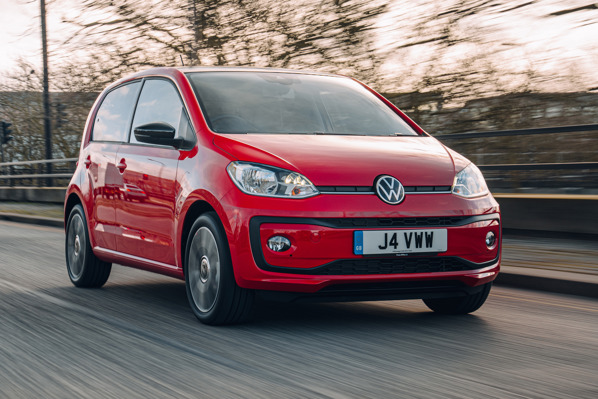
- Solid, reliable small car with low emissions and EV option
- Look for 66 plate or earlier models for cheap tax
- Up GTI offers performance with low emissions
The Volkswagen Up, along with the related SEAT Mii and Skoda Citigo, brought a new feeling of solidity to the 'stripped-out' city car market. It's very close to the original Golf in size and recalls the slim pillars, big windows and lack of bulk of older designs without feeling crude. There's a choice of three- or five-door models, all fun to drive.
The minimal trim is high quality and assembled well, so this small VW feels solid and reasonably refined for such a cheap car. Whether you choose the Volkswagen, Skoda or SEAT they've proven reliable and robust, representing good value as a used car.
The 1.0-litre petrol engine is also extremely fuel-efficient, which means CO2 emissions are low. Most pre-April 2017 models fall into bands A and B, and will cost £20 a year. For anyone missing the classic Golf GTI, the Up GTI feels a lot like that pioneering hot hatch and has a few interior details to make any '80s nostalgia buff feel happy. As with the electric e-Up, it arrived in the UK after the April 2017 cut-off date for flat-rate VED.
4. Ford Fiesta
.jpg?rmode=max&width=601&height=400)
- Lots of choice on the used market
- A feeling of strength and quality
- Post-2013 facelift still feels modern
Ford's skill at making cars for the masses aligned perfectly with the era of cheap road tax. An all-new Fiesta launched in 2002 set the stage for three generations of class-leading small cars and ultimately, the re-launch of the Puma as a best-selling small SUV. Find an older example in good condition and it's more than capable of mixing with cars 23 years younger, but it's the 2008 Fiesta that, with revisions, saw the brand out to the end.
You'll have no trouble finding a Fiesta for sale. A best-seller when new, it's still one of the most popular used cars in Britain. Regardless of power output the 1.0-litre Ecoboost should fall into band B or C, but this clever three-cylinder engine is not without problems. There are low-CO2 diesel options, again with their share of issues as the cars age. We'd look for later models of 1.25-litre Zetec petrol for reliability and low running costs.
Check early cars for rust, particularly near the rear axle mounts. And when buying a 1.0-litre Ecoboost make sure any technical updates such as cooling system revisions have been carried out. Timing belts should be changed before 10 years regardless of mileage and servicing must be done with the correct specification of oil. Wet belt replacement costs have fallen, but neglect will wreck the engine and Ford's original servicing recommendations were inadequate.
5. Volkswagen Golf GTE
.jpg?rmode=max&width=602&height=385)
- Hot-hatch performance, small car emissions
- Golf GTE and Audi A3 e-Tron are scaled-down PHEVs
- Very capable but quite rare
Masking the size and weight of batteries meant the first plug-in hybrids tended to be based around SUVs. Volkswagen's Golf GTE and the related Audi A3 e-Tron showed that the blend of electric motor and small, efficient engine could work well in the challenging, competitive family hatchback format.
What marks the Golf GTE out from other early PHEVs is how normal it feels. The extra weight does blunt the 204PS performance slightly, but the car is just as enjoyable to drive as long as you plug it in. Let the battery run out and you'll be down on power until it's recovered enough energy for a boost again. Charged up, the Golf GTE will do around 20 miles on electric power alone – ideal for those short shopping trips.
Prices start from around £5000 but we'd recommend paying around £8000 and looking for the nicest examples. The GTE's was only offered for short periods, but the combination of 1.4-litre engine and electric motor remains at the heart of Volkswagen Group hybrids to this day.
6. Citroen C1
.jpg?rmode=max&width=598&height=389)
- Citroen's low-cost small car saves money everywhere
- Japanese engineering is reassuringly reliable
- Watch out for neglect and missed services
The Citroen C1 is a popular, very affordable city car that was sold across two generations, starting with the 2005 debut of a trio of cars from Toyota, Peugeot and Citroen. Collectively referred to as the 'Citybug', most models feature an economical 1.0-litre petrol engine designed by Daihatsu and are among the cheapest cars to tax. Most C1s fall into road tax band A or B, costing £20 a year.
The C1 is really fun to drive, with nimble handling and a lively engine. It’s also a great choice for new drivers, with excellent visibility and light controls. Short overhangs front and rear make it easy to park and most models feature 50/50 split folding rear seats to expand the small boot.
The Citybug series is one of the few cars offering automatic licence holders a two-pedal option with low VED. It's an automated manual, with a driving technique that still needs awareness of biting points and use of the handbrake. This means that many two-pedal models suffer problems at low mileage, despite being cheaper to overhaul and maintain than a conventional automatic. We'd also recommend caution when looking at the 1.2-litre models with wet-belt PureTech engines.
7. Smart Forfour
.jpg?rmode=max&width=596&height=397)
- Smart's second-generation four-seater is a great city car
- Unusual rear-engine design means lots of space
- Wide-opening doors and fun attitude
While the brand may be best known for its innovative two-seater Smart Fortwo, Smart's four-door Forfour is just as clever. Based on a joint platform developed with Renault, the 2014 Forfour was designed to be electrified from the beginning and formed the basis of the 2014-2019 Renault Twingo III.
The electric Forfour was offered just in time for the 1 April 2017 change in VED rules – at the time, not a problem, but now it attracts the full rate. You'll want the 0.9-litre petrol turbo, which is fun to drive and better for long trips, though the 1.0-litre is easier to maintain. Unlike the original Smart you can get the Forfour with a manual gearbox or a twin-clutch automatic. Prices start at around £2500 for a 1.0 Prime, rising to around £8000 for a 2021 EQ Forfour. We'd avoid these now due to the combination of short range and flat-rate VED.
Although it's not as space-saving as the Fortwo, the 3.5-metre long Forfour is appreciably smaller than many cars, with agile handling and a small turning circle. The doors are designed to open wide and present a big aperture so it's easier to use with child seats and you'll find a wide variety of colours and contrasting panels plus there's an optional full-length fabric or glass sunroof. There's even a Brabus version.
8. Mitsubishi Outlander PHEV
.jpg?rmode=max&width=603&height=397)
- Once, the most popular plug-in hybrid in Britain
- All-wheel drive versatility and around 30 miles EV range
- Good economy in mixed use, but poor if not charged
Yes, you can get a four-wheel drive SUV with cheap road tax. The groundbreaking Mitsubishi Outlander PHEV falls into Band A in early 2.0-litre form as long as it was registered before 1 April 2017. That gives a broad range of specifications for a spacious five-seater that's capable of zero-emissions short runs and long drives with running costs comparable to a diesel.
The Outlander PHEV was a best-seller, but many owners worked them hard and Mitsubishi's departure from the UK didn't help buyer confidence (the Outlander is set to return in 2026). There are many neglected examples on the used market as a result. If you can accept paying the flat-rate VED the 2018-on 2.4-litre model is better overall. Don't dismiss a cheap 2.0-litre Outlander if it's been looked after though, as it's still a very versatile car.
Areas to watch include general corrosion underneath and the condition of cooling pipes and pumps. The motor, battery and cabin heater circuits are complicated and vulnerable to damage underneath the vehicle - many issues start with neglect here. It's also worth noting that despite the big 4x4 appearance, the PHEV can only tow 1500kg.
9. Skoda Superb Estate
.jpeg?rmode=max&width=599&height=399)
- Large, family-friendly and economical estate
- A match for any Volkswagen and many Audis
- Cheap tax doesn't mean low spec and performance
You really can have an incredible car with low VED if you find the right version of Skoda Superb Estate. The good news is you can get a huge, well-equipped estate that costs only £20 a year to tax, falling into band B. The bad news is that it's a 10-year-old diesel, so it's likely to have been worked hard and competition for good ones will be strong. Look for the 2.0-litre TDI CR, 190PS Laurin & Klement for the ultimate blend of low running costs and effortless performance, though adding the DSG gearbox pushes it to band C and £35 tax.
You can go for lower specification models and the 120ps 1.6-litre TDI CR may be easier to find, with the SE Business spec offering DSG and remaining in band B. Don't want a diesel? The 1.4-litre TFSi with 150ps and DSG gearbox falls into band C, but with rather less torque it's not economical or as unstressed as that 2.0 TDI will be. Some versions were only offered for six months before the VED rules changed, so look for a 66 plate.
Expect to pay around £7500 for average mileage and condition examples, and over £10,000 for a well maintained high-spec example. Choosing the large, but less practical Skoda Superb hatchback saves around £1500 and increases the chances of finding that privately-owned, cared for model. Timing belt changes, emissions system issues and regular oil changes are essential. That's the case for any Euro 5 or 6 diesel. And yes – some examples of the 1.6-litre TDI CR are ULEZ compliant, but not all, so check any potential purchase before buying if you want to drive in clean air zones.
10. Tesla Model S
.JPG?rmode=max&width=602&height=401)
- Big Tesla offers long range, high performance
- Buy with care as repairs can be expensive
- A good Model S is capable and efficient
Thanks to the juggling of VED rates and cutoff dates, the Tesla Model S is an unusual but very tempting low-tax option for anyone who does a lot of motorway driving and wants a big, luxurious car with lots of modern tech. This Jaguar XJ-sized high-end EV joined the UK market in late 2013 and immediately made the cautious, small-battery and basic electric cars offered by Renault, Nissan and others look like toys.
The Model S was considerably more expensive than rivals, let alone contemporary EVs, but with its choice of 70kWh to 90kWh battery and supercar-baiting performance it proved sought after. Exemptions and discounts for use in London and for company car drivers meant it sold well. Tesla also offered reasonably-priced refits of the computer and infotainment system. It's worth doing serious research before buying a used Model S.
You can choose from almost four years of production to get a car that's cheap to tax, achieves 0-62mph in 5.5 seconds and still offers a real-world range many new EVs struggle to match, but you're looking at paying over £10,000 for a high-mileage car over 10 years old, up to around £25,000 for the narrow band of March 2017 registered 'Ludicrous' models. Some cars may feature a very appealing option, however - free Supercharging for life.
Why should I look for cars registered before April 2017?
Cars registered between 1 March 2001 and 31 March 2017 are taxed based on CO2 emissions. A sliding scale of tax bands from A to K (expanded to M in March 2006) defines the costs for CO2 emission categories and the fuel type is no longer a factor. It means that low emissions car from that period are cheaper to tax than the same models registered after April 2017.
What happened to road tax after April 2017?
From April 2017, flat-rate car tax was introduced. This is £195 per year regardless of emissions or fuel type as of 1 April 2025. This rate only applies from the second year onwards as the first-year road tax s still based on CO2 emissions. Zero-emission vehicles cost £10 and the highest-emitting (band M, 255g/km CO2) cars cost £5490 for the first year. Diesel cars that aren't tested to RDE2 standards are penalised with a higher rate.
Newly registered vehicles move to the flat rate from the second year, but it's worth noting that cars with a list price of more than £40,000 pay additional 'Expensive Car Supplement' of £425 a year for five years, regardless of emissions or fuel type. At the time of writing new cars with a list price of £40,000 or more will cost £690 per year to tax until they are six years old – though zero-emission cars have a higher £50,000 allowance from 1 April 2026, meaning EVs below the threshold registered from 1 April 2025 won't have to pay the higher rate.
Why do electric cars pay road tax?
As an incentive to move away from fossil fuels the Government retained a zero-rated tax band and exemptions from first-year tax rates for zero-emission vehicles, but that has now ended. Instead, newly registered zero-emissions vehicles pay a £10 first-year rate from 1 April 2025, saving £100 over the lowest CO2 band. The annual tax rate for EVs is now the same flat rate £195 as all other cars. As sales of EVs have increased, the impact of heaver vehicles, need to invest in charging points and facilities and loss of revenue from exemptions means that they're now taxed to reflect their impact on infrastructure.
