
Leapmotor C10 Review 2026: UK Price, 603-Mile Range REEV & Specs | Honest John

Leapmotor C10 Verdict

 Well equipped for the price. Clean-looking interior design. Tie-up with Stellantis makes it less of an unknown.
 Complete lack of physical buttons on the dash is infuriating. Poorly calibrated brake pedal. Constantly unsettled ride.
Find out more about the Leapmotor C10
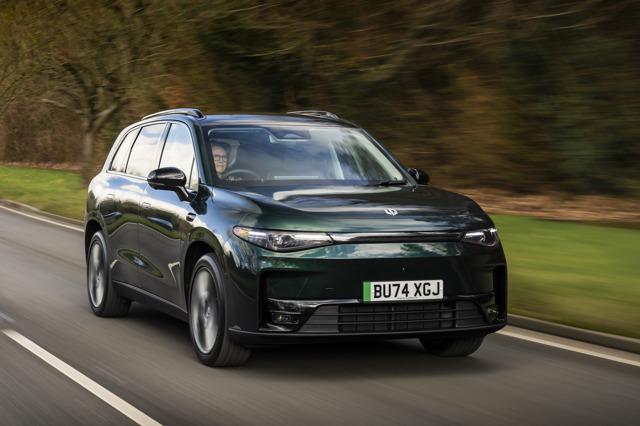
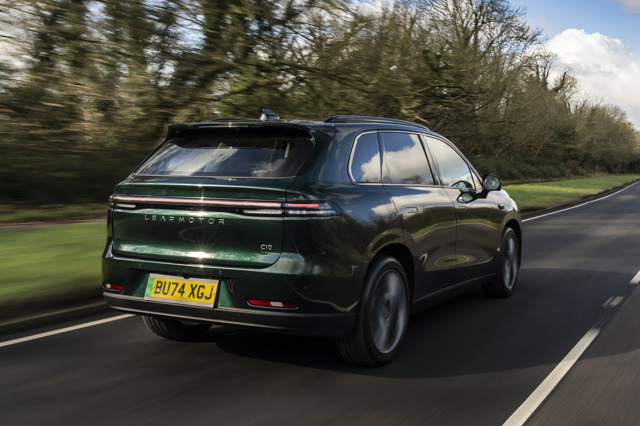
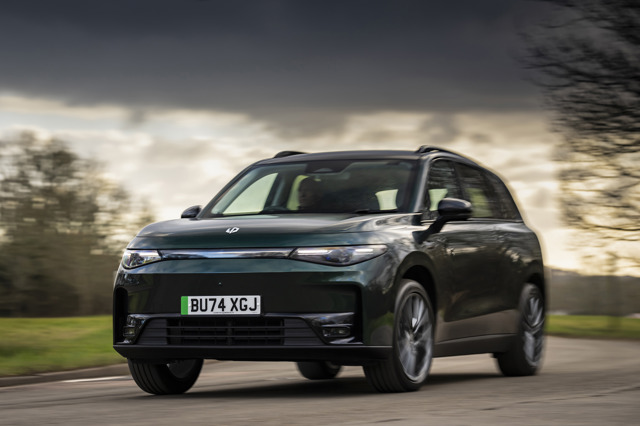
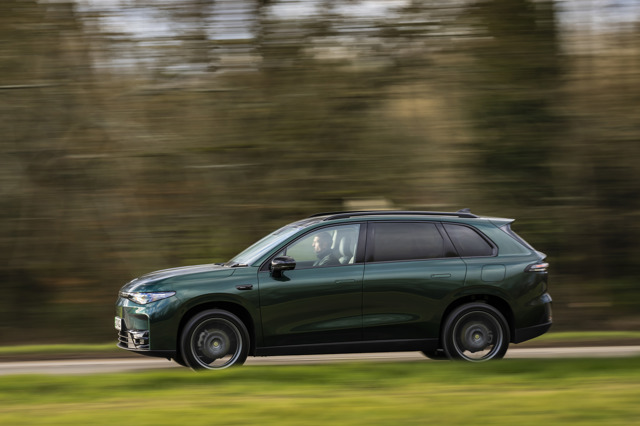
One of many Chinese car brands to arrive in the UK recently, Leapmotor is attempting to see off a wide variety of rivals with its C10 electric SUV. Its price — especially when discounts are taken into account — seems compelling considering its impressive levels of standard kit, but there's more to it than that. Find out everything you need to know in our full Leapmotor C10 review.
It's starting to get hard to keep track of all the Chinese car brands now available in this country, but the Leapmotor C10 has an inherent edge over many of its competitors.
Stellantis owns a 20% chunk of the brand, plus a controlling stake in the joint-venture tasked with selling its cars outside of China. This enables Leapmotor to take advantage of Stellantis's vast dealer and distribution network, plus its marketing clout.
Given that Stellantis is behind Citroen, Peugeot and Vauxhall, among several others, it ensures Leapmotor has a head start over other Chinese newcomers through its association with more familiar brands. Its cars ideally need to be up to snuff as well, but on that front, it's been a bit of a mixed bag so far.
The dinky Leapmotor T03 is incredibly cheap and mostly cheerful, although when the main competition is the Dacia Spring, the bar isn't exactly high. That's not the case for the much larger Leapmotor C10 which has a lot more to do, with an extensive and talented list of rivals to choose from.
Those include more expensive European options, including the Renault Scenic E-Tech and the Skoda Enyaq in addition to other Chinese value-focused models, such as the BYD Atto 3.
For car buyers it would be ideal if the C10 was as good as the Scenic and Enyaq while also being cheaper. Unfortunately, its price has much heavy lifting to perform in order to distract attention from its less appealing aspects. These include an over-reliance on its large infotainment touchscreen, unpolished driver assistance systems and a choppy ride.
Boot space is disappointing for the C10's size and its rapid charging capability is underwhelming. Clawing back some ground, its passenger space is very impressive and it's reasonably quick.
You can also have Leapmotor's largest model in two very distinct flavours. There's a fully electric C10 which combines a rear-mounted motor with a 69.9kWh battery pack while the alternative is what's known as a range extender electric vehicle, or REEV for short.
Badged Leapmotor C10 Hybrid EV, its electric motor remains under the boot floor, the battery is substituted for a smaller one, while under the bonnet you will find a 1.5-litre petrol engine. This may sound like a plug-in hybrid (PHEV) but there's an important distinction. With PHEVs both the engine and electric motor propel the car, whereas with REEVs only the motor turns the wheels — the engine's role is to be an on-board generator for the battery.
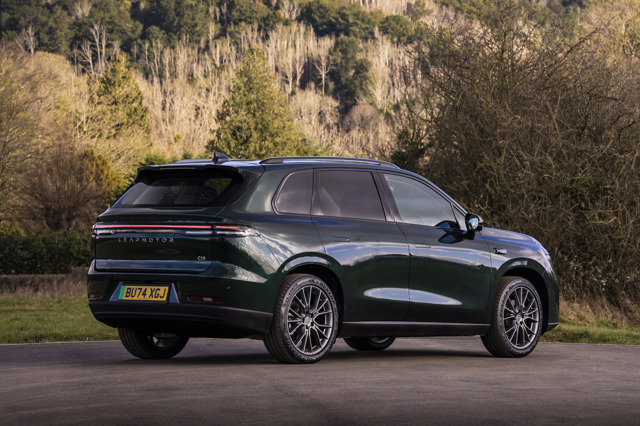
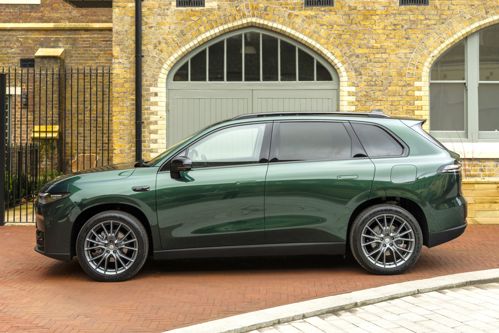
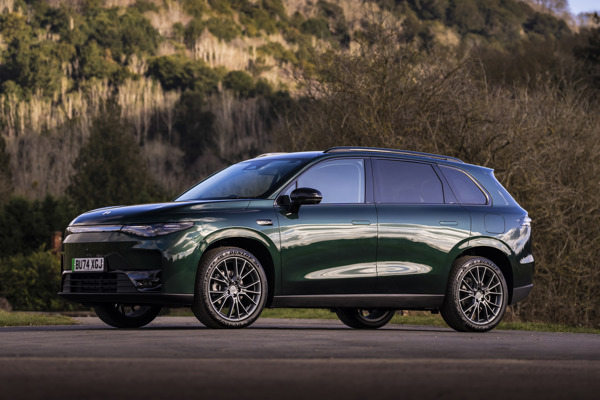
Considering the Leapmotor C10's discounted sub-£33k price means it's relatively cheap, the standard equipment levels are generous. Electrically adjustable, heated and ventilated front seats, a 360-degree parking camera system, a panoramic roof and 20-inch alloy wheels are among the features fitted at no extra cost.
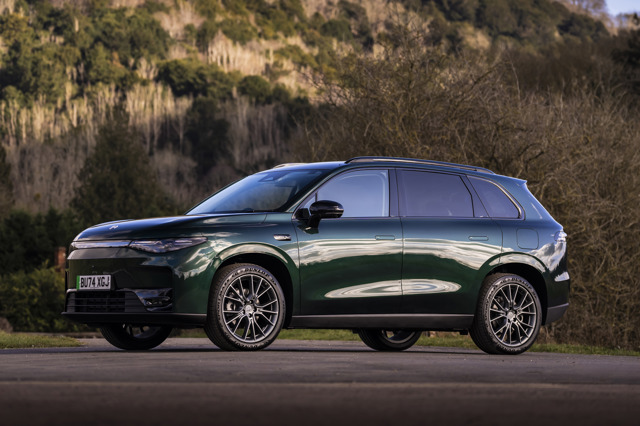
Mind you, it needs big wheels as there's a curiously large amount of space between the tyres and wheel arches that even those 20-inch rims struggle to fill.
Leapmotor C10: Range and charging times
| Leapmotor C10 electric | 263 miles |
| Leapmotor C10 Hybrid EV — electric only | 90 miles |
| Leapmotor C10 Hybrid EV — combined | 603 miles |
How far the Leapmotor C10 will cover on a single, full charge depends upon the version in question. According to the official WLTP Combined cycle, the fully electric C10's 69.9kWh battery provides a driving range of 263 miles.
That's only two miles more than the BYD Atto 3 manages from its 60.4kWh battery, while 59kWh versions of the Skoda Enyaq are rated at up to 269 miles.
Using only the power stored in its 28.4kWh battery, the Leapmotor C10 Hybrid EV can travel 90 miles, which will be more than is needed for most drivers' daily needs. Factor in the engine charging the battery as well and the range potential extends to 603 miles.
It's frustrating that Leapmotor quotes the majority of its battery recharging times from 30-80%, whereas 20-80% is the norm. Bear that in mind when comparing figures published by other manufacturers.
Curiously, the AC charging limit for both C10s is 6.6kW, which is lower than the 7.4kW maximum which can be outputted by most UK domestic wallboxes. Leapmotor quotes 6 hours 6 minutes for a 30-80% recharge of the electric-only C10 — for a flat-to-full rehcarge it will be close to 12 hours.
Surprisingly, the AC recharging time for the C10 Hybrid EV, also limited to 6.6kW, is quoted for 0-100%, needing to be plugged in for 4 hours 30 minutes.
Recharging using a public DC connection is underwhelming with both C10s, again because of their restricted on-board charger speeds. The Hybrid EV caps the inward flow of energy at 65kW with the fully electric version only increasing it to 84kW. Compare that with the Skoda Enyaq's 165kW capability.
For a 30-80% increase in battery charge levels, the C10 electric needs 30 minutes, the Hybrid EV version requiring 18 minutes for the same state-of-charge elevation.
Reviews for Leapmotor C10's top 3 rivals




Leapmotor C10 handling and engines
Leapmotor C10 2026: Handling and ride quality
The ride quality of the Leapmotor C10 never seems to settle, constantly jiggling even over smooth surfaces. Its suspension movements are surprisingly firm, although it at doesn't crash over larger imperfections in the road surface as a result.
There's vagueness in the steering which gives little impression of what the front wheels are up to. Grip levels are okay, but the C10 has a tendency to lean in the corners to a reasonably significant degree, even when it feels like you're not really pushing on.
One of our biggest misgivings about the handling concerns the response from the brakes. They are strong enough but the calibration of the pedal is poor. In the initial part of its travel precious little happens, yet press it a bit harder and the brakes bite aggressively bite — you feel like you're about to get thrown through the windscreen.
Refinement at high speed depends on the road surface. Over rougher sections of asphalt, tyre noise can become pronounced and boomy. The C10's insulation from wind noise is just about acceptable.
Leapmotor C10 2026: Engines
There are two distinct versions of the Leapmotor C10 available — a fully electric version and a range extender alternative badged Hybrid EV. Which you choose has a big impact on what's going on under the bodywork.
The electric-only C10 is powered by a rear-mounted motor sending drive to the rear wheels, which is good for 218PS and 320Nm of torque. The 0-62mph time is a respectably brisk 7.5 seconds, while the top speed is capped at 105mph.
It feels swift enough, at least it does after a brief pause when you put your foot down followed by a surprisingly long period during which the motor slowly ramps up. Given that electric motors deliver their torque instantly, why there's a lag is unclear. It won't catch people off guard with an instant surge forwards, but it feels far too tardy as it is.
The Sport driving mode shortens this delay slightly but whatever mode you're in, the throttle is also quite slow to resond when lifting off, which can be disconcerting as speed is maintained for longer than is asked of it.
The C10 Hybrid EV is a very different kettle of fish being a range extender EV. Although it additionally features a 1.5-litre, four-cylinder petrol engine under the bonnet, it doesn't directly drive the front wheels. Instead its sole purpose is as an on-board generator to top the level of charge up in the battery.
It uses the same electric motor with identical output figures It produces the same 218PS and 320Nm but it isn't as quick as the fully EV C10, completing the 0-62mph sprint in 8.5 seconds. We haven't tested the C10 Hybrid EV yet, so bookmark this review to read our driving impressions in the weeks ahead.
Leapmotor C10 2026: Safety
The Leapmotor C10 was awarded the full five stars from Euro NCAP when it was crash-tested.
When looking at the individual categories, it was given 89% for adult occupants, 85% for child occupants, 77% for vulnerable road users and 76% for its safety assistance systems.
Among the standard-fit safety assistance systems is a driver attention monitor, autonomous emergency braking, lane-keeping assistance, adaptive cruise control, a 360-degree parking camera, door opening warning and rear cross-traffic alert.
The C10's problem is that a lot of these systems don't work all that well. The lane assistance constantly interferes with the steering when you're nowhere near the white lines and the driver attention monitor is very sensitive and struggle to detect the driver's eyes through sunglasses.
We also experienced the rear cross-traffic alert system aggressively activate when manoeuvring the car, despite being nowhere near anything we might have reversed into.
There are further misgivings about the adaptive cruise control. The C10's power output display shows that the throttle does not stay at a constant level to keep the car at the chosen speed — instead it rises and falls continuously, making for a less-than-smooth driving experience on dual carriageways and motorways.
Leapmotor C10 2026: Towing
The fully electric Leapmotor C10 can tow braked loads of up to 1500kg. No figure has yet been published for the Hybrid EV version.
Leapmotor C10 interior
Leapmotor C10 2026: Practicality
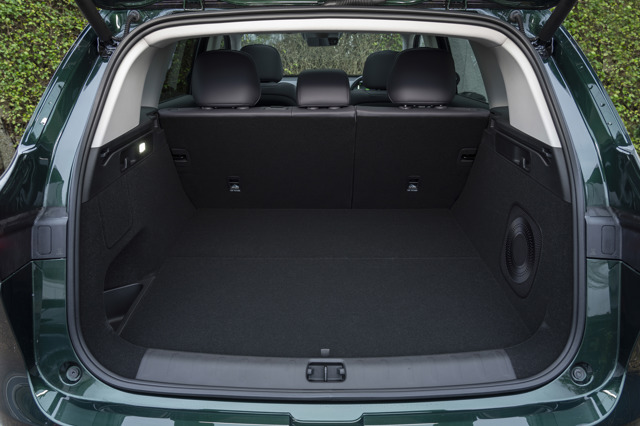
For a 4739mm-long car, the Leapmotor C10's 435 litres of boot space is underwhelming. The Skoda Enyaq is 81mm shorter overall and yet has 585 litres of load space. The C10's rear bench folds in a 60/40 split to give a nearly completely flat load area offering 1410 litres of cargo volume.
Note that those figures relate to the fully electric version as some space has been lost in the C10 Hybrid EV — its capacities are 400 litres with the rear seats up and 1375 litres when they are folded over.
The C10's boot floor is split into two sections. Lift the one nearest the boot's opening and you will find the puncture repair kit, while the further one hides a space intended for the Type 2 charging cable.
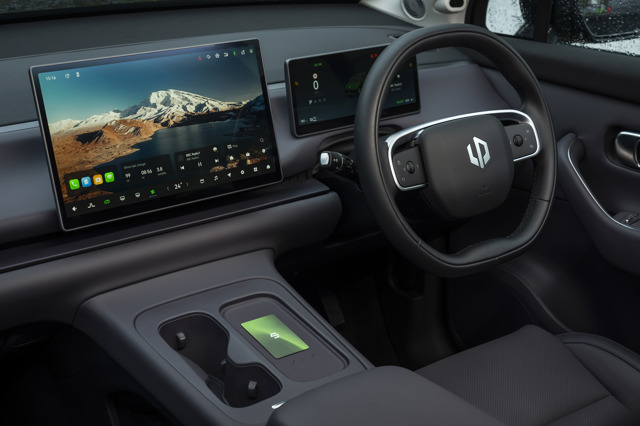
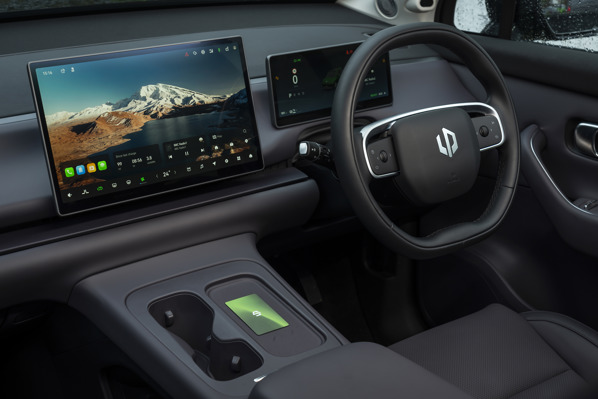
The centre console isn't one solid unit, instead featuring a bridge-like upper section with an open storage area below. The tray at the bottom isn't that deep, limiting what you can put in it. On the upper deck is a pair of cupholders and a wireless phone charging tray, while further back is a storage area under the central armrest. This same structure also houses a couple of cupholders for rear-seat passengers.
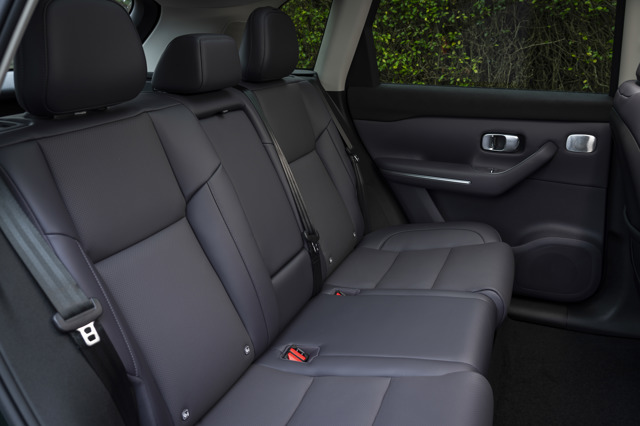
The modest boot space is made up for with an impressively roomy interior. There's ample leg and headroom in the back, while the standard-fit panoramic sunroof amplifies this feeling of airiness. The chunky windscreen pillars aren't great for forward visibility, though.
On the subject of being able to see out, the C10 also has a habit of steaming up unless you set the windscreen demist function to auto, which seems to just constantly and noisily blast out air.
Getting inside in the first place is an atypical experience. There's no traditional key fob, with the C10 instead using a near-field communication (NFC) card. This needs to be placed on a specific spot on the driver's side door mirror for a few seconds, before then being placed on the smartphone charging tray to turn the Leapmotor on.
We have seen systems like this before that act as auxiliaries to conventional keys and they definitely have a place. They are much easier and safer to carry during particular outdoor pursuits, especially water-based activities such as surfing, but having it as the only way to access the car removes the convenience of a keyless system that's actually hands-free.
You can additionally program your smartphone to use as a key, but that still seems like needless faff.
Leapmotor C10 2026: Quality and finish
The Leapmotor C10's interior is a sea of grey, a lot of it made from hard, cheap-feeling plastics. Yes, the seats are clad in faux leather, but it doesn't exactly scream 'upmarket'.
We can't give Leapmotor a free pass in this regard, as many cars from other emerging Chinese brands, including BYD, Jaecoo and Omoda, have impressed us with their high interior quality and plush feeling interiors at reasonable prices.
Everything seems to be put together well enough in the C10, at least.
Leapmotor C10 2026: Infotainment
The Leapmotor C10's 14.6-inch touchscreen infotainment screen looks great with its sharp graphics, but it soon becomes frustrating because of how much you need to use it. As you will have noticed from the photos, the dashboard doesn't have a single physical button on it.
Initially, we couldn't even find the hazard warning light switch, but weirdly, it's on a small bank of buttons on the ceiling, including the SOS trigger. This seems like a poor place for it — if you're approaching a genuine hazard and need to warn other motorists of a potential danger, the last thing you want to do is take your eyes off the road to look for that button.
There are a few unlabelled buttons on the steering wheel, a combined indicator and wiper stalk to the left of the steering column and a drive selector on the right. Everything else has to be controlled through the screen.
Along with the climate control settings, which are quite commonly relegated to a screen nowadays, you will also need to use it to turn on the heated steering wheel and the heated seats, plus to toggle an adjustment mode for the door mirrors.
You then have to use the steering wheel's button pads to alter their positions, because apparently it's too much to ask to have dedicated controls for these mounted on the driver's door, as is the case in almost every other car on sale.
Along with it being distracting to use the screen for so many things, it's not a pleasant experience. The display isn't the most responsive and sometimes needs a couple of prods before it does what you were asking of it. Although there is a temperature setting shortcut along the bottom, it's only for the driver's side of the dual-zone climate control.
The 10.25-inch digital instrument cluster looks similarly crisp, but it too is flawed. A large portion of it is taken up by a driving assistance display, with other cars picked up by the C10's sensors represented in virtual form. They jump around wildly, reminscent of the 16-bit Lotus Esprit Challenge video game from the early 1990s.
With all of this going on in the middle of that display, your speed is pushed over to the left, which seems like an odd choice. On the right, you can pick between different displays, including the trip information, but the fonts used are very small making them difficult to see.
Leapmotor C10 value for money

Leapmotor C10 2026: Prices
The official on-the-road price for both the fully electric Leapmotor C10 and the Hybrid EV range extender version is £36,500.
Although the Leapmotor C10 electric doesn't qualify for the government's Electric Car Grant (ECG), since summer 2025 the company has seen fit to apply its own Leap-Grant discount that matches the ECG's upper band of £3750. That seems rather generous given that few cars actually qualify for the larger amount, with most only getting £1500 off.
This drops the on-the-road price of the electric C10 to £32,750. Considering its high level of standard kit, that sounds like good value, especially when the cheapest Skoda Enyaq is £37,510 inclusive of its ECG discount. The starting price of the BYD Atto 3 is £37,730, but you get more gear with that than in the entry-level Enyaq.
At its discounted price, the C10 starts to make some sense, but there are a lot of compromises that make it off-putting. If the Leap-Grant discount ends and it reverts back to its on-the-road price, it will be a much harder sell.
Presently it's unclear if the C10 Hybrid EV will also be in receipt of any degree of Leap-Grant discount. If not, a plug-in hybrid version of the Peugeot 5008 or the Skoda Kodiaq would make a better choice.
Leapmotor C10 2026: Reliability and running costs
How cheap the Leapmotor C10 is to run will very much depend on which version you choose and how you charge it.
Ideally, you want to avoid expensive public chargers unless necessary and charge at home. Based on the UK's current average electricity cost, a flat-to-full recharge of the electric C10 will cost £18.66, with the Hybrid EV's smaller battery lowering that to £7.58. However, you can slash those figures by getting onto an EV-friendly electricity tariff and timing your charging sessions to coincide with cheaper off-peak periods.
Leapmotor's warranty lasts for four years, which is longer than the three-year cover most manufacturers give, but the mileage limit is less generous at 60,000 miles. There's also the mandatory eight-year/100,000-mile separate coverage for the high-voltage battery, guaranteeing at least 70% of its capacity up to that point.
The C10 might cost you more to insure than other comparable EVs, sitting in group 41, which is high considering its value and performance. For comparison, the Skoda Enyaq 60 is only in group 27.
Satisfaction Index
 What is your car like to live with?
We need your help with our latest Satisfaction Index, so that we can help others make a smarter car buying decision. What's it like to live with your car? Love it? Loath it? We want to know. Let us know about your car - it will only take a few minutes and you could be helping thousands of others.
Help us with the Honest John Satisfaction Index nowLeapmotor C10 models and specs
The Leapmotor C10 doesn't have a series of trim levels like most cars — instead it comes in a single, nameless specification level.
Standard features for the Leapmotor C10 include:
- 20-inch Trident alloy wheels
- Automatic LED headlights and daytime-running lights
- Animated LED tail lights
- Heated, electrically adjustable and folding door mirrors with reverse-tilt function and integrated LED indicators
- NFC key card
- Flush exterior door handles
- Electrically operated tailgate
- Automatic windscreen wipers
- Dark-tinted rear privacy glass
- Panoramic glass roof with electric blind
- Rear parking sensors
- 360-degree parking camera system
- 10.25-inch digital instrument cluster
- 14.6-inch touchscreen infotainment system
- FM and DAB radio
- Online Amazon music
- Integral online navigation
- Bluetooth device connectivity
- In-car wifi
- 2x USB-A, 2x USB-C and 1x 12-volt sockets
- 12-speaker sound system
- Wireless smartphone charging pad
- Heated and ventilated electrically adjustable front seats
- Silicone Oekotek artificial leather upholstery
- Heated artificial leather-wrapped multifunction steering wheel
- Dual-zone automatic climate control with composite filter and air quality sensor
- Heat pump
- Ambient interior lighting
- Adaptive cruise control
- Hill start assist
- Four driving modes
Model History
- March 2025: Leapmotor C10 specs confirmed, prices start at £36,500
- December 2025: Leapmotor C10 REEV priced from £36,500
March 2025
Leapmotor C10 specs confirmed, prices start at £36,500
Order books are now open for the Leapmotor C10. The D-segment SUV is priced from £36,500, and offers a 263-mile range from its 69.9kWh battery.
Standard equipment is generous, including electrically powered, heated and cooled front seats, 20-inch alloys, a panoramic sunroof, 360-degree surround view camera, heated steering wheel, a 12-speaker premium hi-fi, a 14.6-inch central touchscreen and a 10.25-inch instrument cluster.
Wireless phone charging and ambient lighting that can be synchronised with music is also included.
December 2025
Leapmotor C10 REEV priced from £36,500
Leapmotor has announced the range-extender version of its C10 SUV. Priced from £36,500, the C10 REEV features a 28.4kWh battery charged by a 1.5 petrol engine, giving a range of 603 miles.
The engine is not connected to the car's wheels. Instead, the rear wheels are powered by a rear-mounted 215PS electric motor.
The car's battery gives a range of 90 miles before the engine kicks in to recharge the battery. The cells can also be charged by plugging in, with a 30% to 80% top-up taking 18 minutes on a DC charger.
Just one trim level is available, in line with Leapmotor's ‘Everything as standard’ approach. All C10 REEV models get a panoramic roof, heated and ventilated seats and 20-inch alloys.
A 12-speaker audio system, 14.6-inch infotainment system, and 10.25-inch digital instrument cluster are also included. The only option is metallic paint (£700).
