
Volkswagen ID.7 Review: price, range and boot space

Volkswagen ID.7 Verdict

 Great all-round drive. Excellent refinement. Useful range even for high-mileage drivers. Roomy. Nice interior.
 List prices are high. Wind-cheating styling is a bit anonymous. Some ergonomic quirks. Average warranty.
Find out more about the Volkswagen ID.7
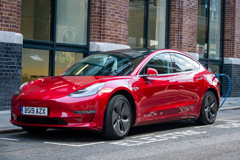
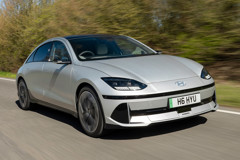
The new Volkswagen ID.7 is one of the largest cars in VW’s ID-branded electric car line-up. This large electric family car takes on its key rival, the Tesla Model 3, along with cars such as the BYD Seal, the impressive Hyundai Ioniq 6 and the BMW i4. You could call it the electric equivalent of the Volkswagen Passat saloon. Has VW thrown a lucky seven? Read our full Volkswagen ID.7 review to find out.
The Volkswagen ID.7 followed the Volkswagen ID.3, Volkswagen ID.4 and Volkswagen ID.5 onto the German firm's ever-growing roster of all-electric ID cars. Like all of those models, it is a five-door hatchback, but it is unquestionably more upmarket than any of them.
Yes, the car is also available in estate form, known as the Volkswagen ID.7 Tourer. However, we've written a separate review of that car, and here, we're concentrating solely on the regular hatchback version. It's available with a small choice of powertrain- and battery options, and in a small choice of trim levels: initially only Launch Edition trim, but later Match and GTX Plus trims.
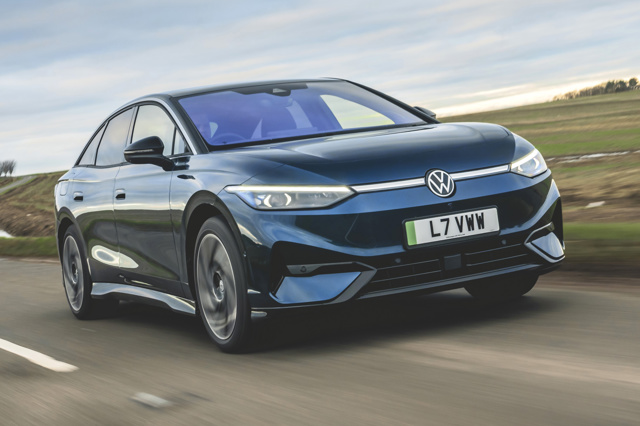
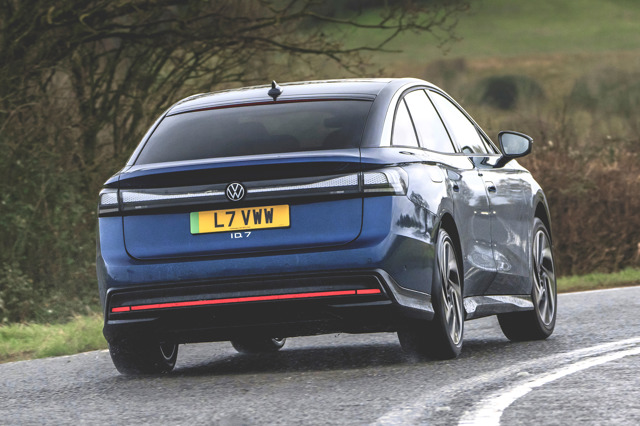
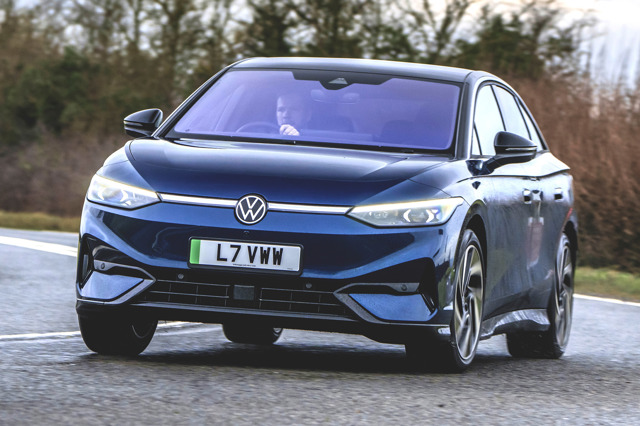
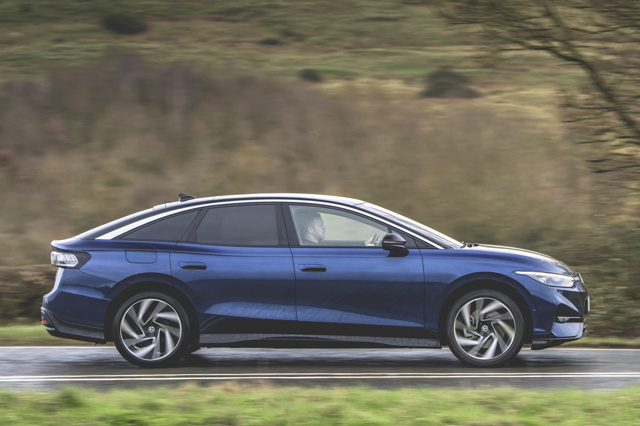
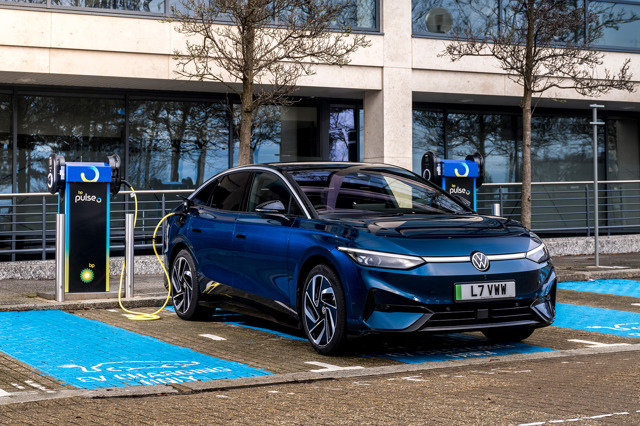
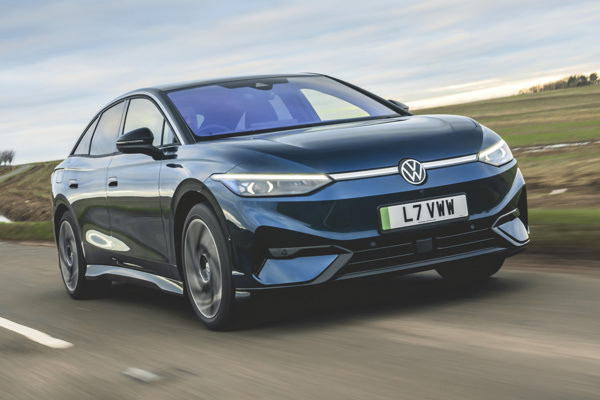
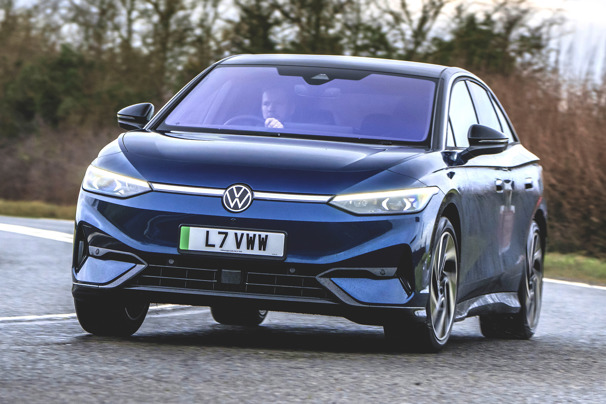
Instead of the SUV-like styling of most other ID cars, the Volkswagen ID.7 takes on a sleeker, lower-slung appearance, which has the added benefit of boosting aerodynamic efficiency. It has a slippery drag coefficient (Cd) of just 0.23, which is great news for high-speed range.
The Volkswagen ID.7 does look suitably upmarket, with its smooth lines and lustrous paint finish. All colours have a contrast black roof, while standard 19-inch alloy wheels are joined by optional 20-inch rims (20s are standard on the range-topping GTX Plus): both having a sparkling diamond cut finish.
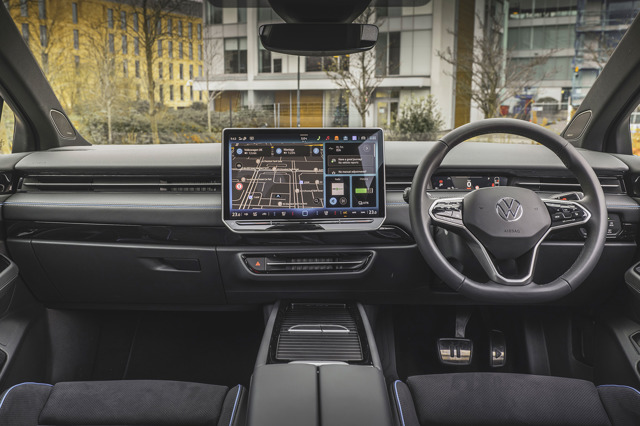
Inside, the Volkswagen ID.7 immediately feels a cut above something like a Tesla Model 3. All the rich, robust build quality VW is famous for is there, and the sustainable upholstery looks and feels really plush. The car is seriously spacious inside, too, with acres of rear space and a vast boot. Clever details abound as well, from the electronic air vents, to the infotainment screen running VW’s latest software.
On the road, it soon becomes clear the Volkswagen ID.7 is one of the most well-honed VW ID models yet launched. Refinement is exceptional, the driving dynamics demonstrate plenty of depth, and performance is swift yet reassuring. It’s a superb motorway car, with a stable, relaxing feel and ample range from the generous battery. Notably, it also has a broader range of dynamic prowess than the Tesla Model 3…
Sure, the Volkswagen ID.7 is initially expensive, but it has plenty of strength in depth, and attractive used values make it a particularly appealing secondhand buy. The Volkswagen ID.7 shows that VW is really getting to grips with how to make electric cars desirable.
Volkswagen ID.7: Range and charging times
| Volkswagen ID.7 Pro | 380 miles |
| Volkswagen ID.7 Pro S | 433 miles |
| Volkswagen ID.7 Pro GTX | 364 miles |
The Volkswagen ID.7 comes with a choice of battery options. There's a 77kWh battery known as the Pro, alongside the Pro S (launched in July 2024), which is an 86kWh capacity battery. Both are available in rear-wheel-drive format in Match-trimmed cars, while the bigger battery also comes as standard in the range-topping four-wheel-drive GTX Plus version.
Even with the smaller battery, the car has an official range of 380 miles, which will immediately earn it a place on the consideration list of many. The rear-drive Volkswagen ID.7 Pro S has an even longer range, with a claimed 433 miles.
In the top-of-the-range ID.7 GTX Plus 4Motion model, the larger battery is used but sacrifices range for performance: it still posts a claimed figure of 364 miles, although as always, treat these figures with caution.
The 77kWh battery has a decent DC rapid charging speed of up to 170kW (later 175kW). If owners use the sat nav to get them to the charging station, the car preconditions its battery ahead of a DC rapid charge, so it can take on the maximum rate of charge: it will go from 10% to 80% in as little as 28 minutes. Volkswagen ID.7 Pro S can DC rapid charge at up to 200kW, dropping the equivalent charging time to around 26 minutes despite the bigger battery.
Charging your car at home will be much, much cheaper, mind. On a regular 7.4kW home wallbox charger, expect a full 0%-to-100% juice-up to take around 11 hours on the 77kWh battery, and around 12 hours on the 86kWh item.
Reviews for Volkswagen ID.7's top 3 rivals
.jpg?width=240&height=160&rmode=crop)


Volkswagen ID.7 handling and engines

Volkswagen ID.7 2026: Handling and ride quality
The Volkswagen ID.7 is available with optional adaptive suspension, called Dynamic Chassis Control (DCC). It's a £1000 option as part of the Exterior Pack Plus on Pro and Pro S versions (or standard on the GTX) so it's worth looking out for on used cars as the pack also adds an electric tailgate.
This serves up excellent ride quality, with a feeling of suppleness and comfort that wouldn’t be out of place on a high-end luxury car. The ride is quiet and well-isolated, and doesn’t seem disturbed even when running on the optional 20-inch alloys.
Handling is impressive, too. Despite being soft and supple, the VW ID.7 is controlled and adjustable through bends, with superb precision through the well-weighted steering. Drivers can steer it through twisting corners fluidly and accurately, without any hairy moments, because it drives in a natural, confidence-inspiring way.
The DCC suspension allows the driver to tailor the suspension's stiffness over a wide range of settings. It can be made very firm and sporty, to capitalise on the responsive and reassuring steering (while the steering itself can be made weightier), adjusting all the way through to soft and floaty. We tended to leave it in regular mode, which delivers a nice balance of abilities.
Volkswagen ID.7 2026: Engines
The Volkswagen ID.7 Pro comes with a 77kWh battery as standard, powering an electric motor driving the rear wheels. This compact motor produces a healthy 286PS with 545Nm of torque. This delivers 0-62mph acceleration in 6.5 seconds with an electronically limited top speed of 111mph.
The Pro S has a 86kWh battery and pretty much the same performance (it's 0.1 seconds slower to 62mph if you're counting), but has a 50-mile longer range.
The GTX performance flagship model adds an additional front-mounted motor to up the power to an impressive 340PS with torque peaking at 560Nm. As a result, the 0-62mph time drops to just 5.4 seconds.
The Volkswagen ID.7 does feel a little heavy under initial acceleration – it weighs 2172kg – but you soon learn that this character is partly intentional. It gives the car a refined feel while creating a feeling of control and precision: in contrast to the all-at-once electric response of a Tesla. Besides, those performance figures show that it does still have plentiful power, with 0-62mph acceleration that’s a match for a Volkswagen Golf GTI.
There is a notable lack of electric motor whine, meaning that the car gathers pace with pleasing refinement. It is a car that uses its electric underpinnings to enhance refinement, which is up there with the class best.
The GTX model's four-wheel drive, rather than the rear-wheel drive set up of the others, gives extra traction that is certainly noticeable in the wet or when accelerating out of a slow corner. It feels reassuringly grippy and is genuinely enjoyable to drive: not something that can be said for a lot of electric cars.
At speed, the Volkswagen ID.7 has plenty of power in reserve, while the aerodynamic bodywork means it cruises along with minimal effort. Wind- and road noise are well suppressed, too, which further enhances its effortlessness. High-mileage drivers will find it a pleasure to drive on the UK motorway network.
The Volkswagen ID.7 doesn’t have a conventional gear selector. Instead, it has a sort of large rocker switch on the steering column, which is more intuitive than the one on the Volkswagen ID.3. This cleans up the centre console and opens up even more space for stowage.
As for brake pedal feel, this is excellent. Electric cars can lack linearity here, as the braking system blends electric motor regeneration with the physical friction brakes. The Volkswagen ID.7 feels more reassuring and confident than most, though, making it easy to slow down to a smooth stop. For the record, it has rear drum brakes - common to many electric cars - rather than discs, but you’ll not be aware of it on the move.
Volkswagen ID.7 2026: Safety
The Volkswagen ID.7 has excellent safety standards. In 2023’s Euro NCAP tests, it scored a full five-star rating, with a superb 95% rating for adult occupant protection and 88% for child safety. Pedestrian protection and safety assist scores were also among the highest recorded by the independent safety organisation during that year.
A smart Travel Assist feature takes active cruise control to the next level. It is available at speeds of over 50mph and helps take the strain out of long journeys by offering support both front and rear, plus side-to-side. It doesn’t rely on painted white lines and can automatically factor in changing speed limits, detecting features such as roundabouts up ahead to begin slowing down in advance.
The combination of information from map data and the swarm data from other connected vehicles makes the Travel Assist feature much smoother in operation, meaning owners are likely to make better use of it. What’s more, the predictive features mean the Volkswagen ID.7 is able to use make greater use of energy recuperation, which can help improve driving range.
Volkswagen ID.7 2026: Towing
The Volkswagen ID.7 is approved to tow braked trailers of up to 1000kg in rear-wheel-drive form, while the all-wheel-drive GTX can pull up to 1800kg. The car is optionally available with a swivelling tow bar, which pops in and out at the press of a button. It’s a neat feature, albeit expensive at more than £1000.
| Engine | MPG | 0-62 | CO2 |
|---|---|---|---|
| Pro | - | 6.5 s | - |
Volkswagen ID.7 interior
| Dimensions | |
|---|---|
| Length | - |
| Width | - |
| Height | - |
| Wheelbase | 2970 mm |
Volkswagen ID.7 2026: Practicality
Practicality is a real standout area for the Volkswagen ID.7. It is based on the same platform as other VW ID models and combines a considerable overall length of 4961mm with a wheelbase of almost three metres. This makes it extremely spacious inside, whether you're sat in the front or the back.
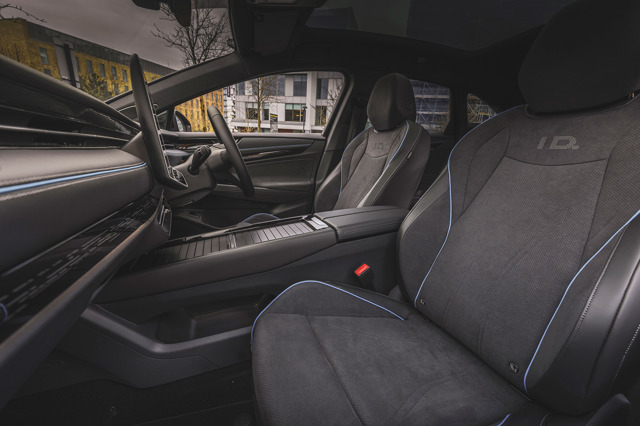
The front seats are easy to step into and there's plenty of space. They are also firm, supportive and extremely comfortable. Event entry-level models are fitted with comfort seats with electric adjustment, front seat heating and massage function, while GTX models get specific seats complete with GTX lettering and red piping.
Both get ArtVelours microfleece upholstery, which is plush and rich, plus we like the Artex microfleece seat bolsters.
At times, it’s a pity the windscreen pillars get in the way, which can make it tricky to see out. This is because of the steeply-raked windscreen, which delivers the slippery aerodynamic drag factor, but becomes less of an advantage when you’re trying to see if the road is clear at a junction…
Between the front seats is an enormous centre console, with added stowage space beneath. The sliding covers are smart and there are neat features to boost its practicality. The interior is also illuminated by 30-colour ambient lighting, which extends to the door panels.
The heated leather steering wheel is nice to hold, but we wish Volkswagen would replace the touch-sensitive buttons with proper physical ones. The latest generation of indicator stalk also includes a rotary switch for the windscreen wipers, rather than a separate wiper stalk. It takes a bit of getting used to.
The electric window switches are odd, too: instead of separate switches for the rear windows, there’s a toggle to switch the single set of switches between front and rear control. This is easy to knock, meaning you’ll often accidentally lower the rear window rather than the front...
A novel feature is the Volkswagen ID.7’s smart air vents. Instead of offering manual control, they automatically move horizontally and vertically, to dynamically distribute air around the interior. They also detect when the driver is approaching and start cooling or heating in advance. Given all this, it’s a pity an energy-saving heat pump isn’t standard, but an option costing more than £1000 instead.
Rear-seat legroom is vast: it’s almost limo-like in the back of the Volkswagen ID.7. This really is where the space efficiency of EVs comes into its own. The seats are very comfortable. too, proving supportive and comfortable even over long distances.
The outer two rear seats are heated. An optional interior pack brings ventilated front seats that have an ‘anti-sweat’ function: moisture sensors detect, um, damp shirts and automatically dry them out.
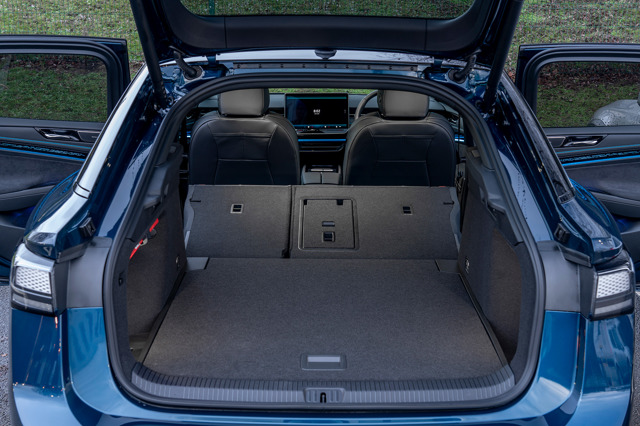
The Volkswagen ID.7 has an enormous 532-litre boot. The hatchback tailgate auto-lifts to reveal a huge opening, which makes loading and unloading much easier. The space is really well-designed, proving long and extra-wide, and a variable boot floor adds flexibility. There is, however, no front boot, or ‘frunk’.
If you want even more cargo space, to could choose the Volkswagen ID.7 Tourer instead, which is a rare electric estate car. This has an even more voluminous load space at 605 litres.
Volkswagen ID.7 2026: Quality and finish
The Volkswagen ID.7 displays excellent quality and finish. It has the VW integrity the brand is famous for, and the interior represents a notable lift over the Volkswagen ID.3 and Volkswagen ID.4 for poshness. The materials are much richer, with greater use of soft-touch plastics and upholstered inserts, and details like the stitched dashboard top add a premium feel.
Engineering details stand out, too. The doors close with a reassuring thud. The paint has a rich, even finish, while panel gaps are even and precise. The Volkswagen ID.7 has a strong and solid feel throughout that shows VW’s build quality is back up to the standards we expect here, and is notably more upscale than a Tesla Model 3.
Volkswagen ID.7 2026: Infotainment
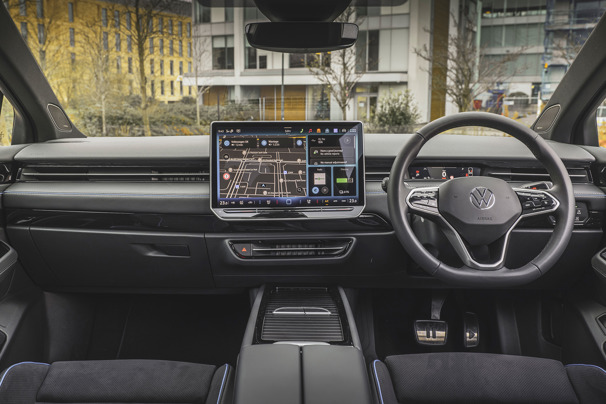
The Volkswagen ID.7 has the latest VW infotainment system that uses next-generation hardware and software. The freestanding 15.0-inch screen now uses a 16:9 format, which has enabled Volkswagen to fully overhaul the whole interface, including the layout and menu structure, making it notably easier to use than the rightly-criticised system in the Volkswagen ID.3 and Volkswagen Golf.
The graphical interface is much cleaner and more logical, while the restructured menu layout is more intuitive. The home screen comprises different-sized tiles, which can be configured by the user across several pages: swipe left and right to access them. The faster processor means the screen works far more intuitively, and its extra-large format means it’s far smarter and richer to use.
The Volkswagen ID.7 has two permanently-displayed bars at the top and bottom of the touchscreen. The bottom bar includes climate control and heated seat settings. There are other favourite icons at the top of the screen, which are easily-configurable. Pressing the Car Control Centre brings up direct access to key vehicle functions, which replaces the physical buttons on other VWs.
Finally, the touch sliders at the bottom of the screen for cabin temperature and stereo volume are illuminated so you can use them more easily at night (this was a glaring omission on earlier ID models), although they remain very fiddly to use.
A voice assistant called ‘Ida’ is said to be more granular. You can ask ‘her’ to do various things including warming your feet and setting the sat nav to take you for coffee. She certainly wasn’t flawless during our test drive, but over-the-air software updates mean she should improve over time, in theory at least.
Ahead of the driver is a simple colour display, which features all you need to know. All Volkswagen ID.7 models have a standard head-up display, with so-called augmented-reality information. We struggled with it, as it seemed too easy to move out of the screen’s viewpoint. This made it difficult to assess how clever the augmented reality layer actually was.
An optional (or standard on the GTX) 700-watt Harman Kardon sound system has 14 premium speakers, including a centre speaker in the front and a subwoofer in the boot. It has several different settings including a vibrant dynamic live sound, and certainly makes the most of the super-quiet interior of the Volkswagen ID.7. It’s bundled into the £1400 Interior Pack that includes the anti-sweat ventilated front seats.
Volkswagen ID.7 value for money

Volkswagen ID.7 2026: Prices
The Volkswagen ID.7 starts at around £51,000 for the rear-drive car with the 77kWh battery, but to upgrade to the larger 86kWh unit, you'll be paying more than £55,000. In both cases, that's in Match trim, which is well equipped as standard, as you'd hope for such a price.
The range-topping GTX version checks in at around the £60,000 mark, meanwhile, but as well as the extra power over the other versions, you also get some other items of standard kit, and desirable ones at that. Even so, the prices of the ID.7 do look decidedly pricey next to those of the Tesla Model 3 when compared like-for-like.
As ever, buying used can get you an ID.7 for a great deal less cash. There's a wide choice of entry-level 77kWh Pro Match cars out there for around £30,000, and these will likely be 2024 cars with around 5000 miles on the dial. That's a huge saving on what is still a relatively new and fresh car.
Volkswagen ID.7 2026: Reliability and running costs
If you mostly charge it at home, the Volkswagen ID.7 has the potential to be very affordable to run. Assuming that you pay the UK's national average rate for your domestic electricity, then a full charge of the 77kWh battery will cost you around £22, while the 86kWh battery will cost around £24 for a full replenishment.
That's already a slice cheaper than fuelling a petrol or diesel car, but things get much cheaper still if you get your home put onto a variable power tariff that allows you to charge your car overnight on discounted power, because the discounts here are sizeable. Do so, and your charging costs will likely be a third of those already quoted. That's seriously tempting for even the staunchest EV-sceptic.
While the ID.7's DC rapid charging speeds are relatively good, don't rely on this type of charging on a regular basis, because it's way more expensive than charging at home. Remember those average-rate home-charging costs we quoted earlier? Well, you can treble those at many of the UK's DC charging stations.
Insurance groups for the rear-wheel-drive Match versions vary between 38 and 39 (out of 50) depending on the battery, while the more powerful GTX has a classification of 41. Strangely, the earlier Launch Edition cars have a rating of 42 despite having the weaker powertrain.
These days, electric cars are liable for the same annual VED road tax costs as drivers of petrol and diesel cars, due to ever-dwindling incentives for EV drivers. What's more, the car's lofty pricetag means that not only will you have to pay the £195 flat rate each and every year, but you'll also be liable for the 'luxury car surcharge', adding another £425 to your annual bill between years two and six of the car's life.
Satisfaction Index
 What is your car like to live with?
We need your help with our latest Satisfaction Index, so that we can help others make a smarter car buying decision. What's it like to live with your car? Love it? Loath it? We want to know. Let us know about your car - it will only take a few minutes and you could be helping thousands of others.
Help us with the Honest John Satisfaction Index nowVolkswagen ID.7 models and specs
The VW ID.7 was introduced as Launch Edition before VW ID.7 Match editions were introduced along with the flagship VW ID.7 GTX model
Volkswagen ID.7 Pro Match models come with:
- 19-inch Hudson Black alloy wheels with gloss-turned surface
- Airstop tyres 235/50 R19 (front), 255/45 R19 (rear)
- Metallic paint and black roof
- IQ.LIGHT LED matrix headlights with automatic headlight control
- Advanced dynamic light assist for LED matrix headlights
- Dynamic headlight range control with dynamic cornering light
- LED rear tail lights with dynamic turn signal
- Poor weather light with cornering light
- Privacy glass for rear side windows and rear window
- Heat insulating glass in side and rear windows
- Windscreen with laminated safety glass, wireless heating, infra-red reflection and noise insulation
- Easy open and close sensor-controlled luggage compartment opening and closing with remote unlocking
- Heated windscreen washer jets
- Remote electrically folding heated door mirrors
- Interior ambient lighting with 30 colours
- Leatherette-wrapped, heated, multi-functional steering wheel with touch control
- ergoActive comfort heated massage seats in front
- Comfort seats with ‘Art Velours’ inserts
- Play and Pause brake and accelerator pedals
- Power-adjustable lumbar support in front seats
- Power seat adjustment for both front seats, with memory feature and seat depth adjustment
- Carpet mats, front and rear
- Centre console with illuminated storage compartment with sliding cover and two drinks holders
- Door and side trim panel in foam film, insert in leatherette
- Rear seat bench unsplit, backrest split folding with centre armrest, including two cup holders and load through provision
- Digital display including speed, odometer, trip, battery charge level and exterior temperature
- Sun visors with illuminated vanity mirrors
- Luggage net
- In-car entertainment and communications
- Discover Pro navigation system with media and internet package
- 15-inch infotainment display
- Digital radio reception (DAB)
- Wireless App-Connect
- Wireless smartphone charger
- Two USB-C ports in the front, two USB-C charging sockets on the centre console in rear, charging capacity up to 45 W
- IDA voice assistant
- Eight + one speakers front/rear
- VW Connect – provides continuous interaction between driver, vehicle and Volkswagen via SIM-card connectivity
- Free VW Connect Plus for the first three years
- Mobility guarantee in case of car breakdown (3yrs inc)
- VW Connect ID. App
- AC charging socket (Type 2)
- Charging cable mode 3, Type 2: 7.2 kW single-phase/11 kW three-phase (32A)
- DC battery charging capability (Type 2: CCS)
- Anti-theft alarm with interior protection
- E-call emergency call service
- Car2X – intelligent vehicle networking
- Warning signal and warning light for front and rear seat belts not fastened
- Driver and front passenger airbag with front passenger airbag deactivation
- Curtain and side airbags in front with centre airbag
- ISOFIX child seat preparation easy-fit (for two outer rear seats, and front passenger seat), compatible with I-size
- Charging flap with weather protection
- Standard electronic engine sound (exterior sound actuator)
- Extended safety system (proactive passenger protection system)
- Safety-optimised front head restraints
- Tyre pressure loss indicator
- Three-point seat belts with seat belt pretensioners
- Exit warning system
- Augmented-reality (AR) head-up display
- Area view 360-degree parking camera
- Rear-view camera
- Driving profile selection
- Adaptive cruise control (ACC)
- Dynamic road sign display
- Front Assist – autonomous emergency braking with pedestrian and cyclist monitoring
- Lane Assist and Side Assist, Traffic Assist, Rear Traffic Alert
- Traffic Jam Assist and Emergency Assist
- Oncoming vehicle braking when turning including swerve support
- Speed limiter
- Driver Attention Monitor and Driver Alert System
- Park Assist with Park Distance Control
- Memory feature for Park Assist Plus
- High Beam Assist, automatic sensing for switching between dipped and main beam
- Electromechanical power-assisted steering, speed sensitive
- Climatronic smart air conditioning, three-zone with intelligent air vents and rear control panel
- Auto-dimming rear-view mirror
- Rain sensor
- Keyless entry and starting with SAFELOCK
- Remote unlocking for tailgate
- Variable boot floor, height adjustable and removable
- Surround lighting with logo projection
Volkswagen ID.7 Pro Match Plus models have:
- Alloy wheels 19" 'Hudson'
- Climate windscreen - assists defrosting & prevents fogging
- Augmented reality head-up display
- Area view and rear view camera
- Massage seats in front
- IQ.LIGHT - LED matrix headlights with automatic headlight control
- ‘Keyless Access’: Keyless locking and starting system with SAFELOCK
- Energy efficient heat pump
Volkswagen ID.7 GTX models add:
- Alloy wheels 20" 'Skagen', Black, diamond-turned
- 'Harman Kardon' sound system with 12 speakers, digital 16-channel amplifier, subwoofer and 700W total power output
- Dynamic chassis control (DCC) adaptive suspension
- Ventilated massage seats for front
- Heated front and rear seats
- Sports style body coloured bumpers
- Energy efficient heat pump
| Dimensions | |
|---|---|
| Length | - |
| Width | - |
| Height | - |
| Wheelbase | 2970 mm |
| Miscellaneous | |
|---|---|
| Kerb Weight | 2184 kg |
| Boot Space | - |
| Warranty | |
| Servicing | - |
| Costs | |
|---|---|
| List Price | £51,495–£55,515 |
| Insurance Groups | - |
| Road Tax Bands | A |
| Official MPG | - |
| Euro NCAP Safety Ratings | |
|---|---|
| Adult | - |
| Child | - |
| Pedestrian | - |
| Overall | - |
On sale until July 2025
| Hatchback | |||
|---|---|---|---|
| Version | List Price | MPG | 0-62 |
| Match 286 Electric Pro 77kWh Battery Auto 5dr | £51,495 | - | - |
On sale until August 2024
| Hatchback | |||
|---|---|---|---|
| Version | List Price | MPG | 0-62 |
| Launch Edition 286 Electric Pro 77kWh Battery Auto 5dr | £55,515 | - | 6.5 s |
Model History
- April 2023: Volkswagen ID.7 revealed
- January 2024: Volkswagen ID.7 Match launched
- July 2024: Volkswagen ID.7 GTX available to order, priced from £61,980
- July 2024: Volkswagen ID.7 Pro S Match on sale now, priced from £55,450
- June 2024: Volkswagen announces ID.7 GTX range flagship
April 2023
Volkswagen ID.7 revealed
The new Volkswagen ID.7 is the German giant’s answer to the Tesla Model 3: a large pure electric luxury saloon. The German carmaker is throwing down the gauntlet, too, with the ultimate ID.7 boasting an EV range way in excess of any Model 3.
The new Volkswagen ID.7 fastback saloon is effectively a fully-electric replacement for the long-running Volkswagen Passat. It will also form the basis of a replacement for the Volkswagen Arteon fastback. It will be sold around the world, including Europe, China and America.
Sitting above the existing Volkswagen ID.5, the new VW ID.7 not only competes with the Tesla Model 3, but will also take on rivals such as the Polestar 2, BMW i4, Hyundai Ioniq 6, Kia EV6 and Genesis G80 Electrified.
A large car, the new Volkswagen ID.7 fastback saloon measures 4961mm long, 1862mm wide and 1538mm tall – making it larger than both the Volkswagen Passat and Arteon. It also has a particularly long 2966mm wheelbase, giving it a ‘wheel-at-each-corner’ appearance.
The new Volkswagen ID.7 is very aerodynamically efficient. A Cd drag factor from just 0.23 ensures it will slip through the air. This will help boost the driving range on motorways – a boon for the high-mileage motorists currently driving Volkswagen Passat and Arteon…
No matter what body colour the new Volkswagen ID.7 is ordered in, the roof and pillars are always finished in gloss black. At the front, there’s an LED light strip connecting the LED headlights – and the contoured front end includes a feature line that runs right to the rear of the car. The designers say this lowers the visual height of the new Volkswagen ID.7.
Inside, the new Volkswagen ID.7 has a high-quality interior, with more soft-touch plastics than in some other electric VWs. It has an all-new architecture, with a standard instrument display replaced by an ultra-slim cluster called ID. Display – this is no bigger than the vent band it’s set within, and displays standard information such as speed and warning lights.
The rest of the driving information features on an augmented reality head-up display, fitted as standard to all new Volkswagen ID.7. The information is fully configurable via the steering wheel buttons, and functions include clever projection of road lane markings and sat nav turn arrows. It is multi-layered: status displays such as speed are projected at close range around 3.5 metres in front of the vehicle, with sat nav information projected around 10 metres in front.
In the centre of the new Volkswagen ID.7’s dashboard is an enlarged 15.0-inch touchscreen that is much clearer and more user-friendly. It uses a next-generation graphic interface and restructured menu navigation. Volkswagen now permanently displays the heater controls in the bottom of the screen, while the touch sliders at the base of the display are illuminated so they can be used at night.
The new Volkswagen ID.7 has a new IDA voice assistant. Drivers can say “hello IDA” and operate a range of requests, including cloud-based queries about the weather and other information.
The new Volkswagen ID.7 has ‘intelligent’ air vents. These detect when the driver is approaching, and automatically start cooling or heating the interior before they climb in. The so-called smart vents have an array of new functions, including the ability to distribute air over large areas as quickly as possible. They can also direct air straight to the bodies of passengers or ventilate the cabin indirectly. The company likens it to a modern iteration of the world-beating climate control system on the ‘modern classic’ Volkswagen Phaeton.
Other smart features in the new Volkswagen ID.7 include ergoComfort seats with an advanced massage function. There’s also a new type of seat climate control – including an auto mode, that uses temperature and moisture sensors to automatically operate three special modes: maximum heating, maximum ventilation or maximum drying. A 14-speaker, 700-watt Harman Kardon sound system will be available too.
The new Volkswagen ID.7 has a large hatchback boot opening. Total capacity has not yet been revealed, bhut the space appears wide and well-shaped, with a flat load floor. There is an underfloor stowage area too, ideal for keeping charging cables safe.
As for rear seat room, the long wheelbase delivers “extremely generous space”, promises Volkswagen. It will feel light and air too, particularly with the new panoramic sunroof option which features smart glass. It can turn from transparent to opaque at the touch of a button, thanks to a polymer-dispersed liquid crystal (PDLC) layer integrated into the glass.
The new Volkswagen ID.7 is, like all cars in the Volkswagen ID family, based on the MEB electric car architecture. This flexible setup was first seen on the Volkswagen ID.3 and the latest ID.Buzz people carrier shows how flexible it is.
The Volkswagen ID.7 will be offered in both rear-wheel-drive and twin-motor four-wheel-drive guises. All models feature an automatic gearbox controlled by the rotary lever behind the steering wheel. The new Volkswagen ID.7 also has an all-new electric motor system developed by the VW boffins. The new motor produces a healthy 286PS and is internally called APP550. It is the most powerful electric motor produced by Volkswagen to date, and is used independently of battery capacity.
The system compromises a permanent magnet synchronous motor electric drive unit, a two-stage, one-speed gearbox, and the inventor. A rotor with ultra-strong permanent magnets delivers an even higher thermal load capacity, while a new combined oil and water cooler system ensures higher thermal stability.
At launch, the new Volkswagen ID.7 will be launched in two drive versions – Pro and Pro S. The new Volkswagen ID.7 Pro will have a 77kW battery, capable of DC rapid-charging at speeds of up to 170kW. The new Volkswagen ID.7 Pro will have a driving range of up to 382 miles, forecasts VW.
Arriving later is the new Volkswagen ID.7 Pro S, with an 86kWh battery – the largest battery yet offered in a Volkswagen electric car. It will DC rapid-charge at speeds of up to 200kW, and Volkswagen is forecasting a very impressive range of up to 435 miles.
The new Volkswagen ID.7 will have a new thermal management system, that preconditions the battery before a charging stop. This operates automatically when the rout guidance is active.
High-tech features available in the new Volkswagen ID.7 include Park Assist Pro with Memory Function. This continuously records the last 50 metres driven, and this parking manoeuvre can be stored when the ID.7 has come to a halt. When it reaches the same position again – such as the driveway at home – the car automatically offers to take over the parking manoeuvre. The driver can even get out the vehicle and leave it to ‘park itself’, monitoring it via their smartphone.
January 2024
Volkswagen ID.7 Match launched
The Volkswagen ID.7 Match has additional equipment including metallic paint, an electric tailgate, exterior pack and assistance pack.
The ID.7 Pro Match replaces the previously announced Launch Edition and is priced £51,550 on the road.
July 2024
Volkswagen ID.7 GTX available to order, priced from £61,980
The new Volkswagen ID.7 GTX is available to order from Thursday 1 August, priced from £61,980.
GTX models have the same 86kWh (net) battery as ID.7 Pro S Match derivatives, but the addition of a front motor results in a power increase of 54PS, taking the total to 340PS. It also means that 4MOTION all-wheel drive is available on the ID.7 for the first time.
The ID.7 GTX is currently the most powerful electric VW vehicle, completing the 0-62mph sprint in just 5.4 seconds.
Electric range is a claimed 366 miles for the ID.7 GTX. The car can also be charged at up to 200kW DC, meaning that a top up from 10 to 80 per cent of battery capacity can take as little as 26 minutes.
To ensure the GTX models stand out, equipment includes 20-inch Skagen alloy wheels, GTX exterior styling, ventilated and heated massage seats in the front and heated rear seats, a Harman Kardon sound system and Volkswagen’s DCC adaptive chassis control system.
Other standard features include IQ.LIGHT LED matrix headlights with illuminated Volkswagen logos at the front and rear, unique GTX daytime running lights, an augmented-reality head-up display, GTX-specific interior styling and Volkswagen’s IDA voice assistant with integrated ChatGPT.
Park Assist Pro, which lets drivers control parking procedures using a smartphone, is on the options list.
July 2024
Volkswagen ID.7 Pro S Match on sale now, priced from £55,450
Volkswagen has announced the addition of the Volkswagen ID.7 Pro S Match and ID.7 Tourer Pro S Match. The new models benefit from a bigger battery and faster charging, making longer journeys less stressful.
The new ID.7 Pro S Match models have an 86kWh battery, compared with the 77kWh battery in the ID.7 Match versions. The result is a claimed range of 437 miles for the fastback and 425 miles for the Tourer.
The Pro S Match models can also be charged at up to 200kW DC, meaning a top-up from 10 to 80 per cent of battery capacity can take as little as 26 minutes.
Both new models have all the same levels of equipment as existing ID.7 models, including a head-up display; a 15-inch infotainment screen, IQ.LIGHT Matrix headlights, three-zone air conditioning with smart vents and heated front seats with massage functions.
Boot space remains unchanged, with up to 1,586 and 1,714 litres of storage respectively in the fastback and Tourer.
The ID.7 Pro S Match and ID.7 Tourer Pro S Match are available to order now, priced from £55,450 and £56,140 respectively.
June 2024
Volkswagen announces ID.7 GTX range flagship
The 340PS Volkswagen ID.7 GTX has been confirmed for the UK, making it the most powerful electric vehicle currently offered by VW. The GTX completes the 0-62mph sprint in 5.4 seconds thanks to its electric dual-motor all-wheel drive.
The ID.7 GTX has an electric range of 366 miles. The GTX’s battery can be charged at up to 200kW at DC fast charging stations. At its quickest, the 86-kWh battery charges from 10 to 80 per cent in 26 minutes.
The new ID.7 GTX features 20-inch Skagen alloy wheels and IQ.LIGHT LED matrix headlights with illuminated Volkswagen logos at the front and rear. The interior features heated seats with red contrasting stitching and 30-colour ambient lighting.
Standard equipment includes wireless App-Connect for Apple CarPlay and Android Auto, an augmented reality head-up display and the IDA voice assistant with integrated ChatGPT. Park Assist Pro, which allows users to control parking procedures using their smartphone, is an option.
