
Toyota Yaris Review: Price, specs and boot space

Toyota Yaris Verdict

 Looks great on the outside and isn't too shabby on the inside, either. Hybrid engine is cheap to run and relaxing. Autonomous driving aids make long journeys painless.
 You get lots of kit, but it is quite pricey. Not as well rounded as a Volkswagen Polo.
Find out more about the Toyota Yaris
Insurance Group 14
On average it achieves 0% of the official MPG figure
If you're looking for a small car you really are spoilt for choice. There's the Volkswagen Polo that is comfortable and practical, and the Peugeot 208 that is stylish to the bone and also available as a pure electric car. The Toyota Yaris gets close to matching these cars in all areas while majoring on ease-of-use fuel economy, thanks to its suite of autonomous driving aids and petrol-electric setup. That's why we think it's one of the best small cars on sale. Read on for our full review of the Toyota Yaris.
If the Toyota Yaris was a European country, it would be Sweden. Famed for being taxing on the wallet, Sweden rewards your investment by providing an excellent quality of life.
In much the same way, the Yaris comes loaded with technology that’s expensive, but ultimately makes your life better.
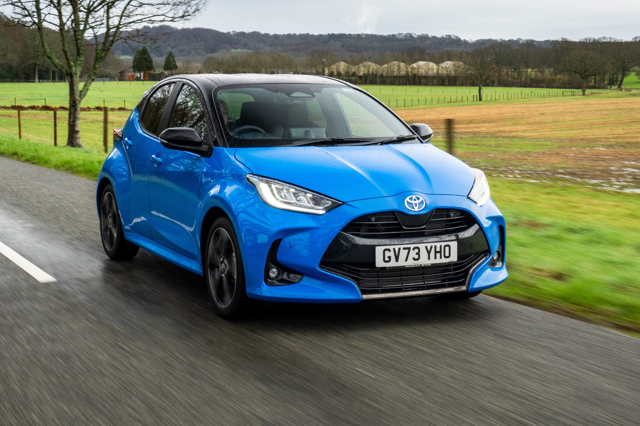
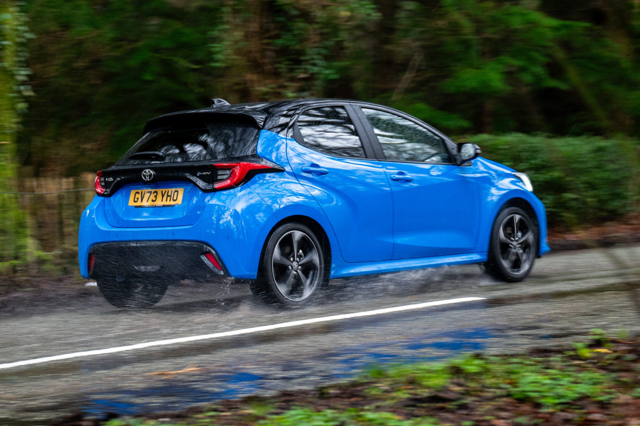
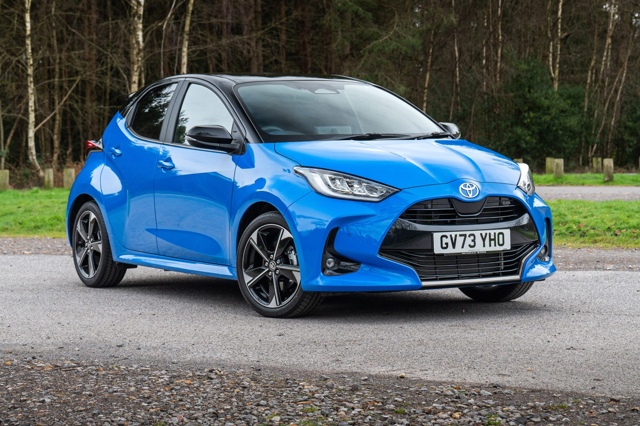
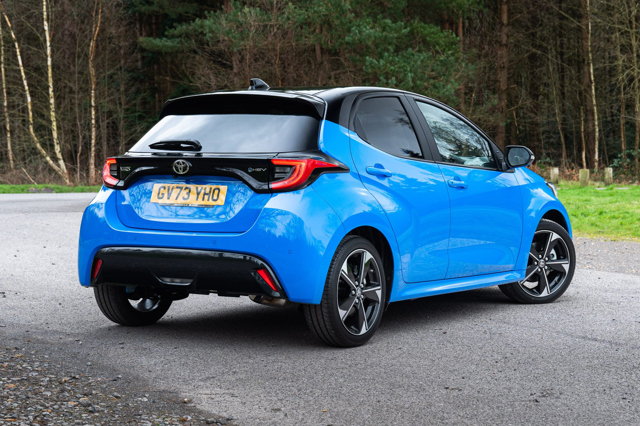
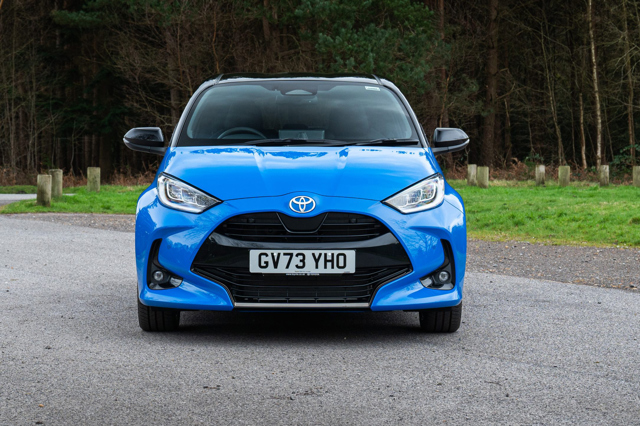
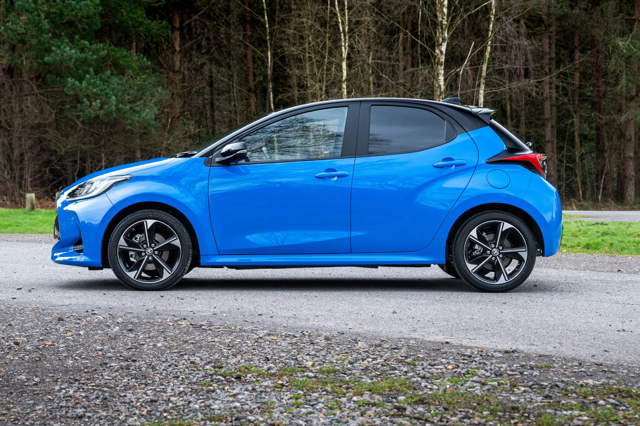
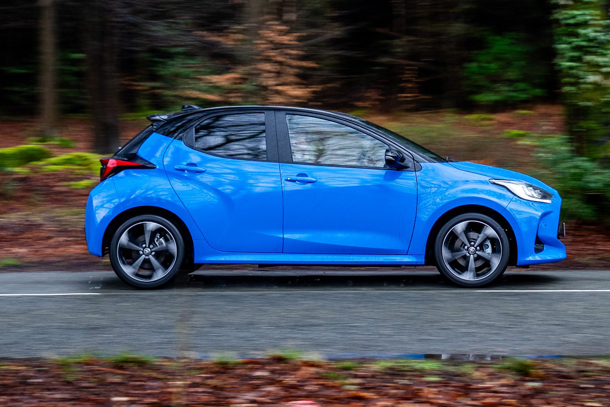
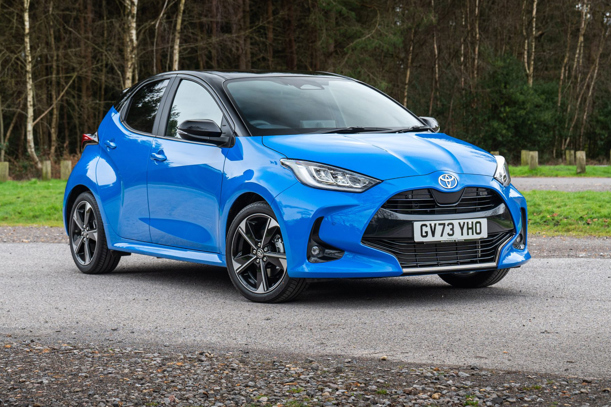
Thankfully, we can drop the Swedish analogy at the Toyota Yaris’s styling, because it’s pure Japanese. A jumble of creases and curves, sharp edges, with a hint of origami, bookended by a gaping grille and pair of attractively protruding tail lights. It’s a Yaris that, whisper it, looks great.
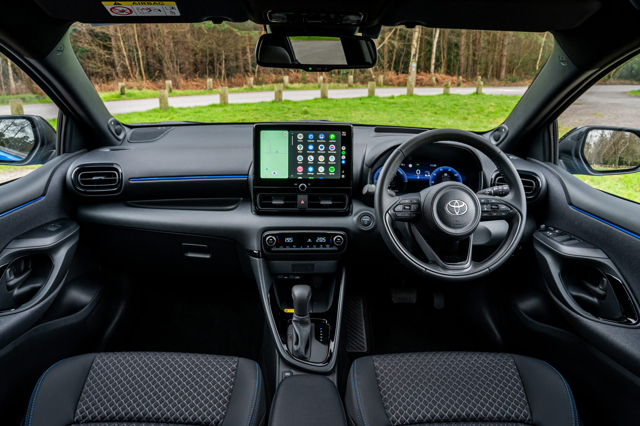
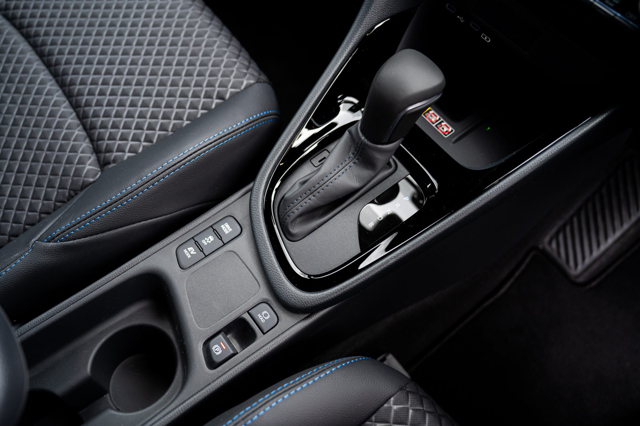
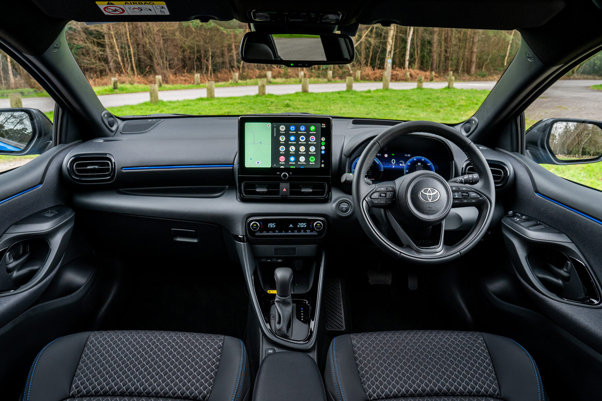
The inside doesn’t quite match these high standards. Its slabby-looking infotainment screen rises awkwardly out the top of the dashboard, but the rest of the cabin is lovingly sculpted. You even get a thick seam of squishy plastic on the dashboard that’ll keep Volkswagen’s head of perceived quality – if such a job exists – trembling under their duvet.
Volkswagen’s head of practicality – pretty sure we've made that up, too – would get off more lightly because, while the Yaris is quite practical for its size, it’s not as spacious in the back as the Polo and it’s boot isn’t as well designed or as roomy.
That’s about where the negatives end, mind you, because the Toyota Yaris is near enough a class-leader in every other respect and it goes about its work in its own unique way, just as previous generations of Toyota's small hatchback have.
Take the hybrid engine. It serves up spectacular fuel economy almost irrespective of how or where you drive. Its ability to drive in silent electric mode almost all of the time in town makes the Yaris extremely relaxing to potter about in, and it’ll take you all the way up to motorway speeds without stirring the petrol engine if battery level allows.
And it’s at this point that Toyota Yaris pulls another trick out its sleeve: its comprehensive suite of autonomous driving aids. Bang up to date, they’ll keep the Yaris arrow-straight in its lane and around curves while braking and accelerating with a deft smoothness that serves only to expose the poor quality of driving of the humans around you.
Sure, you have to keep your eyes on the road and your hands on the wheel, but it cuts down on fatigue and makes long motorway slogs less exhausting as a result. It makes the Yaris the small car to have if you do lots of long-distance driving.
And it's worth saving your energy, because when you turn off onto an A road, you realise the Toyota Yaris is actually decent fun. It grips well and steers with precision. It’s not a genuine driver's car like a Ford Fiesta (may it rest in peace) but, unlike the old Yaris, it is at least playing the same sport.
And anyway, like Sweden, you sense Toyota hasn’t tried to copy anyone else: it's made things better by going its own way. So, while the Yaris isn’t the last word in dynamics or the very best in terms of practicality, it makes up for that with its smart design, a relaxing driving and unnervingly good fuel economy. We can't ignore Toyota's enviable reputation for reliability, either, and you also get a warranty that could last you ten years if you get your car serviced at a Toyota main dealer.
It's no longer just the safe choice. Instead, the Toyota Yaris is a desirable car that just so happens to also be very sensible.
Reviews for Toyota Yaris's top 3 rivals



Toyota Yaris handling and engines
- Engines range from 1.5 Hybrid to GR 1.6 T
- Readers report Real MPG to be between 28–81 mpg
Toyota Yaris 2026: Handling and ride quality
The Toyota Yaris doesn’t quite strike the same fine balance between comfort and fun as the Volkswagen Polo, but it gets closer than any Yaris has before it.
It feels impressively tidy and assured for the vast majority of the time, and it’s only when you get close to its handling limits that it starts to feel a little nose-heavy. That said, the engine drone caused by the CVT gearbox when you approach those limits means you'll likely never drive it like that anyway.
Comfort-wise, the suspension is a little on the firm side, but it still does a pretty good job of isolating you from bumps and potholes. The Yaris is also a very easy car to drive, with light controls, and a standard automatic gearbox. And while that hybrid powertrain might exist to provide low emissions and excellent fuel economy, it also means that the Toyota runs on electric power much of the time at lower urban speeds, making it quieter than some luxury saloons in that environment.
Hit the motorway and the Yaris has another trick up its sleeve: its standard autonomous driving aids, which do an excellent job of accelerating, steering and braking the car for you. As a result, you no longer need to dread intercity hikes and it helps take your mind off the Toyota’s occasionally taught ride.
Toyota Yaris 2026: Engines
Initially, the Toyota Yaris came with only one engine and gearbox combination: 1.5-litre three-cylinder petrol engine boosted by two electric motors to give a total of 116PS, with the power fed through a CVT automatic gearbox.
Around town, it will drive on electric propulsion almost all of the time, and it has enough juice to get you up to motorway speeds for short bursts. It helps the Toyota return around 60mpg in more or less all conditions.
And it’s far from slow. It’ll whisk you from 0-62mph in a respectable 9.7 seconds and tops out at 108mph. That said, while the CVT gearbox makes the Yaris as easy to drive as a supersized dodgem, there’s a level of disconnection between pressing the accelerator pedal and actually accelerating that makes the Toyota less engaging than a competitor with a conventional auto' or a manual gearbox.
When the Yaris was facelifted in 2024, a second powertrain became available. It was exactly the same setup as the 116PS powertrain, but with total power hiked to 130PS. This was standard on the range-topping GR Sport and Premiere Edition trim levels, and was later applied to the Excel version as well.
Predictably, though, it doesn't feel all that much different. It sprints from 0-62mph half a second quicker, but it's top speed is identical, as is its general character.
Toyota Yaris 2026: Safety
The Toyota Yaris scored five stars when it was crash-tested by Euro NCAP in 2020, yet due to the more stringent protocols since introduced that dropped to a four-star rating for its 2025 re-test.
Its autonomous driving aids make it very safe on the motorway. Plus, you get automatic emergency brakes that detect cars, pedestrians and cyclists, plus auto-dipping headlights, and a system that can send your location to the emergency services after an accident.
Toyota Yaris 2026: Towing
Whether you're hauling a trailer with or without brakes fitted, the maximum a Toyota Yaris can tow is 450kg.
| Engine | MPG | 0-62 | CO2 |
|---|---|---|---|
| 1.5 Hybrid | - | 9.7 s | 92–110 g/km |
| 1.5 Hybrid 130 | - | - | 99–103 g/km |
| GR 1.6 T | - | 5.5 s | 186 g/km |
Toyota Yaris interior
- Boot space is 207–947 litres
- Euro NCAP rating of five stars
| Dimensions | |
|---|---|
| Length | 3940–3995 mm |
| Width | - |
| Height | 1455–1505 mm |
| Wheelbase | 2510–2560 mm |
Toyota Yaris 2026: Practicality
Thanks to its tall seating position and large doors, it’s easy to get into the front of the Toyota Yaris. All models come with a steering wheel that moves up, down, in and out, and a driver’s seat that’s height adjustable so small and tall people can get equally happy behind the wheel.
Not everyone will like the tall position of the driver’s seat – even in its lowest setting – but you soon get used to it and it aids visibility.
The Yaris has room inside for four adults, helped by all models coming with four passenger doors. It feels tighter in the rear seats than in a Volkswagen Polo and Hyundai i20, which can accommodate tall passengers and gives them a surprising amount of kneeroom, although the Yaris is still fine. The Yaris is also a touch narrower than the other two, although none of them are particularly comfortable five up.
A variety of storage cubbies makes it easy to keep the cabin looking spick and span and the 286-litre boot is larger enough for several carry-on cases. That said, the boot lacks features – like the adjustable floor you get in a Polo – so you don’t get a completely flat load bay when you fold away the back seats. With the seats pushed down, there's 947 litres of cargo room.
Toyota Yaris 2026: Quality and finish
The Yaris’ build quality isn’t peerless but you do sense that Toyota wanted to inject some flair into the design rather than settling for pure functionality like in previous iterations of the Yaris.
There are some sculpted shapes to feast your eyes on – including the overdesigned interior door handles – and all but the entry level model gets a digital dashboard that keeps things looking modern, although it’s not as impressive as the vast one-piece screen that’s an option in the Volkswagen Polo.
The Polo just edges the Yaris for interior quality by feeling more consistently solid: things like the flimsy glovebox lid and centre armrest let the Japanese car down. That said, the Toyota Yaris has a thick band of squidgy plastic that runs across the centre of the dashboard that helps raise the ambience, and all models come with a Nappa-leather trimmed steering wheel that feels brilliant to hold.
Toyota Yaris 2026: Infotainment
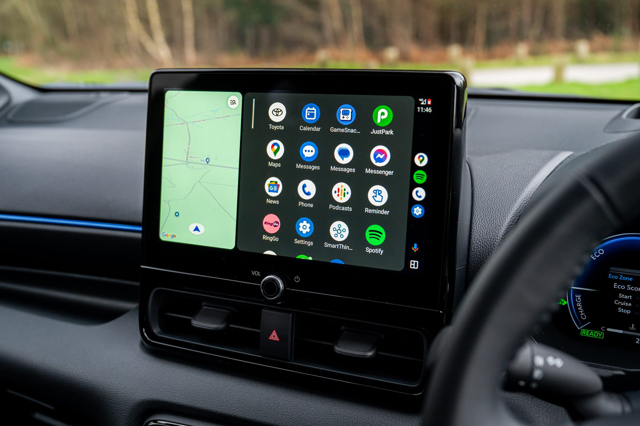
All Toyota Yaris models come with a centre touchscreen infotainment system. In early cars, it was a 7.0-inch display in Icon models and an 8.0-inch screen in the Design and GR Sport versions. Go for the Excel trim, and you got an even bigger 9.0-inch display. When the car was facelifted in 2024, the 9.0-inch screen became standard on the Icon and Design models, while Excel and GR Sport got a larger 10.25-inch screen, along with wireless phone charging.
Compared to the system you get in a Volkswagen Polo, the Toyota's graphics look a little washed out, the screen isn’t quite as responsive, and its menus aren't as logically arranged, but these are all relatively minor gripes.
A row of conventional buttons that run down the screen’s edges make it easy to flick between menus, and wireless Apple CarPlay and Android Auto are fitted as standard so you can use your phone’s mapping and music apps on the car’s big screen.
The infotainment screen also keeps you in the loop with what's going on with the hybrid engine, telling you how power's being divvied out, as well as giving you incremental fuel economy figures and an economy score at the end of each trip.
Toyota Yaris value for money

Toyota Yaris 2026: Prices
The Toyota Yaris range starts at a noticeably higher price point than the Hyundai i20 or Volkswagen Polo. The entry-level Icon version starts at around £24,000, while prices rise to upwards of £30,000 at the very top of the range. Do bear in mind, though, that all versions of the Yaris come with a sophisticated hybrid drivetrain, which goes at least some way to explaining its high-ish price. So does the generous level of standard equipment, plus a warranty that could last up to ten years or 100,000 miles if you get your car serviced annually within Toyota's dealer network.
As usual, though, some tremendous savings can be made by turning to the used car market. The cheapest Yarises of this latest generation can be had for around £13,000, but these will be early examples with very high mileage. You don't have to pay too much more - around £14,000 or so - for a younger example with a much lower mileage of around 45,000 miles. That's a big saving, and Toyota's exemplary reputation for reliability - plus that warranty - means you should have no qualms about buying used.
Toyota Yaris 2026: Reliability and running costs
The Toyota Yaris is only available as a petrol-electric hybrid, and thankfully, it's very cheap to run.
Lower-end versions with the less powerful 116PS hybrid system and smaller wheels are capable of returning between 57.6mpg and 70.6mpg according to the official WLTP tests, while the higher-end versions, with their larger wheels and uprated 130PS powertrain, are capable of between 65.6mpg and 67.2mpg. Whatever the case, the car should be capable of a real-world average of around 60mpg without you having to try too hard.
The Yaris isn’t the cheapest small car to insure but it won't break the bank. The cheapest versions to cover sit in Group 13, while the priciest ones sit in Group 16. In terms of VED road tax, you'll pay the same flat rate as all other cars regardless of fuel type. That's currently charged at £195 per year. The car's pricing is such that no version will be liable for the expensive luxury car surcharge.
Satisfaction Index
 What is your car like to live with?
We need your help with our latest Satisfaction Index, so that we can help others make a smarter car buying decision. What's it like to live with your car? Love it? Loath it? We want to know. Let us know about your car - it will only take a few minutes and you could be helping thousands of others.
Help us with the Honest John Satisfaction Index nowToyota Yaris models and specs
Toyota starts off the Yaris range with the Toyota Yaris Icon trim, which comes with:
- 16-inch alloy wheels
- reversing camera
- automatic headlights and wipers
- heated door mirrors with power adjustment
- automatic air conditioning
- DAB radio
- infotainment touchscreen
- Apple CarPlay and Android Auto
- adaptive cruise control
Next in line is the Toyota Yaris Design trim with:
- different 16-inch alloy wheel design
- LED daytime running lights,
- rear privacy glass
- electric windows for the back doors (later made standard throughout the range)
At this point, Toyota splits the Yaris range between the opulent Excel model and the athletic-looking GR Sport model.
The Toyota Yaris GR Sport has:
- 18-inch alloys
- sports suspension
- front passenger seat has height adjustment
- dual zone air-con
- keyless entry and ignition
Go down the luxury route with the Toyota Yaris Excel and you'll get:
- 17-inch alloy wheels
- rear cross traffic alert
- blind spot monitor
- all-round parking sensors
- grey fabric and synthetic leather upholstery
When the car was facelifted in 2024, a new range-topping Premiere Edition trim level became available, but it wasn't long before this was withdrawn.
| Dimensions | |
|---|---|
| Length | 3940–3995 mm |
| Width | - |
| Height | 1455–1505 mm |
| Wheelbase | 2510–2560 mm |
| Miscellaneous | |
|---|---|
| Kerb Weight | 1160–1280 kg |
| Boot Space | 207–947 L |
| Warranty | 3 years / 60000 miles |
| Servicing | 15000 miles |
| Costs | |
|---|---|
| List Price | £28,595–£28,715 |
| Insurance Groups | 14 |
| Road Tax Bands | A–J |
| Official MPG | - |
| Euro NCAP Safety Ratings | |
|---|---|
| Adult | - |
| Child | - |
| Pedestrian | - |
| Overall | 5 |
Currently on sale
| Hatchback | |||
|---|---|---|---|
| Version | List Price | MPG | 0-62 |
| GR Sport VVT-h 130 E-CVT Auto Start/Stop 5dr | £28,595 | - | - |
| Premiere Edition VVT-h 130 E-CVT Auto Start/Stop 5dr | £28,715 | - | - |
On sale until March 2025
| Hatchback | |||
|---|---|---|---|
| Version | List Price | MPG | 0-62 |
| Design VVT-h 116 E-CVT Auto Start/Stop 5dr | £21,880 | - | 9.7 s |
| Excel VVT-h 116 E-CVT Auto Start/Stop 5dr | £23,315 | - | 9.7 s |
| Icon VVT-h 116 E-CVT Auto Start/Stop 5dr | £20,820 | - | 9.7 s |
On sale until August 2024
| Hatchback | |||
|---|---|---|---|
| Version | List Price | MPG | 0-62 |
| Circuit 1.6 T 261 AWD 3dr | £32,570 | - | 5.5 s |
| Convenience 1.6 T 261 AWD 3dr | £31,250 | - | 5.5 s |
| Entry 1.6 T 261 AWD 3dr | £29,070 | - | 5.5 s |
On sale until April 2024
| Hatchback | |||
|---|---|---|---|
| Version | List Price | MPG | 0-62 |
| GR Sport VVT-h 116 E-CVT Auto Start/Stop 5dr | £24,875 | - | 9.7 s |
On sale until November 2022
| Hatchback | |||
|---|---|---|---|
| Version | List Price | MPG | 0-62 |
| Dynamic VVT-h 116 E-CVT Auto Start/Stop 5dr | £22,945 | - | 9.7 s |
| Launch Edition VVT-h 116 E-CVT Auto Start/Stop 5dr | £25,030 | - | 9.7 s |
Model History
- October 2019: 2020 Toyota Yaris revealed
- January 2020: Toyota GR Yaris announced
- March 2020: Toyota GR Yaris priced from £29,995
- August 2022: Toyota Yaris Hybrid GR Sport priced from £24,420
- March 2024: Revised Toyota Yaris arrives, priced from £22,630
- April 2025: Toyota Yaris updates for 2025
- March 2026: Toyota Yaris updates for 2026
October 2019
2020 Toyota Yaris revealed
Due for launch during the second half of 2020, the new Yaris will strengthen its position as Toyota’s best-selling model in Europe, benefiting from significant advances in design and engineering.
The new Yaris is the first model to be built on the Toyota New Global Architecture (TNGA) GA-B modular platform for small cars. This is the foundation for radically improved dynamic performance, safety and design freedom of the kind already witnessed in other TNGA-based Toyota models, such as the new Corolla, C-HR and RAV4.
In every aspect, it responds directly to the needs and preferences of today’s compact car customers: sharp styling, great manoeuvrability, excellent cost-of-ownership, comfort, quality and the clever application of new technologies, including multimedia functions and a new hybrid powertrain.
Yaris was the first car in its class to offer customers the choice of self-charging hybrid power; now it builds on that reputation with a new 1.5-litre hybrid system, featuring a new three-cylinder 1.5-litre petrol engine that delivers even greater efficiency – low CO2 emissions, improved fuel economy and, as a full hybrid, the ability to run on electric power alone.
Details of the UK model range, technical and equipment specifications and prices will be announced in 2020, nearer the on-sale date.
January 2020
Toyota GR Yaris announced
Positioned at the top of the new Yaris range, the GR Yaris is a unique model that benefits from the design and engineering skills of Toyota Gazoo Racing and Tommi Mäkinen Racing, Toyota’s partner in the WRC. As well as serving as the official homologation model for development of the next Yaris WRC car, it also has all the attributes required for owners looking to compete in local rally competitions. Scheduled for launch in the second half of 2020, it will follow the GR Supra as Toyota’s second global GR model.
Every aspect of the car has a performance focus: an all-new platform and engine, new suspension, lightweight construction, aerodynamic styling and a new GR-Four permanent all-wheel drive system. With high power and low weight, it has all the credentials for competition success, and for delivering exhilarating performance as a super-hot hatch for the road.
The WRC-skilled team of designers and engineers at Tommi Mäkinen Racing focused on perfecting the aerodynamics, weight distribution and light weight of the new car – the three qualities essential to achieving the best performance and drivability.
A lower roofline improved the car’s ability to cut through the air, while positioning the new 1.6 turbo engine further back towards the centre of the car and locating the battery in the boot helped produce a better chassis balance for improved handling, stability and responsiveness.
The three-door body shell is made from lightweight materials including carbon fibre polymer and aluminium, to deliver an impressive power-to-weight ratio, while the new platform allows for a wider rear track and new double wishbone rear suspension system. The team also devised reinforcements beneath the side members to ensure the suspension’s performance potential can be realised.
Although the new GR Yaris sits at the top of the all-new Yaris range, it has a unique design with a three-door body and a roof lowered by 91mm, creating a coupe silhouette. Frameless doors add to the coupe look. At the front the grille design and spoiler express the car’s authentic GR status, while at the rear the wide tread and muscular wings accommodate 18-inch alloy wheels.
The GR Yaris’s engine is an all-new, three-cylinder turbocharged unit that benefits from motorsport technologies to maximise performance, including multi-oil jet piston cooling, large-diameter exhaust valves and a part-machined intake port. Displacing 1618cc, it produces a maximum 261PS and 360Nm of torque.
Compact and lightweight, the DOHC 12-valve engine features a single-scroll ball-bearing turbo and is matched to a six-speed manual transmission, engineered to accommodate high torque levels.
Achieving a strong power-to-weight ratio was a key objective to help meet the GR Yaris’s performance targets. The body shell is constructed predominantly from lightweight materials, including a new carbon fibre polymer for the roof that can be compression moulded. Aluminium is used for the bonnet, doors and tailgate. As a result, the GR Yaris has the power of a C-segment performance hatch but the weight of a B-segment machine (kerb weight 1280kg). Its power-to-weight ratio of only 5.0 kg per bhp helps deliver 0-62mph acceleration in less than 5.5 seconds and an electronically limited top speed of 143mph.
The GR Yaris’s performance is supported by a new GR-Four all-wheel drive system designed to optimise drive power to each wheel, while also being simple and lightweight. The distribution of torque between the front and rear axles is governed by a high-response coupling. As an option in the Circuit Pack (details below), two Torsen limited-slip differentials manage the split between the left and right-side wheels to give natural and direct car control.
The system uses slightly different gear ratios for the front and rear axles and allows for a theoretical range of front/rear torque balance from 100:0 (full front-wheel drive) to 0:100 (full rear-wheel drive). This flexibility gives a performance advantage over AWD on-demand systems that use twin-coupling or permanent AWD systems with a centre differential. The GR Four system is also considerably lighter in weight.
The driver can adjust four-wheel drive performance to suit their preference or the driving situation using a 4WD mode dial switch. In normal mode the base front/rear torque distribution is 60:40; in Sport mode the balance shifts to the rear, with 30:70 distribution to achieve a fun-to-drive quality on winding roads and circuits; and in Track mode the base setting is 50:50 for fast, competitive driving on circuits or special stages. In each mode, the torque balance will automatically adjust in response to the driver’s inputs, vehicle behaviour and road or track conditions.
The GR Yaris has a new, dedicated platform that combines the front end of Toyota’s GA-B platform – debuting in the all new Yaris model in 2020 – with the rear of the GA-C platform. This allows for a new suspension design and accommodation of the GR-Four all-wheel drive system, while also contributing to the car’s excellent stability and handling.
Where the standard new Yaris uses a torsion beam rear suspension, the GR Yaris has a double wishbone set-up, with every element optimised for performance. A MacPherson strut system is used at the front.
The performance braking system features large, 356mm grooved front discs with four-pot callipers, engineered to cope with rigorous demands of high-speed track and special stage driving with high-level heat capacity.
Customers can upgrade their GR Yaris with an optional Circuit Pack. This equips the car with a Torsen limited-slip differential on both the front and rear axle, performance-tuned suspension and 18-inch forged alloy wheels with Michelin Pilot Sport 4s 225/40R18 tyres.
GR YARIS TECHNICAL SPECIFICATIONS
| ENGINE | |
| Type | In-line, 3 cylinders |
| Valve mechanism | DOHC 12-valve with VVT-i |
| Fuel system | D4S direct and indirect injection |
| Supercharging | Single-scroll turbo |
| Displacement (cc) | 1,618 |
| Bore x stroke (mm) | 87.5 x 89.7 |
| Compression ratio | 10.5:1 |
| Max. power (bhp/DIN hp/kW) | 257/261/192 |
| Max. torque (Nm) | 360 |
| Emissions level | Euro 6d temp |
| TRANSMISSION | |
| All-wheel drive system | GR-Four |
| Transmission | 6-speed manual |
| PERFORMANCE | |
| Power-to-weight ratio (kg/bhp, kg/DIN hp, kg/kW) | 5.0, 4.9, 6.7 |
| Max. speed (mph) | 143 (electronically limited) |
| CHASSIS | |
| Front suspension | MacPherson strut |
| Rear suspension | Double wishbone |
| Steering | Rack and pinion, electric power steering |
| Min. turning circle (m) | 10.8 |
| BRAKES | |
| Front (diameter, mm) | Ventilated discs (356) with 4-pot fixed callipers |
| Rear (diameter, mm) | Ventilated discs (297) with 2-pot fixed callipers |
| TYRES | |
| Type | Dunlop SP Sport MAXX050
Michelin Pilot Sport 4s (option) |
| Size | 225/40R18 |
| DIMENSIONS & WEIGHT | |
| Overall length (mm) | 3,995 |
| Overall width (mm) | 1,805 |
| Overall height (mm) | 1,460 |
| Wheelbase (mm) | 2,558 |
| Front track (mm) | 1,530 |
| Rear track (mm) | 1,560 |
| Kerb weight (without driver, kg) | 1,280 |
March 2020
Toyota GR Yaris priced from £29,995
UK customers will have the choice of two versions, GR Yaris and the GR Yaris Circuit Pack, with respective on-the-road prices of £29,995 and £33,495.
Specifications and further details will be announced later. Meanwhile, those keen to be among the first UK GR Yaris owners can sign up to Toyota’s “keep me informed” service for the new model, via their local Toyota centre or the toyota.co.uk website, prior to orders being accepted later in the year. First deliveries to customers are expected from November 2020.
August 2022
Toyota Yaris Hybrid GR Sport priced from £24,420
Toyota says the GR Sport brings performance looks and sharper handling to the Yaris Hybrid range, inspired by the international multi-championship-winning achievements of Toyota Gazoo Racing.
Its stand-out styling features include 18-inch, 10-spoke machined alloy wheels with alternating red deco lines around the rim and a chrome-framed grille with a piano black G-motif patterned mesh.
The performance theme also introduces a new T-shaped rear diffuser, black door mouldings and door mirror casings and a slim red insert spanning the tailgate between the rear combination lights. As a finishing touch, there are Gazoo Racing badges on the front bumper and tailgate.
The GR Sport can be specified with optional bi-tone paintwork, including an exclusive combination of Ash Grey bodywork with an Eclipse black roof.
In the cabin there are sports front seats featuring the GR logo on the headrests and black fabric upholstery with red contrast stitching. The logo is also on the starter button and the three-spoke steering wheel. Both the steering wheel and shift lever are leather-wrapped with red stitching.
Other standard features include dual-zone automatic air conditioning, eight-inch multimedia system, six speaker audio system and smartphone integration via Apple CarPlay and Android Auto.
GR Sport owners can add a City Pack to their car’s specification, equipping it with auto-retracting door mirrors, front and rear parking sensors with auto brake function, a Blind Spot Monitor and navigation. Other options packs include Essential Protection Pack, which includes a rear bumper protection (black), boot liner and front and rear mudflaps. The Protection + Pack has stainless steel rear bumper protection, boot liner, front and rear mudflaps and rubber floormats.
The GR Sport is not just about looks, it delivers sharper handling, too. Extra underfloor bracing on each side of the car has increased structural rigidity, while aerodynamic drag has been reduced by adding liners to the front and rear wheel arches. The suspension systems have been upgraded with tuning of the shock absorbers to react more quickly at lower speeds and adjustment of the rear springs to suppress body movement and wheel lift under acceleration and braking.
The Yaris Hybrid GR Sport is on sale now with an on-the-road price of £24,420.
March 2024
Revised Toyota Yaris arrives, priced from £22,630
Toyota has upgraded the Yaris hatchback, including the addition of a higher-power hybrid powertrain that comes as standard on higher-grade GR Sport and Premiere edition models. The 130PS hybrid joins the existing 116PS version.
Other features new to the Yaris range include both a 12.3-inch driver’s instrument display that can be configured and customised to suit the driver’s preference, and a 10.5-inch multimedia system that’s more powerful, quicker to respond and offers a wider range of functions.
The Yaris also gets a Smart Digital Key. Linked to the MyToyota app, this gives up to five users access to the vehicle using their smartphone.
Toyota has also announced that all Yaris models will get the latest generation Toyota Safety Sense systems as standard. These include the potential for over the air updates, a new camera and radar system which can scan further and wider than before, and Acceleration Suppression that intervenes to slow any sudden acceleration when it recognises the risk of a collision with a vehicle ahead.
The final change is the addition of the Yaris Premiere Edition, complete with two-tone Neptune Blue paint.
Toyota Yaris pricing
Icon 116PS 1.5 Hybrid £22,630
Design 116PS 1.5 Hybrid £23,535
Excel 116PS 1.5 Hybrid £26,700
GR Sport 130PS 1.5 Hybrid £28,805
Premiere Edition 130PS 1.5 Hybrid £28,925
April 2025
Toyota Yaris updates for 2025
Toyota has announced changes to its Yaris range for 2025. The most significant update is the mid-range Yaris Excel now gets the more powerful 130PS version of the 1.5-litre hybrid powertrain as the standard powertrain.
Excel models also get new 17-inch alloy wheels, while the top of the range Yaris GR Sport gets new 18-inch alloys, revised logos on the seats and a wireless phone charger as standard.
March 2026
Toyota Yaris updates for 2026
Toyota has announced some minor changes to the Yaris range for 2026, including some spec changes for the Design trim level.
Yaris Design models now get 17-inch alloy wheels and new black fabric upholstery with contrast stitching, while smart entry and start and a wireless smartphone charger are also standard equipment.
The entry-level Icon trim now includes auto-folding door mirrors, while all Yaris models can now be had with Persian Salt metallic paint – including a bi-tone option for the Yaris GR Sport.
The new Yaris is on sale now with first deliveries from April.
