
Peugeot E-308 Review: Price, range & boot space

Peugeot E-308 Verdict

 Stylish, high-quality cabin. Improved driving range on facelifted model. Comfortable and refined to drive.
 Only one motor/battery combination. Cramped for adults in the rear and taller drivers. Lack of physical climate controls.
Find out more about the Peugeot E-308
Best Plug-in HybridThanks to the ever-growing popularity of SUVs, family-sized hatchbacks such as the Peugeot 308 have become much less common sights on the UK’s roads. Could the addition of a fully electric version be the stimulus it needs to catch car buyers’ collective attention? Find out with our full Peugeot E-308 review.
For the Peugeot 308, choice is king. You can have one as a mild hybrid or plug-in petrol, a diesel (yes, still), and as an EV in the form of this Peugeot E-308. Given that none of the 308's combustion engines are particularly amazing, going for the electric one seems like it might be a good idea, but a look at the E-308's 'line-up presents a bit of an issue. Because there isn't one.
Its original battery and motor combination consisted of a 156PS front-mounted motor with a 50.4kWh (but marketed as 54kWh) useable capacity battery. This resulted in modest performance and a modest range. Living with the former is fine, but with a real-world driving range of around 200 miles, even at warmer times of year, it seemed a shame to not even have the option of a bigger battery.
Now that the Peugeot E-308 has been treated to an array of mid-life updates, the driving range issue has been addressed. To an extent.
Before you get too excited, the E-308 has fundamentally the same motor and battery pack as before, but the chemistry of the latter has been improved, bumping the useable capacity to 55.4kWh. That's enough to nudge the official driving range figure up by 21 miles to a best of 279 miles.
Not game-changing but definitely a step in the right direction, all without the weight penalty of an enlarged massive battery pack.
There's also a new Vehicle-to-Load (V2L) function making it possible to use the high-voltage battery to power devices that use a three-pin plug. A kettle or, as suggested in the lifestyle-heavy marketing materials, an e-bike — something Peugeot also happens to make.
Originally, the Peugeot E-308 was quite pricey, but its cost has dropped considerably. As it's also eligible for the government's Electric Car Grant (ECG), it's cheaper still, with a starting price under £30,000. Plenty of other EVs have also seen price drops and the E-308's field of rivals has got bigger since its launch.
It's a curious mix of cars built from the ground-up as EVs plus electric versions of otherwise petrol- and diesel-powered cars much like the E-308. Close to home is the Vauxhall Astra Electric, which is built from much of the same bits and pieces as the E-308. From the same massive Stellantis group of manufacturers is the Citroen e-C4, which is more comfortable than the Peugeot.
From further afield, the MG 4 EV is an excellent value alternative, while there's also the Cupra Born and the Volkswagen ID.3, two more corporate relatives.
If you're not set on a hatchback, there are taller SUV-shaped options for similar money, including the Kia EV3. Improved or not, the Peugeot E-308 will need to work hard to stand out amongst all those.
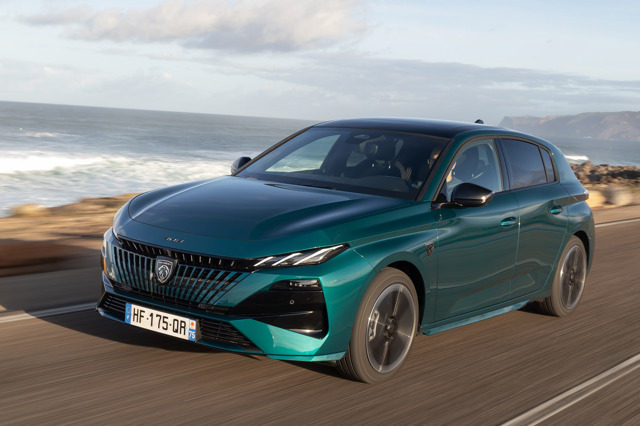
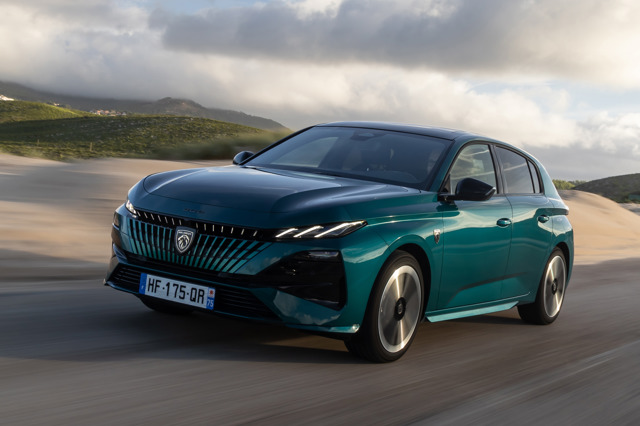
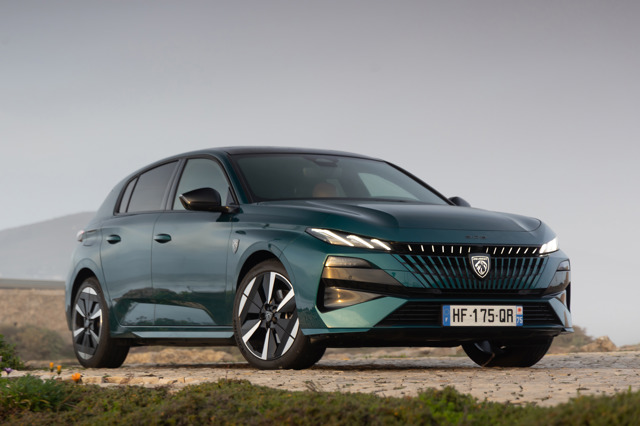
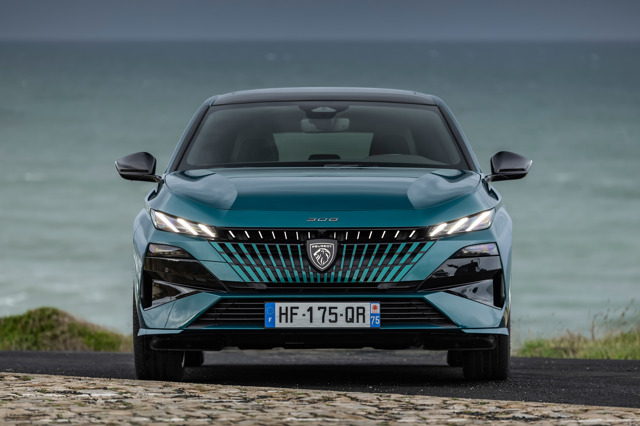
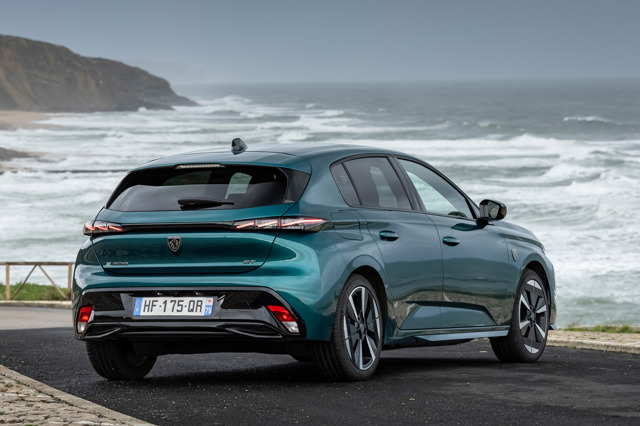
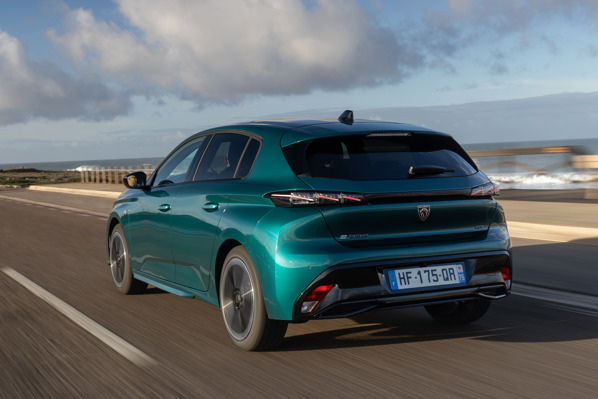
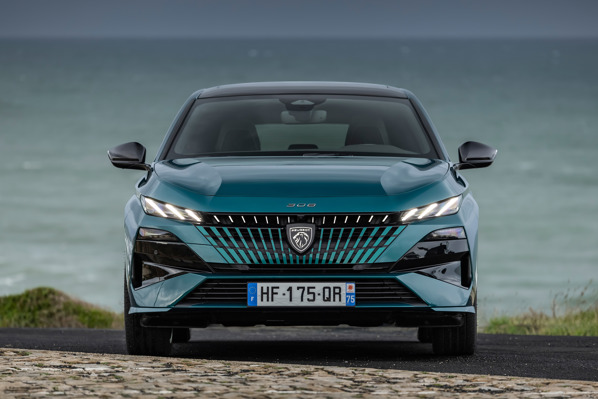
Aside from the improved range the E-308 also gains the same aesthetic tweaks as its combustion-engined siblings. This includes a revised front end that ditches the massive 'lion's claw' daytime-running lighting elements for a more subtle triple-claw-like motif inside the redesigned headlights.
Those tie in with strokes of LEDs above the grille, all subtly done, unlike some cars' front ends which give Blackpool's illuminations a run for their money. Whether you like the backlit grille badge is a matter of personal taste.
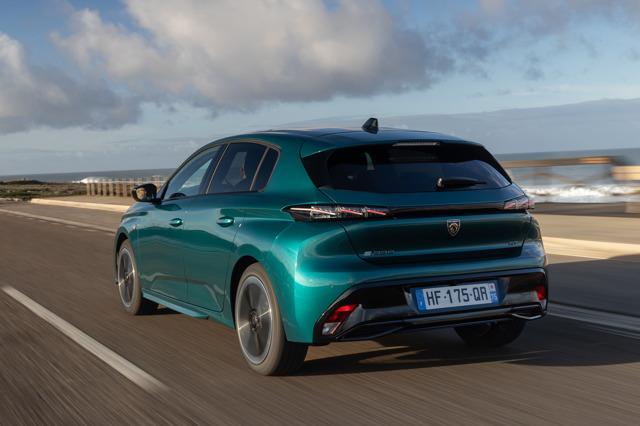
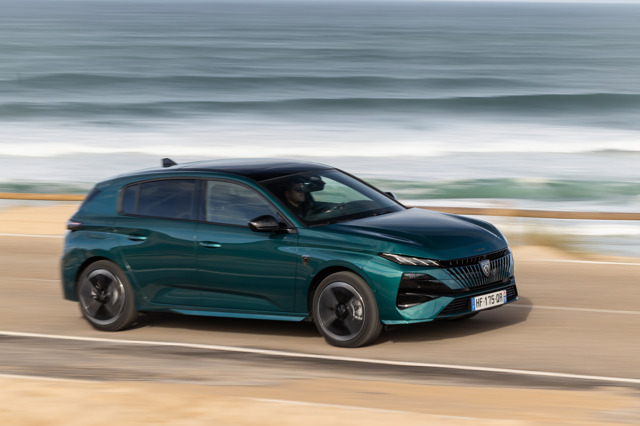
The E-308 was already a great-looking car and now it's more distinctive than ever. Its exterior is matched by a similarly stylish cabin, although the strange i-Cockpit driving position won't be for everyone. The infotainment system isn't amazing, either, nor are we keen on having to use it for climate functions.
Peugeot E-308: Range and charging times
| Peugeot E-308 54kWh (pre-facelift) | 254-258 miles |
| Peugeot E-308 55kWh (post-facelift) | 277-279 miles |
For the facelifted Peugeot E-308 a WLTP Combined cycle driving range of 277-279 miles depending on which trim level you choose. The pre-makeover models will cover fewer miles — officially it's a best of 258 miles for the Allure, while the GT is 254 miles.
In the real-world, you’ll get closer to 220 miles — and that’s if it’s warm and you’re not abusing Sport mode. For the highest range possible, keep the E-308 at its most efficient in Eco mode, all 109PS of it.
It’s disappointing that a heat pump, which improves efficiency by getting the battery up to operating temperature quickly, isn’t standard apart from with the range-topping GT Premium, but it can be had as a £400 extra-cost option on Allure and GT versions.
Based on our experiences a full recharge at home using a 7.4kW wallbox will take about 7 hours 30 minutes. Peugeot quotes a 20-80% top-up using the same AC connection at 4 hours 25 minutes.
DC rapid charging is pegged at just 100kW, which is far from cutting edge but it’s sufficient to perform the same 20-80% state of charge increase in 30 minutes.
Reviews for Peugeot E-308's top 3 rivals

Peugeot E-308 handling and engines

Peugeot E-308 2026: Handling and ride quality
The Peugeot E-308’s ride quality is one of its standout features, traversing most road surfaces with the comfort and compliance of a bigger, more expensive car. It’s certainly best at higher speeds, although undulating rural roads can unsettle it, while cobbled surfaces at urban pace aren’t expertly absorbed either.
Like most EVs, the E-308 is heavy, owing to the battery's position under the floor — for reference its 287kg heftier than the lightest 308 available, the Hybrid 145. Rather than fight against it by stiffening the suspension to make the car firm and sporty, Peugeot has given the E-308 a softer, more compliant setup, with a bit of body roll built in.
In this regard it doesn’t feel that far removed from its Peugeot E-3008 SUV cousin, rather than having the sharpness of the Cupra Born. It’s rarely jarring when it hits a shallow pothole or a motorway expansion joint, although a smidge more height in the tyre sidewall might help on this front — all E-308s ride on identical 18-inch alloy wheels shod with 45% profile rubber.
The flipside of that is that it’s far from the last word in sharp handling. Its steering is reasonably quick to respond to small inputs at the wheel, exaggerated by its tiny size, but its lardy kerb weight and soft suspension contrive to make the E-308 feel cumbersome at times. The suspension damping is non-adjustable, so although the E-308 has different driving modes, they don’t make it any firmer or softer.
Peugeot E-308 2026: Engines
Unlike many of its rivals, the Peugeot E-308 has just one electric motor, so at least choosing between different options isn’t going to slow you down. Both pre- and post-facelift E-308s have identical performance.
Mounted under the bonnet is a single electric motor, sending drive to the front wheels via a one-speed transmission which is used the same as you would an automatic.
Producing 156PS and 270Nm of torque this setup accomplishes the benchmark 0-62mph acceleration test in 9.8 seconds, making it far from the quickest electric car on the market. In order to reduce the chances of the battery reserves being wasted through high-speed driving, the Peugeot’s maximum speed is electronically governed to 106mph.
The overall effect makes the E-308 feel sluggish, especially in the context of the 3.8-second 0-62mph time of the MG4 EV XPower, which costs less than £37,000, so not an enormous amount more than the Peugeot.
Again it’s as though Peugeot doesn’t want the E-308 to feel particularly different to drive alongside other 308s — while EVs don’t need breakneck acceleration, part of their appeal is how quickly they’re able to gather pace. That lack of zip also shows its face when using the adaptive cruise control — press Resume and you’re immediately aware the gap to the car in front increases for a while as the E-308 gently picks up its pace.
The lack of alacrity is exacerbated by driving modes that actually slow the car down. Yep, three modes — Eco, Normal and Sport. In Eco power is limited 109PS to extend the driving range, while the maximum in the default Normal tune is 136PS. In other words, it’s Sport mode is where you get the full 156PS.
It likely goes without saying that in anything other than Sport mode, the E-308 is about as vivacious as a teenager that’s just been asked to tidy their room.
Peugeot E-308 2026: Safety
The Peugeot E-308 didn’t smash the Euro NCAP test, figuratively speaking, in the way you might hope, achieving a four-star rating in 2022.
Thankfully, its highest score is for child occupants, at 87%, but its adult score (76%) and vulnerable road user result (67%) are both mildly disappointing. It’s very easy to find rivals with five-star scores, including the Renault Megane E-Tech.
That said, the E-308’s results are not something to really worry about. Standard safety kit includes six airbags, lane-keeping assist, adaptive cruise control with stop-and-go, blind-spot monitoring, rear parking sensors and post-collision automatic braking. It also an Intelligent Safety Brake feature that uses cameras and radar for pedestrian and cyclist detection.
Peugeot E-308 2026: Towing
If you hoped to tow using a Peugeot E-308 then prepare to be disappointed — it's not been homologated to tow a trailer of any capacity.
You can still spec a manually retractable tow bar in the configurator for £790 should you wish to use a rear-mounted bicycle carrier.
| Engine | MPG | 0-62 | CO2 |
|---|---|---|---|
| 156 54kWh | - | 9.8 s | - |
Peugeot E-308 interior
| Dimensions | |
|---|---|
| Length | - |
| Width | - |
| Height | - |
| Wheelbase | 2680 mm |
Peugeot E-308 2026: Practicality
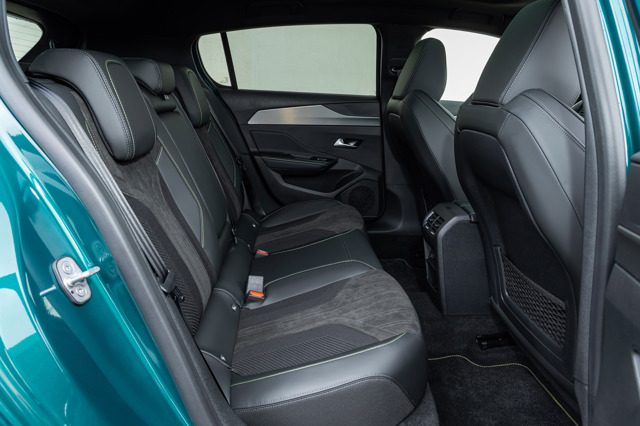
If you’re after the roomiest electric family hatchback on the market, you should look at something other than the Peugeot E-308. The MG 4 EV and the VW ID.3 both have quantifiably more rear legroom than the Peugeot, although the Renault Megane E-Tech is a tad more compromised than the E-308 in that regard.
The Renault makes ground back up with a boot volume that’s 79 litres more capacious than the E-308’s 361-litre capacity, a figure which is also more modest than the MG 4 EV (363 litres) and VW ID.3 (385 litres).
There’s a 60/40 split to the Peugeot’s rear seatbacks although they don’t lie flat when folded forwards, creating an awkward step when sliding long, heavy loads along the boot floor. A ski-hatch behind the rear centre armrest is handy for slender-yet-lengthy cargo but that feature’s only fitted to GT specification models upwards.
Total carrying capacity when the whole rear seat’s folded and the Peugeot’s loaded to ceiling height is 1271 litres, which beats the MG’s 1177-litre space but remains behind the Renault’s 1332-litre cavern. Families with pre-teenage children will be fine using the Peugeot E-308 but its limitations will become more apparent if you need to fit bulky child seats into the back and carry buggies.
When it comes to rear knee room specifically, you do wonder why Peugeot made the front seats so chunky. They’re very comfy but making the seatbacks slimmer seems like an easy way to liberate more rear space. It’s a shame there’s no frunk for your charging cables either, although there’s a small amount of space under the boot floor for those.
Cabin storage is also limited, with the E-308 having a relatively small glovebox and limited centre console space — the split armrest on top of the largest cubby between the seats at least keeps what’s in there out of view.
The pair of cupholders on the centre console have a sliding cover should you wish to close it when not in use and the optional wireless smartphone charging pad is slotted under the main dashboard out of view — it didn’t seem to work reliably on test, though.
Peugeot E-308 2026: Quality and finish
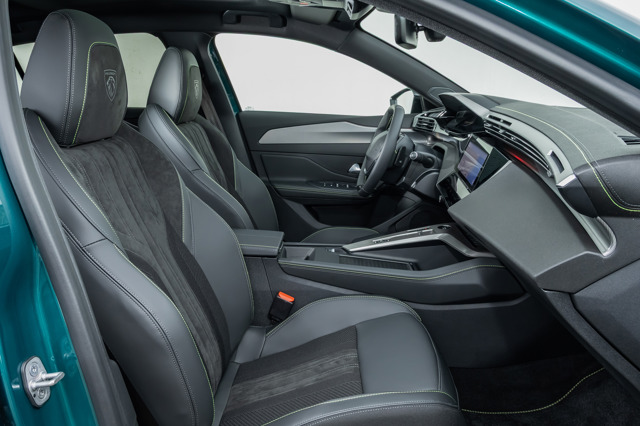
Ostensible cabin quality is one of the main attractions that will swing you towards a Peugeot E-308. Saying nothing of overall reliability, which is improving slowly for Peugeot, the feel of the E-308’s interior is outstanding.
The soft-touch, stitched top to the dashboard looks and feels great, as does the faux suede trim on the seats, doors and the dash. Pity it’s all dark grey and black, mind.
All the digital stuff looks lovely too. Not just the graphics for the infotainment and the i-Toggles, but the 3D effect of the digital instrument panel. Some may find it gimmicky, but others will enjoy the novelty — if it’s not your cup of tea you can always switch it off and opt for a flat 2D look.
It trounces the MG 4 EV and Volkswagen ID.3 for tactility and solidity, which you might expect in the former’s case, but the latter shows how far ahead of your expectations the E-308 could be.
Peugeot E-308 2026: Infotainment
Peugeot E-308 evidently reflects the firm’s attempt to correct an area of its cars that has caused most consternation in the recent past. Peugeot’s multimedia systems have been historically poor, while this one's 10.0-inch touchscreen is good… If not still not quite there, yet.
The i-Toggles work well, offering you a neat, configurable and always-on row of shortcuts under the main screen. Plus there’s a physical volume knob — always a winner — and proper buttons for accessing driving modes and air con menus.
But the E-308’s main issue is software-related. Its operation is sluggish, partly because Peugeot has built a transition graphic between menus. That’s lovely for PowerPoint presentations, but not when you’re switching between navigation and media menus at 70mph. A lot of the control icons are on the small side, too.
Wireless smartphone mirroring is standard, at least, so you can bypass the proprietary system’s media and navigation quirks for something familiar.
Peugeot E-308 value for money
Peugeot E-308 2026: Prices
As highly specified and with its lovely interior finish the Peugeot E-308 is, earlier versions felt like they were priced too high when new. Following the introduction of the government’s Electric Car Grant (ECG) in August 2025 as well as Peugeot’s price realignment drive, the situation’s now more balanced.
With the ECG discount factored in, the facelifted E-308 comes in at £29,495 in Allure trim, £31,495 as a GT and £32,995 in GT Premium guise.
Elsewhere, it’s the Citroen e-C4 that now seems something of a bargain as £26,150 gets you behind the wheel of one, while the MG 4 EV can be had for £27,245. For the VW ID.3 you’re looking at £30,860 with a small step to £31,295 for the Renault Megane E-Tech.
Yes, the Peugeot E-308’s now cheaper than before, but so is everything else.
Peugeot E-308 2026: Reliability and running costs
The Peugeot E-308’s prices are somewhat offset by the low running costs typical of an electric car. To give you a working example, 10,000 miles could cost less than £200 in electricity, if you charge exclusively at home using an EV-specific off-peak tariff.
Maintenance costs are minimised, with no oil changes or exhaust repairs and fewer moving parts to go wrong, so servicing and upkeep costs are relatively low too.
Vehicle Excise Duty (VED) — the tenner for the first year aside — is now £195 annually, the same as combustion-engined Peugeot 308s. While the Expensive Car Supplement now also applies to EVs, the E-308's lowered price means you won't need to worry about getting anywhere near the £50,000 threshold.
For company car drivers, it’s even better. In Benefit-in-Kind (BiK) tax alone, a 40% rate-payer will save around £2000 per year by running an E-308 instead of a 308 Hybrid 145 — that’s the difference a 3% band makes for the EV model compared with 28%. Ouch.
Satisfaction Index
 What is your car like to live with?
We need your help with our latest Satisfaction Index, so that we can help others make a smarter car buying decision. What's it like to live with your car? Love it? Loath it? We want to know. Let us know about your car - it will only take a few minutes and you could be helping thousands of others.
Help us with the Honest John Satisfaction Index nowPeugeot E-308 models and specs
As of the Peugeot E-308's 2025 facelift, it's available in three trim levels: Allure, GT and GT Premium.
Specification levels are broadly the same as the combustion-engined 308s, with the main point of difference being a larger size of wheel for the Allure.
The Peugeot E-308 Allure is fitted with the following equipment as standard:
- 18-inch Seattle diamond-cut alloy wheels
- Full LED headlights
- Peugeot signature 3-Claw daytime-running lights
- Dark-tinted rear windows
- Rear parking sensors
- 180-degree reversing camera
- Leather-wrapped steering wheel
- 10.0-inch digital instrument cluster
- 10.0-inch touchscreen infotainment system
- Keyless start
Building on that is the Peugeot E-308 GT featuring:
- Matrix LED headlights
- Illuminated grille and badge
- Keyless entry and starting
- Front and rear parking sensors
- Eight-colour interior ambient lighting
At the top of the range the Peugeot E-308 GT Premium adds:
- 360-degree four-parking camera system
- Heated steering wheel
- Drive Assist Pack Plus additional driver aids
| Dimensions | |
|---|---|
| Length | - |
| Width | - |
| Height | - |
| Wheelbase | 2680 mm |
| Miscellaneous | |
|---|---|
| Kerb Weight | - |
| Boot Space | - |
| Warranty | |
| Servicing | - |
| Costs | |
|---|---|
| List Price | £39,995–£40,045 |
| Insurance Groups | - |
| Road Tax Bands | A |
| Official MPG | - |
| Euro NCAP Safety Ratings | |
|---|---|
| Adult | - |
| Child | - |
| Pedestrian | - |
| Overall | - |
Currently on sale
| Hatchback | |||
|---|---|---|---|
| Version | List Price | MPG | 0-62 |
| Allure 156 Electric 54kWh Auto 5dr | £39,995 | - | 9.8 s |
| GT 156 Electric 54kWh Auto 5dr | £40,045 | - | 9.8 s |
On sale until April 2024
| Hatchback | |||
|---|---|---|---|
| Version | List Price | MPG | 0-62 |
| First Edition 156 Electric 54kWh Auto 5dr | £42,080 | - | 9.8 s |
Model History
- September 2023: Peugeot E-308 opens for orders, priced from £40,050
- November 2025: Revised Peugeot E-308 on sale, priced from £29,495
September 2023
Peugeot E-308 opens for orders, priced from £40,050
Peugeot has announced that the latest addition to its all-electric model range, the new Peugeot E-308, is now open for orders, with prices starting from £40,050.
The E-308 powered by a 156PS electric motor and a 54kWh battery providing a range of up to 257 miles. A heat pump is included as standard for greater efficiency and comfort.
The E-308 is available with a choice of three trim levels from launch: Allure, GT and, for a limited time, First Edition.
Allure variants start at £40,050 and include 18-inch alloy wheels, heated front seats and a heated steering wheel, a reversing camera and 3D Connected Navigation and natural voice recognition.
GT models start at £42,250 and add full Matrix LED Technology headlights with 3D LED taillights, eight-colour ambient lighting, front parking sensors and a 3D digital instrument cluster.
Limited-run First Edition models start at £42,080 and feature an exclusive interior and a choice of three colours: Okenite White, Olivine Green, and Selenium Grey.
November 2025
Revised Peugeot E-308 on sale, priced from £29,495
Peugeot has announced prices and specs for the revised E-308, which is now on sale, with first deliveries expected in December. The E-308 starts at £29,495 including the government's £1500 Electric Car Grant.
The E-308 features a revised front end with the option of an illuminated Peugeot logo, new alloy wheel designs and new lights.
Three trim levels are available - Allure, GT and GT Premium. Allure models include LED headlights, rear parking sensors and reversing camera, 18-inch alloys and new front seats.
GT adds matrix LED lights, the illuminated grille, front parking sensors, Alcantara interior trim and i-Connect Navigation and configurable Peugeot i-Toggles for the infotainment.
GT Premium is a new top-spec trim level that includes Alcantara heated front seats, a heated steering wheel and a 360° Vision and Drive Assist Plus Pack. A heat pump is also standard on GT Premium, and optional on other trims.
The electric powertrain has been updated. It develops 156PS and range has increased by 25 miles to 279 miles from its 58.4kWh (55.4kWh usable) battery.
Three levels of regenerative braking are now available, easily adjusted via steering wheel paddles.
A three-phase 11kW onboard charger comes as standard, providing 20% to 80% charging times of three hours and 35 minutes from an 11kW AC charger. Using a 100kW DC rapid charger, a 20% to 80% charge takes 32 minutes.
Peugeot E-308 prices, including Electric Car Grant
E-308 Electric 55kWh 156 £29,495
E-308 GT Electric 55kWh 156 £31,495
E-308 GT Premium Electric 55kWh 156 £32,995
