
The Omoda 9 is like a cut-price Range Rover Velar




Omoda 9 Verdict

 Roomy interior with impressive quality. Well equipped for a reasonable price. Decent to drive.
 Infotainment glitches. Annoying driver attention alert system. Some elements of the driving experience lack polish.
Find out more about the Omoda 9
Everyone loves a bargain, don’t they? That being the case, it’s easy to see why the Omoda 9 might appeal. That’s because, although it’s hardly cheap at around £45,000, it gives you an awful lot for your money. Find out precisely what in our Omoda 9 review.
But before we get stuck into all of that, just what the merry heck is Omoda? Well, you know all those Chinese carmakers you’ve heard about in the media? The ones that are entering European markets and disrupting the established status quo with bundles of tech and low prices? Well, Omoda is one of them, sitting alongside sister brands Jaecoo, Lepas, and Chery as the European offerings of Chinese manufacturing powerhouse Chery International. The 9, meanwhile, is Omoda’s flagship SUV.
It’s only a five-seater, despite its fairly huge proportions, but it comes stuffed with pretty much every item of kit someone could even think to put into a car. And it does that while costing around the same as an SUV from the class below. And for many car buyers, that’s enough to at least get them interested.
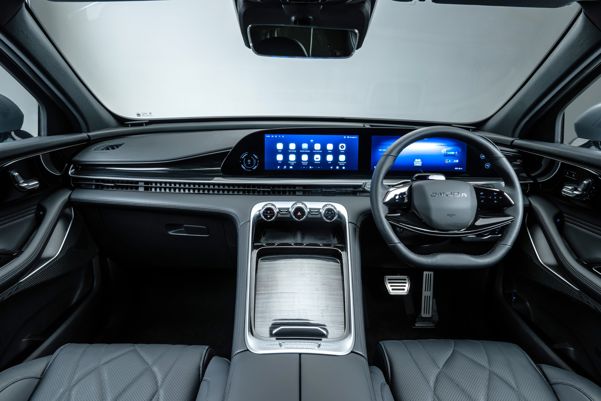
And don’t go thinking that you’ll have to put up with a cheap-feeling plasticky interior in order to get such stonking value, either. The Omoda 9’s cabin is a thoroughly plush and pleasant place in which to spend your time, with elegant materials, compelling design and oodles of space.
It comes fitted with a clever powertrain as standard, too, a plug-in hybrid system that posts some very impressive numbers. Those numbers include a 449PS power output, combined with a 93-mile all-electric range and a 200-plus-mpg official fuel economy figure. In truth, treat all those numbers with healthy scepticism: they look rather better on paper than what transpires in reality, but if it's bragging rights you’re after, then the Omoda 9 seems to have plenty.
And yes, there are a variety of areas in which the car lacks some of the polish of its best European rivals. The powertrain doesn’t feel quite as sophisticated, the ride-and-handling balance doesn’t feel as deft, and the software doesn’t feel as finished. But you know what? It feels close enough in those areas that, for the right buyer, that simply won’t matter given the value that it provides.
If you’re looking for a large SUV, the Omoda 9 is certainly worthy of your consideration. Go in with your eyes open, and make sure you know where the compromises are, how severe they are, and whether you’re prepared to make them. And if you are, then you’ll get a whole lot of car for an eye-rubbingly low price compared to more familiar competitors.
Reviews for Omoda 9's top 3 rivals


Omoda 9 handling and engines
Omoda 9 2026: Handling and ride quality
The Omoda 9’s standard equipment list includes an adaptive suspension with continuous damper control, and if you fiddle with the corresponding touchscreen menu, you can make the car’s ride softer or firmer according to your mood.
And yes, you can feel the difference: there’s a touch more float in the softer settings, and a touch more jitter in the firmer ones. We are only talking a touch here, mind: the differences are very marginal at best, and ultimately, you can fiddle with the screen all day long, and your driving experience won’t really be enhanced – or damaged, to be fair – to any great degree.
Importantly, though, regardless of what setting you dial into the car, it does a thoroughly reasonable job in the ride-and-handling stakes. Okay, so sharper-edged low-speed bumps aren’t smoothed over with quite the same polish as they are in the cushiest luxury SUVs, but most of the time, you’ll waft along very comfortably, indeed.
The car’s impressive refinement contributes to this easy-going nature, too. There’s obviously very little noise from the powertrain when running in electric-only mode, but there isn’t all that much more when the petrol engine kicks in, either, and it stays smooth as well as quiet for the vast majority of the time. Standard double-glazed side windows help shut out wind noise pretty effectively, although we did notice a strange but thankfully faint whistling noise from around the windscreen on our test drive. Road noise is well isolated.
Likewise, the Omoda 9’s handling isn’t the last word in dynamism, but it’s perfectly capable. You’re very aware that you’re at the helm of a big, heavy car when you change direction, but you do so stably and securely, with strong grip and decent body control. Granted, the steering is a little slow to respond at the straight-ahead position, but it reacts positively enough to the initial lull, and it’s quite pleasantly weighted.
Omoda 9 2026: Engines
The Omoda 9 comes with just a single powertrain, a plug-in hybrid system dubbed – very modestly – by Omoda as the Super Hybrid System, or SHS for short. It uses a 1.5-litre turbocharged petrol engine along with a pair of electric motors - one on each axle - fed by a 34.5kWh lithium-iron phosphate battery.
Using a clever three-speed transmission, the various power sources are deployed in a variety of different ways depending on what the car decides is best for efficiency at the time. When the battery level is high enough and the speeds are low enough, the car is propelled by either one or both of its electric motors. When the battery level is lower, or the prevailing driving conditions require more pace (such as when the car is cruising at motorway speeds or in need of maximum acceleration for an overtake), the petrol engine chimes in, either to recharge the battery, or to help drive the wheels, or both.
Added together, the various power sources deliver a total of 449PS, and Omoda claims a 0-62mph time of 4.9 seconds. Both those figures sound quite impressive, but the real-world sensation is somewhat less so.
Put your foot down, either from a standstill or when already on the move, and there’s a long pause before anything happens. And then, once the powertrain does recognise the movement of the throttle pedal, the car surges forward in a brawny yet smooth way. It’s an undeniably brisk-feeling machine, but it won’t be hurried into serving up its prodigious performance before it's ready.
The throttle response is supposed to become sharper when you select Sport mode, but you won’t notice much difference, and the initial pause in proceedings remains. That said, the throttle is nevertheless easy to modulate, making it easy to regulate your speed, and that’s not something we’ve been able to say about some other Omoda/Jaecoo models we’ve tried.
Omoda 9 2026: Safety
The Omoda 9 comes with a vast suite of ADAS (Advanced Driver Assistance Systems) measures as standard. These include front collision warning, autonomous emergency braking, rear cross traffic alert and braking, blind spot detection, a driver monitor system, lane departure prevention, lane departure warning, emergency lane keeping, lane control assist, and traffic jam avoidance assist.
If you’re one of those people who find all that stuff annoying, the Omoda has a neat feature. Swipe downwards from the top edge of the central touchscreen, and you’re immediately presented with a menu that allows you to turn the offending systems off one by one. European safety legislation means that you’ll have to do this every time you start the car as they get automatically reinstated, but you might well find that you don’t always feel the need to, due to the fact that most of the systems in the 9 aren’t as annoying or as intrusive as we’ve found them to be in other Omoda/Jaecoo models.
The exception to this rule, however, is the driver attention monitor, which is there to remind you to keep your eyes on the road. This admonishes you with an annoying bong if you so much as glance at the touchscreen, which you often have to.
The Omoda 9 received the full five-star rating from Euro NCAP when it was tested in 2025.
Omoda 9 2026: Towing
The Omoda 9 is only rated to tow up to 1500kg’s-worth of braked trailer. That’s not abysmal, but it’s not great either, considering the size of the car.
Omoda 9 interior
Omoda 9 2026: Practicality
The Omoda 9 is a large car, measuring 4,775mm long, 1,920mm wide, and 1,671mm tall, similar dimensions to a Skoda Kodiaq. The good news is that this translates into bags of interior space. The front seats have loads of headroom and legroom, as you’d expect, and the cabin also feels very wide, so you keep a respectful distance from your front-seat passenger, with no elbow-banging.
The width of the cabin pays even greater dividends in the back, because it means that three people can sit across the rear bench in relative comfort, made even more comfortable by a wide central seat with a flat floor in front of it. The rear seats also have very generous legroom, and although headroom is a little more limited due to the standard panoramic roof, there’s still more than enough for tall adults to travel comfortably.
The boot has 660 litres of space, which is very generous, even if it doesn’t look quite that big when you’re standing in front of it. Access to the space is good, partly because there’s barely any load lip, but there’s hardly any underfloor storage, so your charging cable will likely be rattling around loose in your load bay.
The rear seats drop to give a maximum cargo capacity of 1783 litres. They fold in a 60/40 split, which isn’t as versatile as the 40/20/40 split found in some such cars. The chairs lie flush with the boot floor when folded, so you get a fairly flat load area, but there is a bit of a slope to it, as those chairs do lie at a slight angle.
Omoda 9 2026: Quality and finish
If you’re worried that the Omoda 9 is going to feel like a cheap knock-off of more established rivals, don't. Nothing could be further from the truth. Everywhere you look are plush materials and finishes - a mix of vegan leather, plausible wood-effect panelling and chrome trimmings - and they’re all assembled in a pleasant and utterly convincing way. Even if you root around in the lower reaches of the cabin, you won’t find a single surface constructed out of below-par plastic. This really is a classy-feeling car.
Omoda 9 2026: Infotainment
The Omoda 9’s infotainment layout is reminiscent of many such systems these days. There are two 12.3-inch screens positioned side-by-side, one behind the steering wheel to serve as an information panel, and another in the middle of the dashboard to operate the car’s various functions. The two screens are housed within the same structure that bends around the driver. The former is reasonably clear but could be more configurable, while the latter delivers crisp graphics and fairly reliable touchscreen responses.
We very much like the fact that the dashboard has three dials, two of which allow you to operate the main elements of the air-con without having to faff around with the touchscreen. That said, some other functions that maybe aren’t quite so central but are still used frequently are buried rather too deeply within the structure of on-screen menus, so the usability of the system is far from perfect. We also noticed a variety of glitches with the software that caused some further usability problems, some of which were fairly severe. We were told that these were unique to the car we drove, and would be fixed with over-the-air software updates.
All the functionality you expect is present and correct, mind. You have DAB radio, Bluetooth, native navigation, wireless Apple CarPlay and Android Auto, four USB ports (two front, two rear), voice control, wireless phone charging, and a 14-speaker Sony surround sound system.
Omoda 9 value for money

Omoda 9 2026: Prices
The Omoda 9 costs around £45,000 for the single high-spec version available. You might think that this sounds like quite a lot for a car from a Chinese brand you’ve never heard of, but it needs some context.
It’s about the same as you’ll pay for an entry-level Range Rover Evoque, which you might also fancy. However, factor in how much bigger the Omoda is (a lot), and how much more standard equipment it has (also a lot), and the fact that it has a sophisticated plug-in hybrid powertrain, and it looks like brilliant value for money.
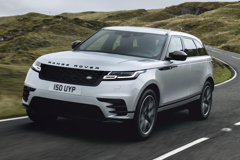
Indeed, compare the 9 to a Range Rover Velar, which is much more similar in size, in similarly-equipped top-spec form and fitted with a PHEV powertrain, and the Omoda’s price advantage amounts to around twenty grand.
Despite such cracking value as a new car, you can still get quite a good price on a lightly used one. We’ve seen as-new pre-registered examples with teeny double-digit mileages for around £3,000 less than the brand new price, and if you can live with around 5,000 miles on the clock, you stand to save more like ten grand.
Omoda 9 2026: Reliability and running costs
The Omoda 9 has the potential to be very cheap to run thanks to its plug-in hybrid powertrain, but for that to be the case, you must use it in the right way.
Firstly, make sure you keep it charged up with electricity. This can be done at home in eight hours using the charging cable provided as standard, which plugs into any regular three-pin domestic socket. It’ll take around half that time if you have a 7kW wallbox home EV charger fitted, although you’ll need a different type of cable. Should you need to charge up on the go, the Omoda 9 is rare among PHEVs in that it can accept DC rapid charging of up to 70kW, allowing you to top up at a public charging station in as little as 25 minutes.
If you pay for your domestic electricity at the UK’s national average rate, a full charge of your 34.5kWh battery at home will cost around £9, but you’ll pay a lot less than that if you get yourself on a variable home EV tariff that allows you to charge overnight on heavily discounted power. Avoid using those public chargers too often, though, because the power that comes out of those is way, way more expensive.
The other way to maximise your economy - other than keeping your battery juiced-up - is to keep your regular journeys short enough that you can complete them on electric power alone. The car’s impressive EV range of 93 miles should give you every chance of doing that if you stay diligent with your charging.
Do bear in mind that the second your petrol engine fires up, running costs will rise significantly, although perhaps not as much as with other plug-in hybrids, which become very thirsty indeed when the battery runs down: that’s because the petrol engine has to haul around the extra weight of the battery.
With the Omoda 9, however, the battery is never allowed to fully deplete (it’s constantly being topped up by the petrol engine, or regeneration from the brakes and electric motors), allowing it to operate like a self-charging hybrid. Omoda quotes a figure of 43.6mpg for this sort of use, which is pretty reasonable. You can pretty much ignore the official WLTP combined figure of more than 201mpg because all PHEVs are bestowed with overly-flattering figures in these tests.
The Omoda sits in group 47 for insurance. These groupings are rated at 1 to 50, with group 50 being the most expensive of the lot, so that tells you the costs involved won’t be insignificant.
VED car tax, too, will be as steep as it can currently be due to the list price of more than £40,000. This means that on top of the normal flat rate of £195 per year, you’ll also pay the ‘luxury car surcharge’, which, between years two and six of the car’s life, adds another £425 onto your annual bill.
Satisfaction Index
 What is your car like to live with?
We need your help with our latest Satisfaction Index, so that we can help others make a smarter car buying decision. What's it like to live with your car? Love it? Loath it? We want to know. Let us know about your car - it will only take a few minutes and you could be helping thousands of others.
Help us with the Honest John Satisfaction Index nowOmoda 9 models and specs
Omoda makes much of its ‘everything as standard’ approach to specifying its cars, and as the brand’s flagship, it’s no surprise that the 9 is positively stuffed with equipment.
There are no trim levels, just a single model offered with the following equipment as standard:
- 20-inch alloy wheels
- Front end with 134 LED daytime running lights
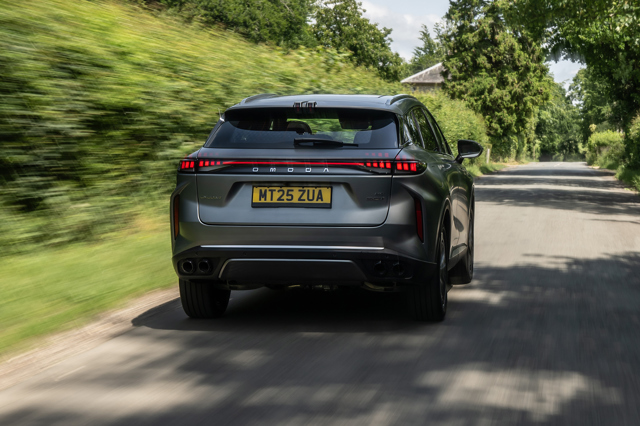
- Full-width LED rear light bar
- Automatic headlights with automatic high beam
- 1.3-metre panoramic sunroof
- Adaptive suspension with continuous damper control
- Dual-zone climate control
- Multi-coloured ambient lighting
- Power-adjustment for the front seats
- Power reclining for the rear seats
- Heating and ventilation for the front-and outer-rear seats
- Vegan leather coverings for the seats and steering wheel
- Heated steering wheel with four-way electric adjustment
- 540-degree panoramic view cameras
- Adaptive cruise control
Model History
- April 2025: Order books open for Omoda 9 SHS SUV, prices start at £44,990
- November 2025: Omoda 9 preview
April 2025
Order books open for Omoda 9 SHS SUV, prices start at £44,990
Order books have now opened for the Omoda 9 SHS SUV. Prices for the plug-in hybrid model start at £44,990.
The 9 features a 449PS plug-in hybrid drivetrain that allows for 93 electric-only miles and an overall range of over 700 miles.
A 540-degree panoramic view camera with transparent view, a 1.3-metre sunroof, a 14-speaker Sony surround sound system, and heated and ventilated seats in the front and rear are all standard equipment.
Omoda also touts the 9's refinement, with acoustically optimised tyres and double laminated glass contributing to a 45.8dB reading at urban speeds, equivalent to the sound of light rainfall or the inside of a modern library.
The 9 SHS costs from £44,990 and includes a seven-year/100,000-mile warranty with no mileage limit for the first three years, plus an eight-year warranty on the 34.46kWh battery, alongside RAC home start, as standard.
Order books are now open, with UK deliveries due to start in June.
November 2025
Omoda 9 preview
Sales of cars from new and unfamiliar brands can be something of a slow burner — evidently nobody’s informed the Chinese Chery group about this as its Omoda and Jaecoo marques’ SUVs are already finding plenty of UK driveways to call home. Will that trend continue with the arrival of the hybrid-powered, luxury-focused Omoda 9?
That’s right, we did say 'hybrid'. While this may appear to fly in the face of moves by both established and new companies alike to switch to electric-only models, it’s a savvy decision by Omoda given that EV sales aren’t taking off as quickly as manufacturers — and the government — would like.
Central to the Omoda 9’s Super Hybrid System — SHS for short — is a development of the plug-in hybrid arrangement also found in the Jaecoo 7. Here a 1.5-litre turbocharged petrol engine works in conjunction with a pair of electric motors and a 34.5kWh battery pack.
That’s a useful amount of energy storage and results in a WLTP Combined cycle electric driving range of up to 93 miles. That tally, combined with CO2 emissions of just 40g/km, could make the Omoda 9 the darling of company car drivers as together they result in a 2025/26 Benefit-in-Kind (BiK) taxation level of 6%.
For reference, with the combustion engine also active the claimed range is north of 700 miles — potentially very long gaps between filling station visits, in other words. There's no official line at this stage on recharging times.
Despite this, the Omoda 9 SHS isn’t a modestly powered eco warrior designed to get by with the least amount of necessary performance. No, its packing a jab of 449PS and a 700Nm of torque uppercut, sufficient for a 0-62mph time of an astonishingly swift 4.9 seconds. All-wheel drive traction assists that alacrity, boosted by six different driving modes, three of which aid progress in tricky conditions.
If you’re already wondering how colossal the Omoda 9’s price tag is then we recommend that you’re sat down with a mug of heavily sugared tea on standby before reading on. In its ‘everything as standard’ specification, the on-the-road price is £44,990, which includes a seven-year/100,000-mile warranty and a separate eight-year warranty for the hybrid system’s high-voltage battery.
For context, the least expensive version of the Toyota RAV4 Plug-in Hybrid costs £44,175 and while its CO2 emissions are just 22g/km, its 18.1kWh battery limits electric driving to a claimed 46 miles. Don't forget to factor-in that it's also down on the Omoda's power figure with only 306PS. Elsewhere, you’ll need £55,250 for a Volvo XC60 plug-in hybrid and £49,030 for the well-regarded Honda CR-V e:PHEV.
As there's just a single Omonda 9 SHS derivative, it's brimming with equipment and technology designed to impress and cosset in equal measure. That includes a twin-screen dashboard display nestled seamlessly within a single 24.6-inch curved panel, which mercifully doesn’t include every control you’ll frequently use. Yes, just beneath the central air vents are a trio of rotary and push-button physical controls for adjusting the interior temperature and switching on the hazard warning lights, among other functions.
Aside from the Omoda 9 SHS’s impressive efficiency, it’s also been designed to feel serene and luxurious. Double-laminated side windows minimise exterior din to a level akin to being in a public library, while the front and outer rear seats are electrically adjustable as well as being heated and ventilated. Just don’t tell whoever’s relegated to the centre of the rear bench.
For audiophiles there’s a 14-speaker Sony sound system, which includes some that are integrated within the headrests to amplify the surround experience. Smartphone mirroring is naturally included, with the centre console-sited wireless charging pad being cooled to prevent your device from getting overly hot.
How effective the Omoda 9’s electromagnetic suspension system proves to be will only become clear once we’ve driven this luxury SUV. It’s a similar situation with what it labels a 540-degree camera system with transparent view, although experience with rivals’ packages suggests that it’ll be a useful addition when manoeuvring in tight confines.
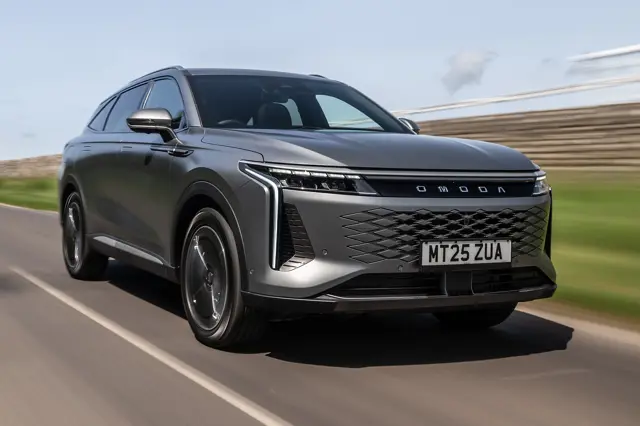
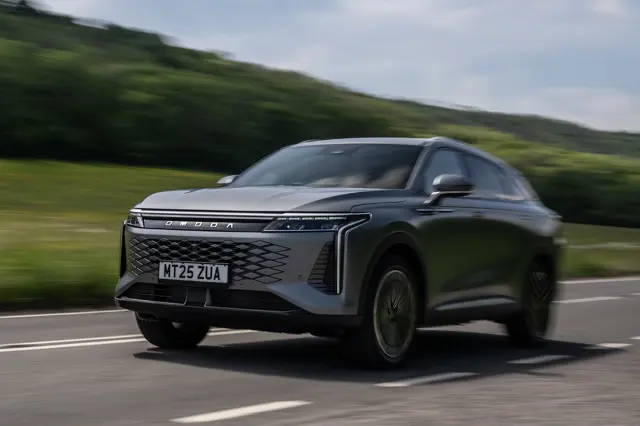
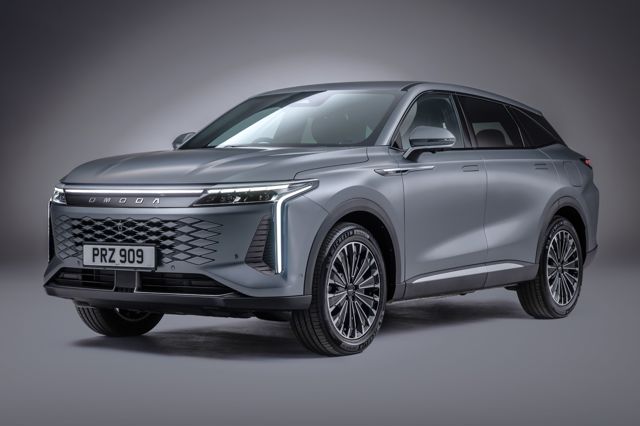
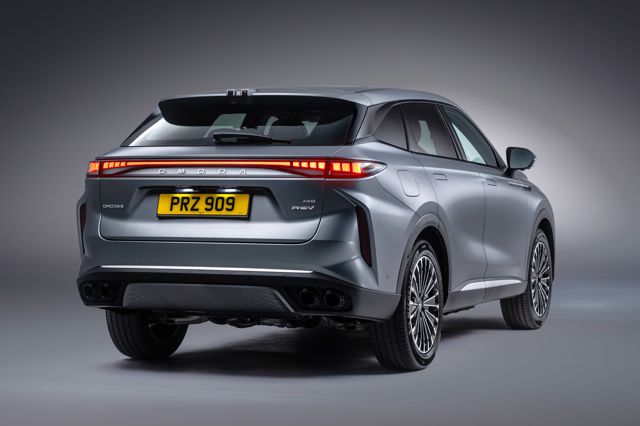
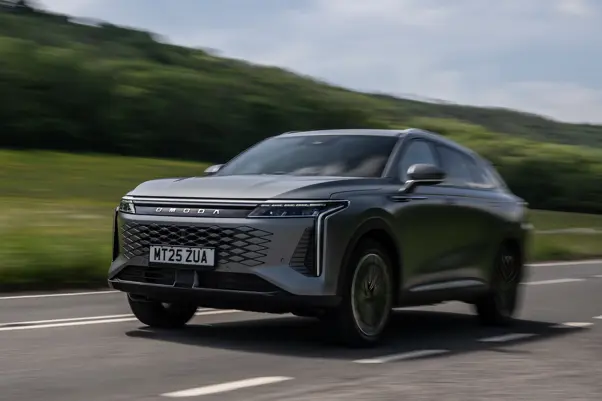
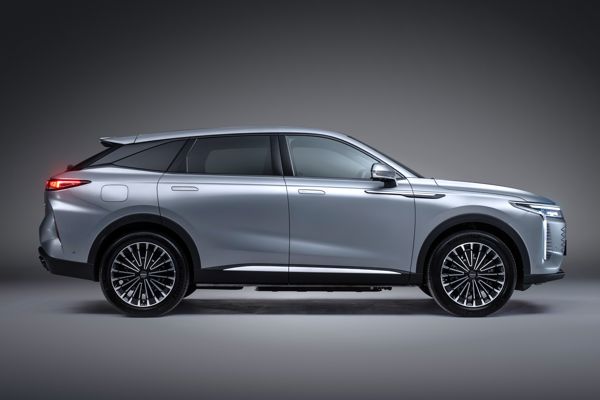
Exterior proportions of the Omoda 9 SHS are said to have been influenced by the Golden Ratio — that’s the one frequently found within nature that humans are predisposed to finding harmonious and beautiful. While that feels over-egged, it’s certainly attractive, with nods to the smaller Omoda 5’s rhombus-patterned front grille, plus a touch of glitz courtesy of the ensemble of 134 LEDs within the daytime-running lights.
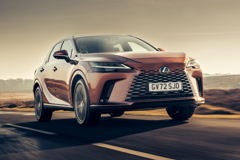
From certain angles there are hints of both the Lexus RX and Range Rover Velar about the 9 SHS — not altogether unsurprising given owners of those cars will be in Omoda’s sights. Of course, they’re both considerably more expensive at £64,795 and £65,445 respectively in PHEV format.
Order books for the Omoda 9 SHS opened at the start of April 2025 with customer deliveries beginning in May.
