
BMW 5 Series Review: Price, mpg and boot space

BMW 5 Series Verdict

 Great to drive, blending comfort and handling superbly. Extremely spacious, high quality interior. Technology is very well integrated into the driving experience.
 Saloons are fundamentally impractical. iDrive infotainment has taken a step backwards for intuitiveness. No diesel choice.
Find out more about the BMW 5 Series
Four-door saloons were once the traditional mainstay for every size of car, from small family runarounds to luxurious transport for diplomats and plutocrats. These days they are few and far between as many manufacturers have dropped them in favour of more popular SUVs, yet some have kept the faith and offer both. Find out how good one of those with the most skin in the game is with our full BMW 5 Series review.
If you wanted to buy a brand new, first-generation BMW 5 Series in March 1973 it would have set you back at least £3499. For reference, the average house price back then was was approximately £7500.
Thing is, with inflation, that 1970s BMW 520 translates to around £58,500 today, which is over £6k more than the current starting price of today's 520i M Sport. Expensive, yes, but better value in real terms, especially when you consider the typical UK property is considerably more than the £122,300 if it had risen in line with inflation.
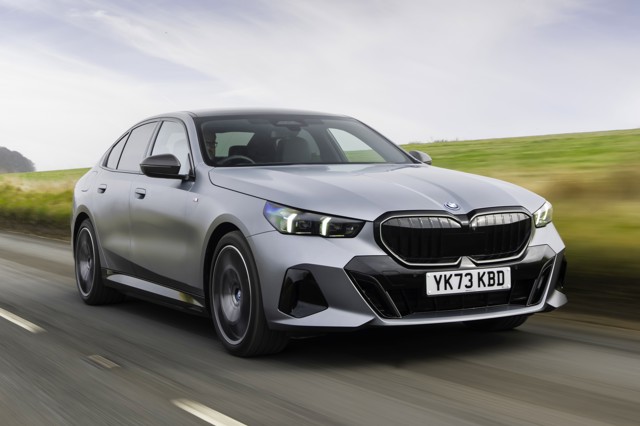
Not only is the Mk8 BMW 5 Series — known by product code fans as the G60 — cheaper in real terms than the original, it’s evolved into one of the very best cars in the world. It’s just brilliant. Even though it’s not flawless — no car is — it’s difficult to pick a better do-it-all car.
It needs to be good, of course, because it competes in a field that includes well-rounded saloons such as the latest Audi A6, the prestigious Mercedes E-Class and the soon-to-be-replaced Lexus ES. But that's about your lot when it comes to four-door cars of this size propelled by combustion engines.
So why are car buyers staying away from saloons and favouring SUVs? It's the format of the bodystyle, with a separate boot lid which hinders practicality. That said, the awesome BMW 5 Series Touring solves that problem courtesy of being an estate, so you don't have to follow the SUV crowd.
The only other issue that the 5 Series really has is its iDrive multimedia system that feels on the complicated side these days. Mainly though, that’s because the BMW is stuffed with so much tech that it's almost fighting a losing battle trying to make it all readily accessible on a touchscreen.
It’s also complicated under its bodywork. A range of power options starts with the 520i petrol, through a brace of plug-in hybrids, the most powerful of which is the supercar-rivalling BMW M5.
There are no diesels now, which is a genuine loss — the 520d version of the previous-generation BMW 5 Series was the line-up's sweet spot. That’s just the market, though — in 2025 you can’t have a diesel 5er or a reasonably priced house.
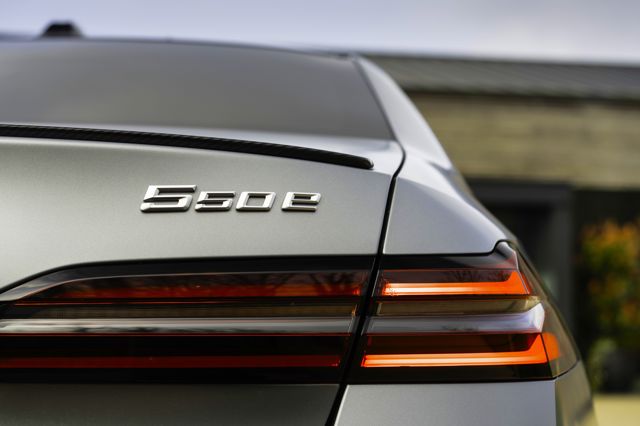
As well as the the fully electric BMW i5, every combustion-engined 5 Series gets battery power of some sort. It's a mild hybrid in the 520i’s case, but while the 530e and 550e PHEVs are both very powerful and efficient, they’re really aimed at company car drivers looking for a tax break.
Every BMW 5 Series is well-specified, just as you would want it to be at this price. As a nod to sales volumes of other models indicating that that everyone wants the M Sport specification, that's the default trim level. It means that nobody has to put up with the apparent shame of having a 5 Series that looks apparently naff with lashings of chrome decor, smaller wheels and a cream-coloured interior. Actually, that does sound good...
Ironic, then, that this is the least sporty 5 Series that BMW's ever made. But that’s a good thing, because there has been a balance shift towards comfort… Luxury, in fact. Today's 5 Series is less of a bigger BMW 3 Series and much more a smaller 7 Series, with outstanding ride quality and refinement, with d a general sense that it’s really a big, posh executive car above all else.
It’s still fun to steer in that way all BMWs tend to be — it turns in sharply and even the four-wheel drive-equipped 550e xDrive feels like it's being pushed from the back, but things are altogether softer now.
For many reasons the BMW 5 Series is one of the most impressive cars money can buy, at any price. If you’re into big saloons and don't need outright practicality, this is one of the best there's ever been.
BMW 5 Series Plug-in Hybrid: Range and charging times
| BMW 530e | 59-64 miles |
| BMW 550e xDrive | 53-57 miles |
Rear-wheel drive is the traditional format for the BMW 530e, although its electric driving range of up to 64 miles is a modern take for a petrol-powered saloon from the marque. As it's more powerful and has xDrive all-wheel drive, the 550e's electric range potential is trimmed back to a maximum of 57 miles.
BMW quotes AC recharging times at a rate of 11kW rather than the UK domestic norm of 7.4kW AC when using a wallbox connection. With the 11kW time being 2hrs 15mins for a flat to full recharge, we estimate that a 7.4kW hook-up will take a further 60-90 minutes to fill the 19.4kWh battery.
Note that there's no provision for DC rapid charging at public charge points.
Reviews for BMW 5 Series's top 3 rivals

.jpg?width=240&height=160&rmode=crop)

BMW 5 Series handling and engines
BMW 5 Series 2026: Handling and ride quality
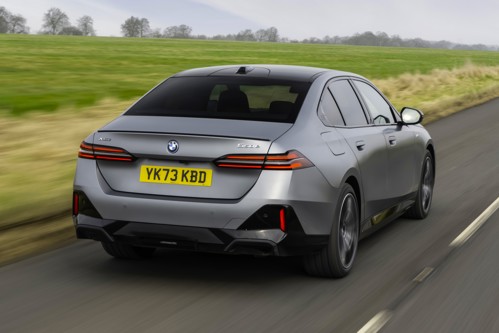
Because the BMW 5 Series leans towards comfort now, it has lost something of its dynamic edge. You won’t immediately sense that it's a sports saloon, regardless of which engine or suspension is equipped.
Its steering feels light, the ride quality is compliant and there’s a general sense that it's a big, quiet four-door rather than a tightly honed, exciting one. None of this is bad, though, because that character is exactly the right one for the majority of driving that most people do — going from A to B, especially so where B is many miles away from A.
What you will find is that the 5 Series is a multi-faceted car, so beneath that veneer of comfort it's still highly engaging to drive.
There are variables, as usual from BMW — and cars of its ilk in general — namely the engine you’re packing, which options you’ve ticked, which suspension is equipped and (if the suspension is adaptive) which driving mode the car’s in.
The standard suspension is on the firmer side, because it’s M Sport specification, though it never gets uncomfortable. Adaptive suspension is a worthwhile option though (despite costing a few grand), because in its softest setting it does a great job of smoothing-out rougher roads while keeping the body stable and well-controlled.
Rear-wheel steer is another option that can affect handling, sharpening the turn-in at low speed and good at making this 5060mm long car feel manoeuvrable. If you’re really bothered about how your 5 Series feels through a tight bend, it’s a box worth ticking.
That length is difficult to work with when it comes to making a car that handles engagingly, especially when said car is supposed to be a comfy executive choice. But BMW has worked a bit of magic here, because drive the 5 Series hard and it reveals itself to be well-balanced and loads of fun.
Switch into Sport mode and the steering is sharp and weighty, while tighter body control means you don’t feel like you’re battling against its huge bulk. The throttle is responsive, regardless of engine choice, and the brakes have a natural progression to them, so there’s a sense of real control.
It’s just brilliant and the best of these types of car when it comes to balancing being a comfy, executive conveyance one moment and sharp, sports saloon the next.
BMW 5 Series 2026: Engines
First thing to be aware of when it comes to the BMW 5 Series' engine choices this time around — there are no diesels. RIP. The last-generation BMW 520d was a stunning car, mainly because it did 60mpg while not feeling or sounding anything like a dirty old caravan puller.
BMW has fully embraced the trend for hybridisation of its petrol engines, offering the 5 Series in mild hybrid 520i or plug-in hybrid 530e and 550e xDrive guises. All are fitted with an eight-speed automatic transmission as standard.
Powered by a turbocharged 2.0-litre engine driving the rear wheels, the 520i boasts outputs of 208PS and 330Nm of torque, sufficient for a 143mph top speed and a 7.5-second 0-62mph time.
Using the same engine while working in conjunction with a powerful electric motor, the 530e ups the ante significantly. Total power is rated at 299PS with torque increased to 450Nm. It's top speed remains unchanged in petrol mode, yet it will touch 87mph when used solely in EV mode. Impressively, the 0-62mph benchmark is shaved down to 6.3 seconds.
It's a case of the same but more with the 550e xDrive, the latter element of its name signifying the standardised all-wheel drive system. It's needed because the electric drive is mated to a six-cylinder, 3.0-litre turbocharged engine for even more grunt.
Here you're looking at 489PS and 700Nm of torque — it's top speed is electronically capped at 155mph (it remains at 87mph in EV mode) with the 0-62mph dart dispatched in just 4.3 seconds.
So, is the 530e the 5 Series range's new sweet spot? Well, as ever with PHEVs, how it performs is hinged on the state of the battery. An electric motor with a full battery working in unison with a petrol engine is a lovely thing. Powerful, efficient and capable of transitioning smoothy between its propulsion types or combining the two.
On the other hand, with the battery drained — which happens far more quickly than you think when you press on — you’re essentially dragging the dead weights of a battery and its motor around, causing power and efficiency both to tank.
Still, as fancy to-work-and-back transport, assuming you charge the battery overnight at home, the PHEVs are smooth, quick and cost-effective. But, we reckon the 520i is the best 5 Series on the market, pound-for-pound.
It’s much cheaper to buy, it’s extremely quiet and smooth and because it’s a less heavy and complicated setup than the PHEVs, it’s nicer to drive for more of the time. Plus its real-world economy should hover around the same 40mpg level the 530e manages when its battery is flat.
BMW 5 Series 2026: Safety
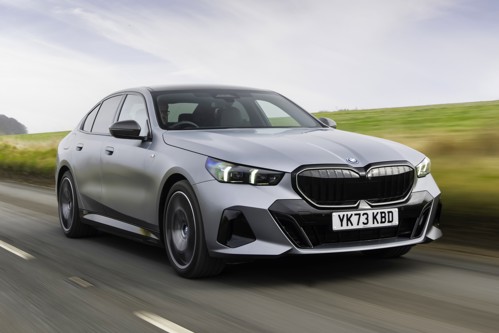
The BMW 5 Series earned a five-star Euro NCAP safety rating in 2023, with excellent individual scores across the board.
It achieved 89% for adult occupant safety, 85% for children, 86% for vulnerable road users and 78% for its safety assistance features. That’s all probably as you would expect — that a big, fancy car like this is nice and safe.
On a more pragmatic level, the 5 Series is an easy car to live with because its safety systems aren’t too intrusive. It doesn’t bong at you constantly for perceived inattention, you don’t have to wrestle with the steering wheel if the car thinks you might be about to drift out of lane and the automatic emergency braking system doesn’t slam the brakes on when you’re parking close to a wall.
You can also easily turn off the feature that automatically slows the car down when it detects you’re approaching a roundabout, curve in the road or an area with a lower speed limit. It’s a nice idea but in practice it just makes you feel like the car has a mind of its own, which is weird.
So, fundamentally it’s a very safe car but sadly, some safety features are optional. Paying extra for more safety always seems… frustrating. Nonetheless, features such as pre-crash steering assistance, which helps you avoid a collision, 360-degree cameras for parking and lane keeping with adaptive cruise control are all optional.
BMW 5 Series 2026: Towing
The removal of a diesel option from the BMW 5 Series might be a concern for those who tow regularly and it is a bit of a loss. The last-generation 520d had a braked trailer towing capacity of 2000kg, a figure only matched by today’s 550e xDrive.
Select the 520i and will tow up to 1800kg of braked trailer load, as does the 530e. Because they’re relatively heavy cars, they’re good for adhering to the 85% rule — the guideline that you should only tow something that’s up to 85% of the car's weight.
So, the 5 Series is a good tow car, as it always was, but it’s taken half a step backwards. Note that all Mercedes E-Classes are rated at 2100kg, regardless of engine choice.
BMW 5 Series interior

BMW 5 Series 2026: Practicality
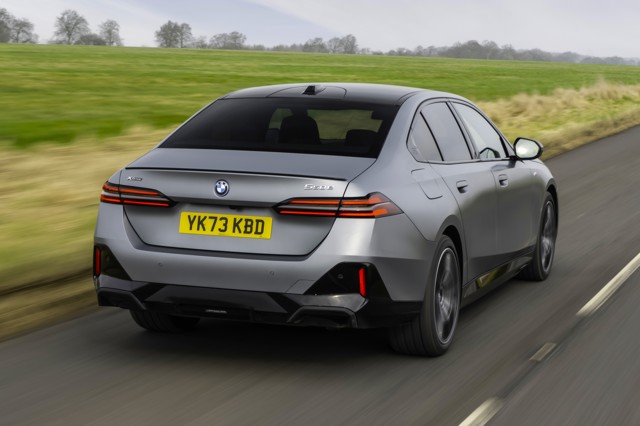
The BMW 5 Series' saloon format is fundamentally flawed because the boot opening is letterbox-like, despite the flat-floored roominess within. Similarly, access for larger items is hampered by the relatively small opening once you have folded the rear seats over. Solving these problems is the 5 Series Touring...
Still, sticking with the saloon its boot volume is substantial at 520 litres, regardless of whether you choose a plug-in hybrid version or not.
That compares favourably with the boot volumes of the Audi A6 (492 litres dropping to 354 litres for the e-hybrid PHEVs) and the Mercedes E-Class (540 litres for non-PHEVs, 370 litres for those you plug in).
It’s a weird shape though, mainly because at either side the side carpeting covers parts of the rear suspension and the boot hinges are massive. The rear seats split in a 40/20/40 configuration as standard, meaning you can at least take your 5 Series to B&Q and buy curtain poles.
Passenger space is excellent. Front and rear, the BMW 5 Series feels extremely airy and comfy — especially with lighter interior colours. There’s plenty of rear legroom and even the middle rear seat is just about suitable for an adult. As per the boot space, outright cabin space is similar to what you will find in its main competitors, though the 5 Series does feel a little more genrous than both.
There are the usual small item storage spaces you would expect — a decent-sized glovebox, a central cubby between the front seats and a smartphone wireless charging pad. The door pockets are moulded specifically for big bottles, which is a nice touch if you’ll be doing a lot of motorway driving. Gotta stay hydrated.
BMW 5 Series 2026: Quality and finish
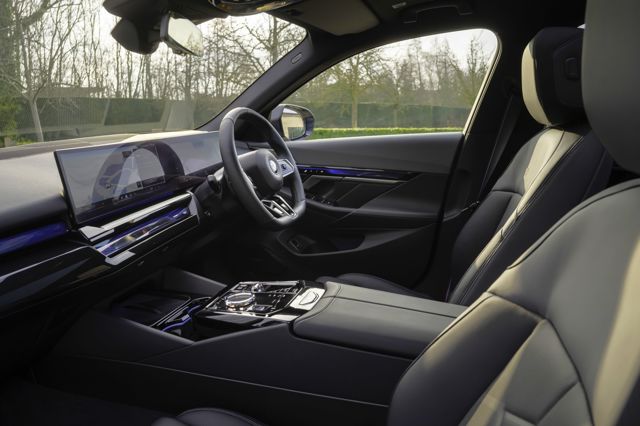
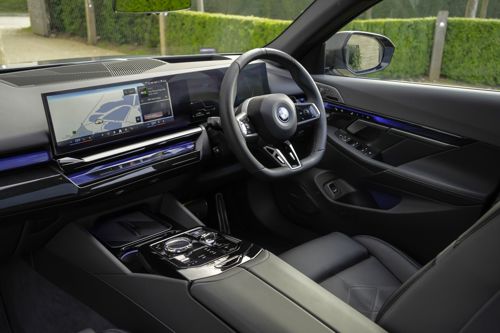
Outstanding. The BMW 5 Series has a cabin that looks and feels spectacular. It doesn’t pass the “is everything in here made from squidgy plastic?" test but you’ll only care about that for the exact length of time you spend squeezing your door bins.
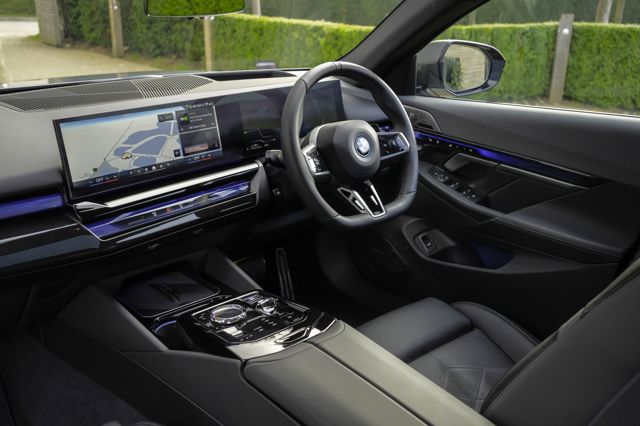
The interior is based on the ‘lounge on wheels’ concept that debuted with the BMW iX, dominated by a curved twin-screen display. But not dominated in the same way that, say, a Tesla is dominated by its screen. It feels like it was actually, you know, designed.
The dash is finished with padded leather with incorporated lighting strips designed to appear crystal-like. Not only does this look great, with loads of colours to choose from, but they're integrated into various safety and comfort features.
Lights on the doors double as blind-spot warning indicators, with the dashboard's strips glow red or blue when you adjust the interior temperature. Useful theatre.
Where the Audi A6 feels too straight-laced and the MercedesE-Class is too reliant on screens, the 5 Series has a lovely mix of old-school luxury and modernity.
BMW 5 Series 2026: Infotainment
Infotainment has long been a huge part of the BMW 5 Series' appeal, because its iDrive system was one of the most intuitive systems available.
It’s fair to say that iDrive's user-friendliness has taken half a step backwards, but that’s only because it’s dealing with so many functions now. That said, those moving from a last-generation 5 Series, with its obvious row of customisable shortcut buttons and physical temperature controls, will at first find this setup baffling. Ditto the steering wheel controls. It takes some learning but most of it quickly becomes second nature.
As you would expect, wireless smartphone mirroring is standard, which means you’ll bypass much of BMW’s proprietary software most of the time. You lose aesthetic slickness but gain with familiarity.
There are myriad ways to control the functions of the car. Well, three — the iDrive scroll wheel, the touchscreen itself or voice commands. All work well. It’s a more responsive screen than the Audi’s and the scroller is more intuitive than most, especially the Mercedes trackpad setup, for those coming out of an older model.
Of the more baffling features of the 5 Series are its driving modes, which go way beyond the typical Eco, Comfort and Sport options, diverting into some bizarre territory. Designed with film score composer Hans Zimmer, modes including Relax and Expressive fill the car with soundscapes linked to acceleration and road speed.
If accelerating away from a roundabout accompanied by a soundtrack akin to a cinematic UFO attack is for you, be sure to select Relax. How, erm, relaxing.
BMW 5 Series value for money
BMW 5 Series 2026: Prices
A starting price of £52,285 isn’t unreasonable for a car that feels as good as the BMW 5 Series, particularly considering its high level of standard equipment. You can spend more than that on a range-topping Hyundai Ioniq 6 — not a like-for-like car, but you understand the point.
Nor is the premium of around £3,000 (give or take, depending on the model) for the much more flexible 5 Series Touring body.
Prices jump for the plug-in hybrid versions, with the BMW 530e starting at £59,655 and the punchier 550e xDrive weighing in in £76,825.
M Sport trim is the baseline, so you won’t be forced to upgrade from SE for the specification most Brits find desirable. There's a level above it, though, called M Sport Pro for a further £3000 which adds, among other things, the illuminated front grille for maximum “OUT OF MY WAY!” vibes.
It won't surprise you to learn that these prices aren't far removed from its key rivals'. The Audi A6 starts at £52,785 or £62,485 as a PHEV, while the Mercedes E-Class is a bit richer — £56,650 for the least costly mild hybrid and upwards of £65,720 for the PHEVs. They watch each other, it seems. Shocker.
BMW 5 Series 2026: Reliability and running costs
For the BMW 5 Series in 520i guise, the highest official WLTP fuel economy rating is 48.8mpg — a figure that’s almost achievable in the real-world.
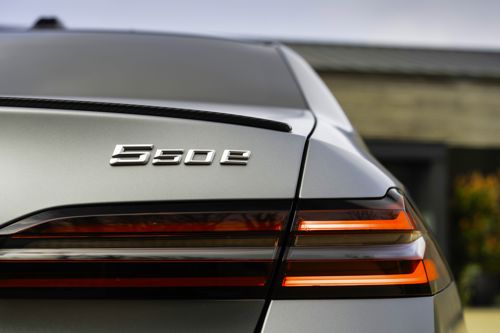
The same can't be said of the PHEV choices unless you always keep the battery topped up and rarely drive far enough to require the engine switch itself on. Even the tweaked measurements used for official figures since January 2025 remain high with the 530e returning a best of 134.5mpg and the 550e xDrive supposedly yielding 100.9mpg. Expect the 530e to have similar real-world fuel consumption to the 520i in the low-40mpgs.
Those artificially high fuel consumption figures do result in lower CO2 emissions, which in turn helps make the PHEVs more attractive to company car drivers thanks to lower rates of Benefit-in-Kind (BiK) taxation. How low? The 520i can fall into as high as the 34% band, while the 550e is rated at 18% and the 530e just 9%. Then again, the all-electric BMW i5 is taxed at 3% BiK, making it something of a no-brainer for many.
The savings for a company car user choosing a PHEV are significant. For a 40% taxpayer, the difference between driving around a 520i versus a 530e (M Sport spec) is huge — you’ll pay around £18,000 more in BiK for the 520i across three years. Fun fact: because the BMW M5 is also a PHEV, it will cost you about half what a 520i will in company car tax.
Because of current VED car rules, there’s only a tenner’s difference in what you’ll pay over five years for all three engine choices — the first year rate is £10 lower for the PHEVs, beyond which they cost the same. All 5 Series choices cost in excess of the £40,000 threshold for the Expensive Car Supplement, which currently costs £425 annually from years two to six of ownership.
Residual values are strong for the BMW 5 Series, which means if you’re planning to lease one you’ll get a decent monthly rate. You can keep your costs manageable by adding a maintenance package — servicing a 5 Series is pricey, especially the PHEVs thanks to their complex petrol-electric drive systems. Paying BMW £1200 to cover all your servicing for up to five years or 62,000 miles is something we recommend you do.
Satisfaction Index
 What is your car like to live with?
We need your help with our latest Satisfaction Index, so that we can help others make a smarter car buying decision. What's it like to live with your car? Love it? Loath it? We want to know. Let us know about your car - it will only take a few minutes and you could be helping thousands of others.
Help us with the Honest John Satisfaction Index nowBMW 5 Series models and specs
There are two trim level choices for the BMW 5 Series range — M Sport and M Sport Pro.
Standard features for the BMW 5 Series M Sport include:
- 19-inch M Sport bi-colour alloy wheels
- M Sport suspension
- M Sport brakes with blue calipers
- Automatic LED head and tail lights
- Front and rear parking sensors
- Reversing camera
- Front Sports seats
- M Sport leather-wrapped steering wheel
- BMW Live Cockpit Plus with Curved Display
- iDrive Multimedia system
- Integrated navigation system
- Backlit BMW Interaction Bar
- Wireless smartphone charging tray
- Automatic air conditioning with 2-zone control
- Through-loading system with 40/20/40-split rear seat backrest
- BMW My Modes — driving modes
- Cruise Control with brake function
Additional features for the BMW 5 Series M Sport Pro include:
- 20-inch M Sport black alloy wheels
- Uprated M Sport brakes
- High-gloss Shadowline dechromed exterior details
- BMW Iconic Glow exterior package, including grille
- M bootlid spoiler
- M Sport seat belts
- Anthracite interior headlining
- Blinds for rear windows
Model History
September 2023
BMW 5 Series now available with plug-in hybrid drive
The new BMW 5 Series can now be had with a choice of two plug-in hybrid models thanks to the arrival of the BMW 530e and BMW 550e xDrive saloons.
Both models feature the latest BMW eDrive technology for plug-in hybrid systems, which is combined in the BMW 530e Sedan with a four-cylinder petrol engine and in the BMW 550e xDrive Sedan with an in-line six-cylinder petrol engine from the BMW Group's latest Efficient Dynamics modular generation.
The electric motor is integrated into the eight-speed Steptronic Sport transmission, and helps contribute up to 184PS in the BMW 530e and up to 197PS in the BMW 550e. That gives total system outputs of 299PS and 489PS respectively.
The electric range is now up to 62 miles for the BMW 530e and up to 56 miles for the BMW 550e xDrive. The high-voltage battery has been upgraded, too, and can be charged from zero to 100 percent of its capacity within 3 hours and 15 minutes. At a conventional household socket, the charging process is completed within 11 hour and 45 minutes.
