
Mercedes-Benz G-Class EQ Technology Review 2026

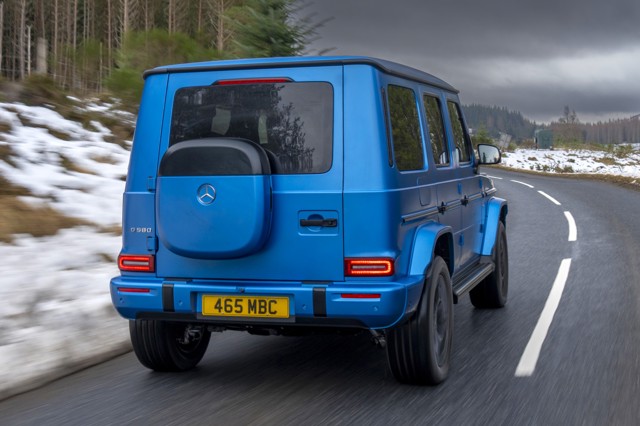

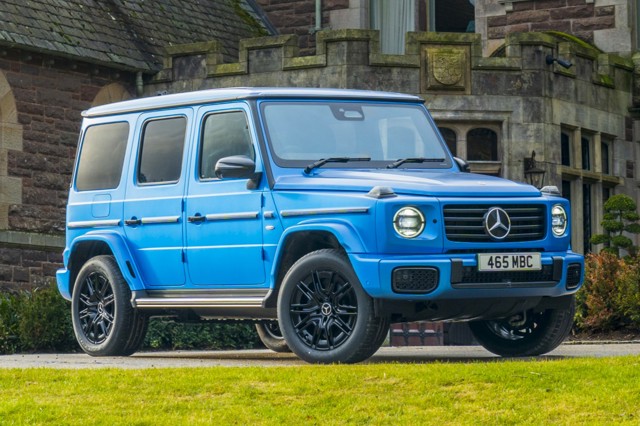
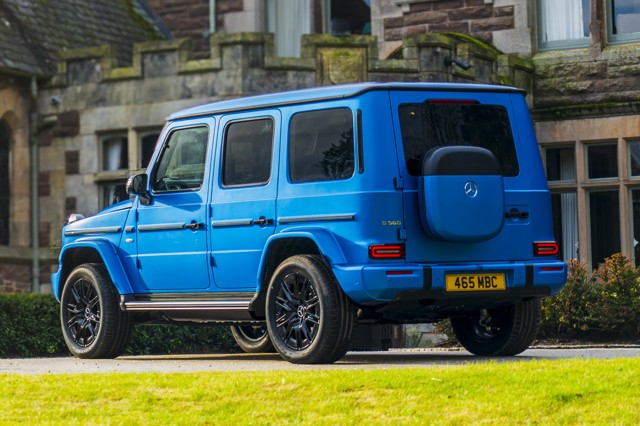

Mercedes-Benz G-Class EQ Technology At A Glance

 Most agile and capable G-Class off-road. Prodigious performance levels. Feel smug about how comparatively inexpensive it is to run.
 Colossally expensive even before you plunder the options list. Real-world driving range isn't that impressive. Its heft means it can't be used for towing.
Despite being one of the most capable SUVs off-road, you’re most likely to spot a Mercedes G-Class in Britain parked-up in exclusive London postcode areas. Most are gussied-up, power-rich, emissions-high AMG models, only venturing away from asphalt should kerbs be mounted when performing U-turns. But that could change with the advent of the fully electric version — find out why with our full Mercedes G-Class with EQ Technology review.
That an electric Mercedes G-Class now exists isn’t a surprise, although how long it’s taken to go on sale is. It was confirmed as being in the pipeline back when the V8-engined versions of this generation of its flagship SUV went on sale in 2018, previewing what was to come with 2021’s Mercedes EQG concept.
If you’re minded that EQG sounds far less of a mouthful than Mercedes G580 with EQ Technology we’re inclined to agree with you, but there’s been a change of heart about how its electric models will be badged in future. Expect the replacement for the Mercedes EQS to be the S-Class with EQ Technology and so on...
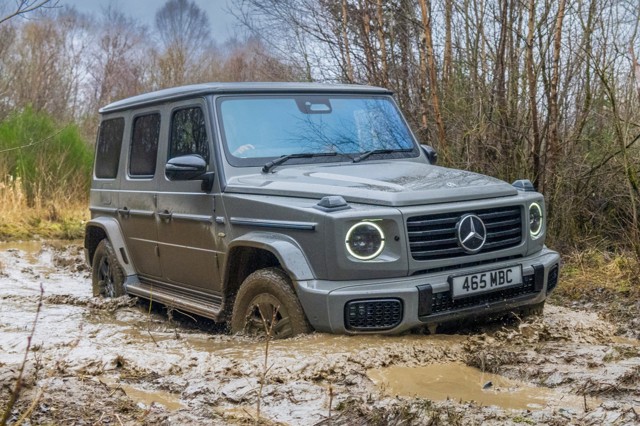
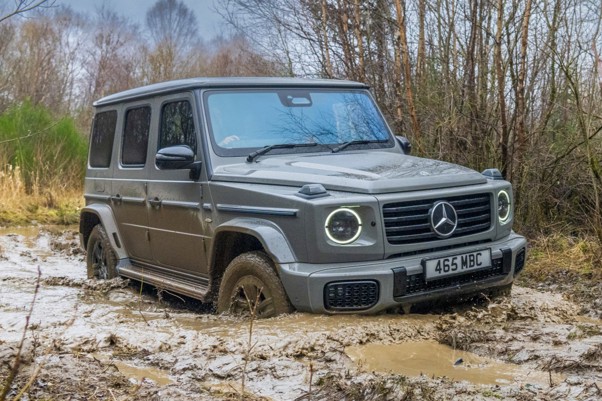
Visually the electric Mercedes G-Class looks as stout and purposeful as its petrol- and diesel-powered siblings, yet battery power has given it some additional tricks to amplify its off-road credentials. Don’t forget that the ‘G’ of G-Class is short for Geländewagen — that’s German for ‘cross-country car’ — and this is the most capable electric off-roader currently on sale.
For how long it can claim that honour depends upon how swiftly its rivals get their acts together. Land Rover has already delayed the introduction of its electric Range Rover, originally due in summer 2025 and while the all-new Porsche Cayenne Electric is now available to order, its colossal grunt is very much focused on road performance, not prowess off-road.
Arguably the most intriguing alternative hails from one of BYD's forthcoming sub-brands in the guise of the Yangwang U8. Whether it will be so labelled when sales commence in 2027 remains to be seen, promising much of the Mercedes’ agility at a lower — but still telephone number-aping — price point.
So, what off-roading tricks does the electric Mercedes G-Class have tucked up its substantial wheelarches?
Designed purely for use on unpaved or loose surfaces such as gravel is G Steering, which allows the electric G-Class to perform almost 90-degree turns by pivoting around the ‘inside’ rear wheel. Turn the steering wheel and the rear wheel on the side of your chosen direction has its brake lock it while the other wheels receive the required power to change the Mercedes’ course.
This is further exaggerated with G Turn — select this function and the G580 EQ Technology performs up to two full spins almost on the spot. Here the wheels on one side of the car drive forwards while those on the opposite side go into reverse. Clever stuff.
Enabling the electric Mercedes G-Class to accomplish those feats are its four electric motors, each positioned close to wheel. Working in unison they produce an almighty 1164Nm of torque. While its top speed is sensibly governed to 112mph to preserve battery life, the G580 EQ will dart from 0-62mph in under five seconds — only just shy of the rorty Mercedes-AMG G63’s time.
Now that the £180,860 introductory Mercedes G580 with EQ Technology Edition One has sold out, the only available specification grade is AMG Line Premium Plus at a smidge under £155,000 appears to be far more reasonable — within this rarefied end of the market, at least.
Mercedes G-Class with EQ Technology: Range and charging
| Mercedes G580 with EQ Technology | 280-283 miles |
Depending on the final specification, including optional extras, the Mercedes G580 with EQ Technology has an official WLTP Combined cycle driving range of 280 to 283 miles. In the real-world, encompassing a mixture of road types and speed limits, you’ll be doing very well if you manage 250 miles from a full charge.
Consider that its enormous high-voltage battery has a 116kWh capacity and the driving range potential doesn’t sound all that impressive, until you remember the electric G-Class weighs 3.25 tonnes with aerodynamic qualities akin to Buckingham Palace.
Using an 11kW AC connection a total recharge requires 12 hours of plug-in time — using a more UK-typical 7.4kW AC domestic wallbox, that 0-100% replenishment will take approximately 18 hours.
Thanks to its 200kW DC on-board charger those occasions when using public facilities aren’t too time-absorbing. Connected to such an ultra-rapid charger a 10-80% top-up could take as little as 32 minutes.
Reviews for Mercedes-Benz G-Class EQ Technology's top 3 rivals
.jpg?width=240&height=160&rmode=crop)



Mercedes-Benz G-Class EQ Technology handling and engines
Mercedes-Benz G-Class EQ Technology 2026: Handling and ride quality
Cars such as the Mercedes G-Class with EQ Technology - purpose-designed to be extraordinarily capable off-road - are often compromised when it comes to how they behave on-road, despite them spending far more time being driven on the latter.
Although it’s not available in fully electric guise, the Land Rover Defender 110 is close in size to the G580 EQ, similarly wieldy away from asphalted surfaces but more composed on them.
Core to this tangible difference is their construction philosophies. While the Defender is built like most conventional cars have been for decades, with a structure that forms its entire inner shell to which components are fitted, the G-Class has a separate chassis.
Essentially this means the Mercedes has a ladder-like base to which its battery pack, electric motors, suspension and wheels are fitted, with the bodywork’s shell effectively sat on top. It’s a much more traditional way of building a car but it theoretically means it's more capable off-road.
And the electric Mercedes G-Class very much is, even discounting its G Steering and G Turn party tricks. Short overhangs — those are the distances from the centre of the wheel to the outer-most edge of the bumpers — combined with 241mm of ground clearance ensure that it can tackle extreme terrain angles and wade through 700mm-deep fords.
Two off-road-specific driving modes — Trail and Rock — meter-out the electric drive most effectively based on surface type and which wheels have the most traction, while Off-road Crawling comprises a trio of low-speed cruise control settings when driving off-piste.
While the electric G-Class lacks a sophisticated air suspension system, those deeper off-road ruts and rocks are tackled effortlessly, with driver and passengers remaining comfortable as the scenery is traversed. Yet on conventional roads, the separate chassis arrangement works against the Mercedes.
Particularly at lower, urban-like speeds, the G580 EQ’s ride quality tends to feel disappointing unsophisticated, with every pothole, raised ironwork and speed bump transmitted loud and clear to its occupants’ posteriors, often with a subtle — but noticeable — shimmy as its body and the frame beneath settle together again.
Although Mercedes switched the G-Class’s steering mechanism to the kind typically found in most modern cars of the past half-century, allowing you to trace the arc of corners with a greater degree of accuracy, there’s not a huge amount of feel through the wheel itself. That prevents jolts when off-road, but on it amplifies a sense of being disconnected from the ground beneath.
Tackle sweeping bends at pace and you will experience a degree of body lean that has long been dialled out of most other SUVs, generating a sense of the electric G-Class feeling like a new old car.
That isolation pays dividends on longer dual-carriageway and motorway schleps, as the ride is much more settled and cushioning, while curves in the road tend to be much gentler, allowing the G-Class to remain perpendicular for longer. Only the thwack as its broad tyres cross expansion joints tends to disturb the equilibrium.
As its battery pack is mounted very low down in the electric G-Class’s overall structure, it feels generally stable and planted at higher speeds. Strong side winds whipping up its vertical sides are felt more keenly than in most other SUVs, but not so much as to feel on the cusp of it changing the Mercedes’ course.
While there’s no one-pedal drive setting for the G-Class EQ, there are five brake energy recuperation settings to choose between. Dauto enables the Mercedes to figure out which is the most appropriate given a gamut of parameters, so will vary depending on speed, steering angle and so forth.
There’s greater consistency with D+, D, D- and D--, the latter having the lowest level of energy harvesting. Brake pedal modulation feels entirely conventional and progressive, especially in the weakest energy recuperation mode, although you’re never not aware of how much mass you’re slowing down when you call upon them.
Overall, the G580 EQ’s driving experience is a charming confection with definite appeal, but it’s unlikely to be one that will appeal to the majority of upmarket SUV customers the majority of the time. Purely for on-road driving, we would rate it as a 3 out of 5.
Mercedes-Benz G-Class EQ Technology 2026: Engines
There’s just the one fully electric drive system available for the Mercedes G-Class with EQ Technology, but its vital statistics confirm a wider assortment to choose between would be superfluous to requirements.
Many years have passed since the numerals in Mercedes model designations directly related to the capacity of the combustion engines which propelled them. Instead, they’re more an indication of power and performance, so it’s useful to understand where the electric G-Class fits into the sequence.
Entry-point to the current range is the diesel-fuelled G450d, followed by the petrol-powered G500 with this electric G580 EQ sat above that. The overall G-Class line-up is topped by the Mercedes-AMG G63.
In fact, thanks to its four electric motors, each sending drive to an individual wheel, the G580 EQ has the highest output figures of any G-Class available, producing 587PS and 1164Nm of torque — astonishing numbers.
Then again, it doesn’t exactly cleave the air as it goes about its business, rather it punches its way through it, and up to 3258kg of heft needs plenty of oomph to get it along the road in the first place.
And get it along it certainly does — that it’s 0-62mph time is just 4.7 seconds, only three-tenths adrift of the AMG G63’s, beggars belief considering the Mercedes’ physics. It’s top speed is electronically pegged at 112mph to prevent unnecessary battery draining.
Similar to its brakes, the G580 EQ’s throttle is easy to modulate, providing smooth, unruffled power delivery regardless of whether you’re slowly trudging in stop-start town traffic or careering up to motorway speeds along a slip road.
Responsiveness levels can be varied with its three on-road driving modes of Comfort, Sport and Individual, the latter allowing a degree of customisation between a range of dynamic parameters. Comfort seems to suit its character best and hardly leaves you wanting in terms of its urgency.
Of course, all of this go is served-up relatively quietly, save for the background whirr of the electric motors doing their thing at a pitch that rises in close correlation with road speed. After all, serene pace is one of the attractions of driving an EV.
Then again, G-Class owners haven’t historically been EV buyers, with the allure of the AMG version’s twin-turbo V8 soundtrack being part of its appeal. For those customers Mercedes has equipped the G580 EQ with G Roar. Turn it on and the speakers pipe out a sound experience reminiscent of a large capacity engine. Yep, turn it off again. Permanently.
Mercedes-Benz G-Class EQ Technology 2026: Safety
Somewhat surprisingly for an expensive, niche car, the Mercedes G-Class with EQ Technology actually has a Euro NCAP safety rating. Not only that, it scored the maximum five stars.
That it was a combustion-engined version that was subjected to crash tests in 2019 is unimportant as the SUV’s structure hasn’t changed in the switch to electric power, hence the score’s transferability.
Adult occupant protection was rated at 90%, the child equivalent at 83%, vulnerable road user protection was rated at 78% and 72% for its electronic driver aids.
Standard safety-related kit for the electric G-Class includes Attention Assist to monitor the driver’s alertness, Active Brake Assist with cyclist and pedestrian detection, Active Lane Keeping Assist, Active Steering Assist, Blind Spot Assist and a dashcam.
Mercedes-Benz G-Class EQ Technology 2026: Towing
Towing with the Mercedes G-Class with EQ Technology isn’t possible as it’s not been homologated for hauling, primarily because of its own weight.
This seems like a significant chink in the electric G-Class’s armour, particularly when all other petrol- and diesel-fuelled versions can tow braked trailers up to the maximum legal capacity of 3500kg.
Mercedes-Benz G-Class EQ Technology interior
Mercedes-Benz G-Class EQ Technology 2026: Practicality
Due to the Mercedes G-Class with EQ Technology’s upright styling, 1969mm height and 2187mm width, it appears to be a far larger SUV than it really is.
In fact, the electric G-Class’s overall 4863mm length is only 140mm greater than the battery-powered Mercedes CLA, inclusive of the cubby attached to its near-vertical rear door. Without it, the body is 4574mm long — just 34mm more than the humbler Kia Sportage.
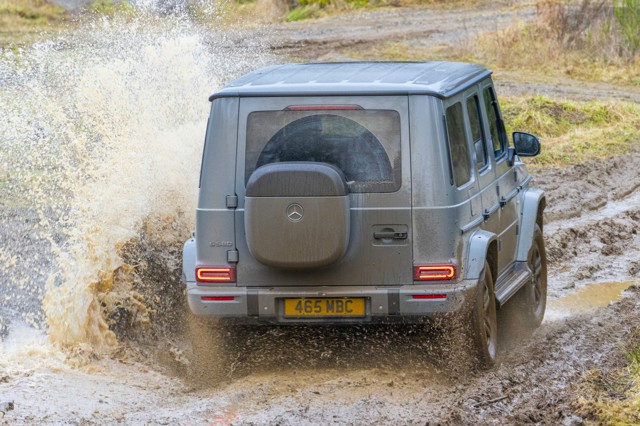
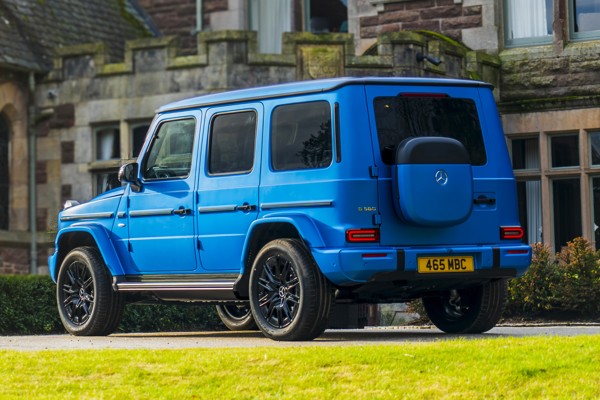
No, that's not a typo — while combustion-engined G-Classes have a covered spare wheel on their tails, the G580 EQ has a lockable cupboard instead. It saves some weight and keeps the charging cables neatly away from the cargo carried in its boot — also handy as there’s no under-bonnet frunk. Should you rather have a spare wheel and bung the cables in the boot, you can opt to do so at zero cost.
Starting with its luggage-handling credentials, the electric G-Class’s side-hinged rear door is only engineered for left-hand drive markets, so it swings out towards the kerb rather than away from it. Less of an issue on a driveway, perhaps, but either way around it makes boot access awkward if you’ve reverse-parked in a multi-storey. Assuming it’s not height-restricted, of course.
Once opened, the space is well-finished and cleanly shaped with vertical sides, albeit narrow with a low luggage cover height relative to the upper edge of the rear seatbacks, which is symptomatic of the side window sill level.
Interestingly, it’s to the seat height that the G580 EQ’s boot capacity is measured, Mercedes quoting 620 litres. That’s 20 litres shy of the combustion-engined G-Classes due to the high-voltage battery nibbling into the available space.
That’s lower than the 781 litres quoted for the Porsche Cayenne Electric and way off the Yangwang U8’s 1031-litre capacity, although we suspect both of those are measured to roof height not seat height level.
There’s no three-way split in the electric G-Class’s rear seatbacks, instead the division is 60/40, although there is a ski hatch through the larger portion from behind the rear armrest. When folded, the seats lie almost horizontally, although there’s a chunky step up from the boot floor level to the plane they’re on.
In two-seater guise, the perpendicular sides of the G580 EQ give it a van-like 1990-litre maximum volume. That trounces the Porsche Cayenne Electric’s 1588-litre capacity although the Yangwang still just edges ahead at 2050 litres.
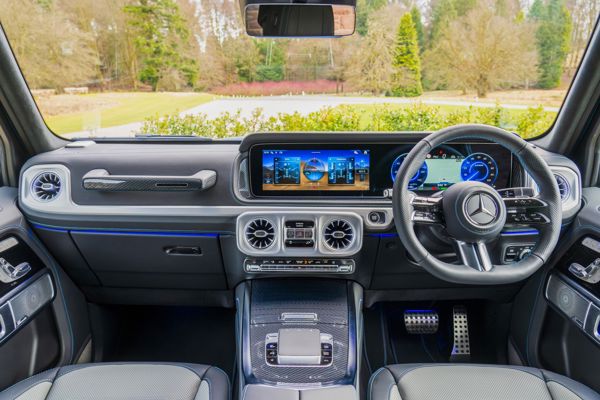
A degree of agility is required to climb aboard the electric Mercedes G-Class, not least because its floor is high relative to the ground and the door apertures are surprisingly narrow, although side steps and a chunky dash-mounted grab handle aids matters on the front passenger side.
All five of the G-Class EQ’s exterior doors continue with its traditional push-button handle design, albeit now with keyless functionality, so you can unlock and re-lock by touch rather than fumbling for your key.
Up front, the electrically adjustable seats are very comfy, with lots of adjustment, so establishing a decent driving position will be straightforward for most. You’re rewarded with an exceptionally commanding view, with the wing-top front indicators helping you to position the G-Class’s nose.
Comfy as you are, it does feel cosy inside, with not an enormous amount of space available to stretch out, especially if the rear bench is occupied.
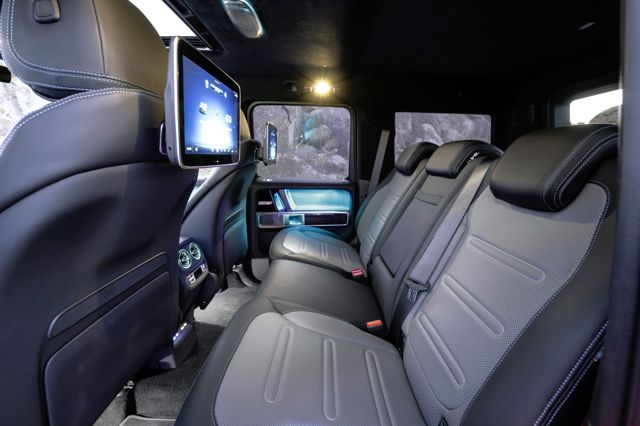
It has width for three, but again feels snug when so occupied. While the centrally positioned passenger is likely to be uncomplaining of seat-breadth or headroom, leg and foot room is tighter, worsened by the elevated lump of the middle of the floor.
It's far more accommodating as a four-seater, with plenty of space beneath the front seats to slot your feet.
In-car storage for odds and ends is fine, with ample door pocket depth, a sensibly proportioned glovebox and a lidded cubby beneath the front centre armrest. As the drive selector is mounted on the steering column, the twin front cupholders and wireless smartphone charging pad are located where the gear lever might otherwise be on the centre console, hidden behind a sliding vanity panel.
Generally, we’re in favour of EV charging ports being located towards the rear, enabling easier use of tethered cables when reversing into public charging bays. The G-Class electric’s is housed behind a flap on the driver’s side rear wing, where combustion-engined versions have their fuel fillers.
Mercedes-Benz G-Class EQ Technology 2026: Quality and finish
General fit and finish of the Mercedes G-Class with EQ Technology is impressive, with almost everything you can touch feeling substantial and able to handle whatever life throws at it. Traditionalists will be thrilled to know the doors latch shut with the same mechanical clink they always have.
Materials use for its interior finish are broadly of a high standard, although the brushed aluminium-look decor panels and switches feel disappointingly plasticky and aren’t cold to the touch.
Having plenty of physical buttons, switches and controls is positive considering Mercedes move away from those in its newer ranges, including the rockers for adjusting the climate temperature, although the display showing the number of degrees appears on the screen above.
Unfortunately, the awkwardly angled and inconsistent-to-operate haptic panels on the steering wheel spokes have migrated to the G-Class. They simply aren’t as effective as individual physical buttons, plus the loss of Mercedes’ old steering column-mounted wand to operate the cruise control remains a retrograde step in car ergonomics in our opinion.
Mercedes-Benz G-Class EQ Technology 2026: Infotainment
Two 12.3-inch screens sit side-by-side behind a single pane to form the Mercedes G-Class with EQ Technology’s digital displays. Sharing a cowl and landscape-oriented, they manage to not look overly glitzy set into the G580’s low-level dashboard.
Closer to the centre of the car is the multimedia touchscreen, which proved slick and immediate in its responses, without needing repeated finger dabs to do as intended. Mercedes’ MBUX operating system has intuitive menus, despite the complexity of the systems it can access.
You may prefer to use Android Auto or Apple CarPlay for even greater familiarity, which you can do so wirelessly.
As standard is an excellent Burmester 3D surround sound system with the only upgrade available being the Rear Seat Entertainment package at £3495. The most obvious features that introduces are two front seatback-mounted 10.0-inch touchscreens.
There’s a broad range of configurability to the screen immediately ahead of the driver, with clear analogue-style instrumentation being the default layout, with other views including a minimalist look and one geared for off-road driving, including details of body angle, both front to rear-and-side-to-side.
Mercedes-Benz G-Class EQ Technology value for money

Mercedes-Benz G-Class EQ Technology 2026: Prices
Let’s not pretend otherwise, at £154,870, the Mercedes G580 with EQ Technology AMG Line Premium Plus — trips off the tongue, doesn’t it? — is an expensive car to buy. It’s also £4k more than the petrol G500 and close to £14,000 more than the diesel G450d. That’s only part of the story as we explain below.
What about its rivals? Well, that’s trickier to quantify given neither the Range Rover Electric nor the Yangwang U8 are yet on sale, but our expectations are that the former will be similarly priced and the latter appreciably less money.
Already available to order is the Porsche Cayenne Electric, which is about as close an alternative to the electric G-Class that currently exists, although its much more of an on-road SUV than a mountain goat away from it.
Note that for £130,900 you’re getting the flagship Porsche Cayenne Turbo version, so called despite lacking an engine to be turbocharged, producing a colossal 1156PS and 1500Nm of torque, comfortably giving it bragging rights over the Mercedes.
Mercedes-Benz G-Class EQ Technology 2026: Running Costs
Here’s where the Mercedes G-Class with EQ Technology claws back advantage over its petrol- and diesel-powered siblings, because it’s much less expensive to run, especially if you switch to a domestic energy tariff that’s EV-friendly.
Doing so could see you paying as little as 7p/kWh which could see a complete charge costing under £9. Okay, its real-world range is about 250 miles, so not great for long-distance cruising, but nine quid’s-worth of diesel isn’t going to allow the G450d to cover anywhere near as much ground.
Public rapid charging is pricey and something we recommend using as infrequently as possible, which could be trickier given the G580 EQ’s driving range. Starting a long journey with a full battery will minimise the cost of public top-ups, so you’ll still be winning overall.
Electric cars lost their VED car tax exemption in April 2025, their owners having to pay £195 annually from the first anniversary of the car being registered. They are also subject to the Expensive Car Supplement when they cost £50,000 or over (from April 2026), which the Mercedes clearly does. That’s an extra £425 per year from years two to six of ownership.
More positively, EVs remain in enticingly low Benefit-in-Kind (BiK) tax bands making them especially attractive for company car drivers. Should a Mercedes G-Class be on the list of models you can choose from — unlikely unless it’s you who owns the company — the G580 EQ is taxed at 3%, while all other versions are in the highest 37% band.
Satisfaction Index
 What is your car like to live with?
We need your help with our latest Satisfaction Index, so that we can help others make a smarter car buying decision. What's it like to live with your car? Love it? Loath it? We want to know. Let us know about your car - it will only take a few minutes and you could be helping thousands of others.
Help us with the Honest John Satisfaction Index nowMercedes-Benz G-Class EQ Technology models and specs
There is one specification grade available for the Mercedes G-Class with EQ Technology — called AMG Line Premium Plus, it closely mirrors the same levels of equipment for its combustion-engined counterparts.
Standard equipment for the Mercedes G580 with EQ Technology AMG Line Premium Plus includes:
- 20-inch AMG 10-spoke, high-gloss black-finished alloy wheels
- Automatic matrix LED headlights with automatic adaptive main beam
- Stainless steel bumper inserts
- Aluminium front grille
- Heated, auto-dimming, electrically adjustable and folding door mirrors, incorporating side indicators and downlighting
- Keyless locking/unlocking and starting/stopping
- Automatic wipers
- Electrically heated windscreen
- Dark-tinted rear privacy glass
- Electrically operated sunroof
- Front and rear parking sensors
- 360-degree parking camera system
- 12.3-inch driver’s display screen
- 12.3-inch multimedia touchscreen
- Wireless Android Auto and Apple CarPlay smartphone connectivity
- DAB radio
- Burmester 3D surround sound system
- Wireless smartphone charging pad
- Electrically adjustable and heated front seats with memory function
- Electrically adjustable and heated rear seats
- Black Nappa leather seat upholstery
- Leather wrapped, electrically adjustable and heated steering wheel
- Leather-covered dashboard
- Manufaktur black-flamed, open-pore ash wood interior trim
- Stainless steel door treadplates
- Thermotronic three-zone climate control
- 64-colour interior LED ambient lighting
- Auto-dimming interior rear-view mirror
- G Roar
- G Steering
- G Turn
- Off-road Crawling
- Electric Drive Select with five driving modes
- Five brake energy recuperation levels
