
eVED pay-per-mile tax: Everything you need to know ahead of 2028
Plug-in hybrid and electric car owners are set to pay an additional mileage-based tax, known as eVED. Our detailed guide explains how it affects you.
Content guide
- What is eVED pay-per-mile tax?
- How much will eVED cost EV and PHEV owners?
- How does eVED compare with the cost of Fuel Duty?
- How will the eVED system work?
- Could eVED mileage be tracked accurately electronically?
- How will eVED work for leased EVs and PHEVs?
- Will VED-exempt owners have to pay eVED?
- What happens with eVED when a car is sold, SORNed or scrapped?
- Will EV and PHEV van and pickup owners also pay eVED?
- Is the eVED pay-per-mile tax fair to EV and PHEV owners?
Your essential guide to eVED pay-per-mile tax
Chancellor of the Exchequer Rachel Reeves announced plans in her autumn 2025 budget to introduce a new, additional pay-per-mile tax for owners of fully electric and plug-in hybrid cars.
Set to go live from April 2028, the pay-per-mile charge is called Electric Vehicle Excise Duty, usefully shortened to eVED for ease. This change impacts owners of fully electric cars (EVs), plug-in hybrids (also known as PHEVs) and the small number of hydrogen fuel cell (FCEV) models on UK roads, regardless of when they were first registered.
For owners of these low- and zero-emission cars, eVED’s introduction is the second wave of taxation announced by the Chancellor since she acquired the keys to 11 Downing Street.
It follows the introduction of full VED taxation rates for EVs and PHEVs, plus the imposition of the Expensive Car Supplement for battery-powered models, albeit at the higher threshold of £50,000.
It is being introduced to start the process of offsetting the expected reduction in Treasury income from Fuel Duty paid on petrol and diesel. Government estimates suggest each combustion-engined car’s owner annually contributes £480 in Fuel Duty taxation.
Presently, EV owners pay no equivalent tax, creating a revenue black hole by 2030 when they are expected to account for 20% of all cars registered.
While the government suggests that it’s fair for all drivers to contribute tax which can be used to keep roads maintained, it’s important to remember that Fuel Duty revenue is not ring-fenced for the nation’s highways, just as duty on tobacco isn’t channelled directly to the NHS. Funds collected through taxation are distributed according to government decisions about country’s needs, irrespective of its source.
You may also like:
- Buying an electric car — should you buy one this year?
- Which cars receive the government’s Electric Car Grant discount?
- Best electricity tariffs for EV drivers
How much will eVED cost EV and PHEV owners?
While the eVED figures so far grabbing the headlines are 3p per mile for EVs and 1.5p per mile for PHEVs, those costs are only applicable for 2028-29 — the first year it will run.
Note that the government has already clarified that these eVED rates will escalate annually in line with inflation.
Among much of the bluster prevalent on social media was the suggestion that eVED’s introduction will make electric cars more expensive to run than petrol- and diesel-powered models. This is untrue.
While we are sceptical about the government’s suggestion that the 3p per mile rate for EVs is half of the averaged-out 6p per mile equivalent of Fuel Duty for petrols and diesels, the reality is that it is that electric cars remain less expensive as we explore below.
For PHEV owners, the picture could be very positive or a bitter pill to swallow depending on how they are driven. Those who manage the vast majority of their driving on battery power alone, Fuel Duty will be a minor factor, potentially making them the cheapest solution.
For high-mileage PHEV owners who can’t do that, there’s the double-whammy of both Fuel Duty and the 1.5p per mile eVED bill. This could make some plug-ins more expensive to run than self-charging hybrid models.
How does eVED compare with the cost of Fuel Duty?
Fuel Duty on petrol and diesel is currently set at 52.95p per litre, but it’s important to note that by the time eVED is introduced in April 2028 it will have increased further thanks to a couple of annual inflation rounds.
Although the government states that Fuel Duty is a de facto pay-per-mile charge, it’s far more nuanced than eVED is. Whereas EV and PHEV owners will be literally charged for each mile driven, how much petrol or diesel a car consumes is influenced by a wider range of factors than simply how far it’s travelled.
Determining exactly how much Fuel Duty equates to on a cost-per-mile basis is only possible after each journey, so for a useful theoretical comparison the table below compares the most fuel-efficient non-PHEV versions of 2025’s top five best-selling cars (according to their official WLTP Combined cycles), plus a couple of larger models, as well as EVs and PHEVs using electric energy alone.
Due to the way in which the official fuel consumption tests are performed, the statistics cannot be used to extrapolate an overall fuel plus electricity range figure for PHEVs to calculate the cost of both.
| Car | eVED or Fuel Duty-based cost | Cost of driving 10,000 miles per year | Cost of driving 10,000 miles per year if fuel economy is 10% higher |
| Any EV | 3.0p per mile | £300.00 | £300.00 |
| Any PHEV using only electric power | 1.5p per mile | £150.00 | £150.00 |
| Ford Puma 1.0 Ecoboost MHEV 125PS | 4.6p per mile | £460.25 | £511.39 |
| Kia Sportage 1.6 T-GDi Hybrid | 4.8p per mile | £477.60 | £530.67 |
| Nissan Qashqai ePower 205 | 3.7p per mile | £374.94 | £416.60 |
| Vauxhall Corsa 1.2 110PS Turbo Hybrid | 3.8p per mile | £383.30 | £425.89 |
| Nissan Juke Hybrid 143 | 4.0p per mile | £400.52 | £445.02 |
| Mercedes E220d Saloon | 4.1p per mile | £408.68 | £454.09 |
| Mercedes E200 Saloon | 5.5p per mile | £553.36 | £614.84 |
| Audi Q7 TDI quattro 237PS | 6.7p per mile | £674.26 | £749.18 |
| Audi Q7 TFSI quattro 340PS | 8.7p per mile | £872.14 | £969.04 |
While it is an admittedly small sample focusing mainly on popular cars which are likely to be less expensive to run, it’s rather telling that the most fuel-efficient non-PHEV petrol and diesel Mercedes E-Class Saloons have a lower Fuel Duty to cost-per-mile conversion than the government’s 6p per mile average claim.
That the diesel-engined Audi Q7 seven-seater SUV’s figure wasn’t particular above that 6p average is equally interesting, perhaps hinting that the government’s quoted mean figure includes fuel efficiency data relating to older cars than those presently available to buy new.
Whatever the reason, those official fuel consumption results can rarely be neared in the real world, which means the amount of Fuel Duty — and its cost-per-mile-equivalent — increases as efficiency drops, as the reflected in the table’s final column representing a 10% worsening of the mpg figures, increasing the gap to EVs and PHEVs.
This data also reinforces that PHEV owners who run almost exclusively using electric power could well be the big winners under the eVED system.
How will the eVED system work?
As the government’s consultation process runs until the end of March 2026 it will be some time before all of the details are finalised. When the collated results from those surveys are complete they will be used to determine the final workings of eVED ahead of its April 2028 introduction.
What does appear clear at this stage is that eVED will be based on owner-provided estimates of how far they think they will drive in the year ahead, with subsequent annual checks.
Once the mileage estimation is provided, the cost for the forthcoming year is calculated enabling fees to be paid monthly or annually using a yet-to-be-launched section of the same website where you already pay VED car tax.
Estimating mileage for the year ahead also means that people buying brand new EVs and PHEVs can have their initial eVED cost added to their car’s on-the-road price, as is the case with VED, which subsequently can be wrapped into the finance agreement.
Twelve months later, owners will be asked to submit mileage recordings for their next eVED payments. If they underestimated their mileage, they will be liable to pay extra, either as a one-off fee or in addition to their eVED costs for the year ahead. Those overestimating their mileage will have their next year’s eVED bill discounted to reflect the offset.
As a further check, when the car is taken for its annual MOT test, the mileage will be officially recorded, as it has been for years. Because cars are not required to have an MOT until the third anniversary of their first registration, an additional yearly check will be required for younger models.
According to the government’s plans, these checks will require owners taking their cars to MOT testing centres around the time of the first and second anniversaries of the vehicle’s initial registration. Only the accrued mileage will be checked and there will be no cost to the owner for doing so.
This will highlight discrepancies between figures, meaning those underestimating their mileages will still pay for the extra distance driven that’s been hitherto unreported. At this point, decisions will be made about whether the differences were down to human error or someone acting fraudulently.
Could eVED mileage be tracked accurately electronically?
Yes it could, but the government has already made it clear is that there are no intentions to introduce electronic windscreen tags, similar to those used for particular stretches of road such as the Dartford Crossing or the Humber Bridge, for eVED.
It remains open-minded about electronic technology more broadly and may well enable an opt-in method of recording mileage using cars’ on-board telematics, such as those which enable drivers to communicate with their vehicles via smartphone apps.
Making such a system optional rather than compulsory preserves individuals’ privacy but it also means that all mileage a covers is subjected to the pay-per-mile tax, including that outside of the UK. Drivers in Northern Ireland typically cross international borders in their cars than in other parts of the UK, but mileage accrued in the Republic of Ireland — and any other country — will be included in your eVED caculations.
How will eVED work for leased EVs and PHEVs?
For the majority of cars the person named as the registered keeper on the vehicle’s V5C document is also its owner, but that’s typically not the case for those paid for on a lease basis.
Usually, the leasing company remains the registered keeper, with the person or business paying the monthly fees doing the driving. Exactly how this will be remedied is unclear at this stage, other than the government pointing out that leasing companies ‘will likely need to develop new approaches for eVED for drivers to pay the accrued mileage liability’.
Similarly, the government and DVLA are consulting with leasing companies and fleet operators to determine methods of managing this process with the least possible amount of administrative treacliness, suggesting a solution similar to existing VED bulk licencing options may be devised.
Will VED-exempt owners have to pay eVED?
Yes, all drivers of UK-registered EVs and PHEVs will have to pay eVED.
Drivers who receive partial or complete exemption from ordinary VED, such as through the mobility component of Disability Living Allowance (DLA) and Personal Independence Payment (PIP), will continue to do so.
However, eVED will be paid in its entirety on the basis that it is an equivalent of Fuel Duty on petrol and diesel, which motorists receiving DLA and PIP also pay at the full rate.
What happens with eVED when a car is sold, SORNed or scrapped?
Because eVED is essentially a payment for future mileage covered based on an initial estimate, the government plans for it to remain tied to the car if there’s a change of ownership.
That will consequently have an impact on selling and trade-in prices, particularly if a high estimate was submitted with the majority of the 12-month period still active. Any balance payments or credit off-sets will be determined when its eVED is next due to be paid.

When a car is declared as being taken off the road — Statutary Off-Road Notice, commonly referred to as a car being SORNed — the accrued mileage is likely to be less than the figure provided at the start of that eVED period by its owner. That should mean credits when it is back on the road.
Annual registration of eVED will still be required annually for cars SORNed over several years, with the expectation that the mileage figure remains unchanged, therefore the eVED cost should be nill.
Authorised Treatment Facilities will continue to act as government partners to record the mileage of EVs and PHEVs which are scrapped. Once submitted, an eVED refund or a bill for further payment will be issued relative to that recording’s comparison with the initial mileage estimate.
How mileages for vehicles with destroyed odometers will be determined is presently being consulted upon.
Will EV and PHEV van and pickup owners also pay eVED?
For the foreseeable future, the eVED system will only apply to cars from its April 2028 introduction. That isn’t to say that beyond that date light commercial vehicles will continue to remain outside of it, of course.
As a result, all vans and pickups weighing up to 3500kg will continue to pay the same flat rate of VED regardless of whether they are fully electric, plug-in hybrids or solely propelled by combustion engines.
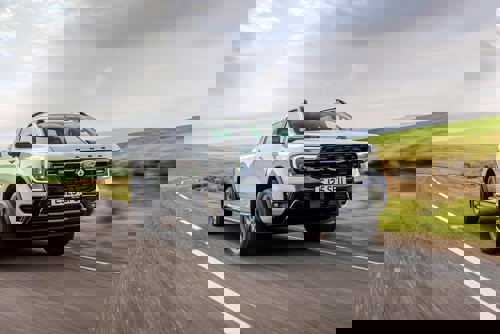
While not specifically referenced in the government’s eVED proposals, that double-cab pickups are classified as commercial vehicles for VED purposes but as cars for Benefit-in-Kind (BiK) reasons, ensures this recently introduced anomaly is set to continue.
Is eVED pay-per-mile tax fair to EV and PHEV owners?
All governments require revenue through taxation. If a reliable income source shows signs long-term reduction, alternatives are required. For a sense of the enormity of the figures involved, overall in 2024-25 Fuel Duty raised £24.4 billion for the treasury, with VED adding a further £8.4 billion to the pot.
The Office for Budget Responsibility (OBR) estimates are that at today’s currency values, Fuel Duty revenue would fall from 2024-25’s £24.4 billion to around £16.5 billion in 2034-35 and closer to £7.5 billion a decade later.
It was therefore inevitable that at some point EV owners would be facing taxation of some kind, future-proofing the revenue stream as income from duty on petrol and diesel gradually declines. This would happen regardless of the political leanings of the party in government, although how it was to be implemented may vary.
To that end, a tax on EVs being driven is something we regard as fair and support providing that there’s a clear financial advantage to using a zero-emission vehicle over one which pumps CO2, as well as other harmful gases and particulates into the atmosphere.
What doesn’t seem fair is that eVED’s introduction means different propulsion methods are being taxed using different methodologies — it lacks transparency which in turn makes it trickier for consumers to make informed decisions.
One argument for a more transparent alternative to eVED revolves around removing fuel duty from petrol and diesel altogether and charging a cost-per-mile tax for all cars, with banding-based rates based on their CO2 emissions and electric driving range capabilities, such as those used for Benefit-in-Kind (BiK) taxation.
Banding for older vehicles could still be managed using CO2 emissions, albeit with their earlier Euro levels additionally taken into account. Cars which pre-date that system’s introduction may require a flat rate across the board.
