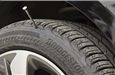
At MOT last month, had advisory note that front tyres wearing badly on inside edge. Took car to my local garage for other MOT work and mentioned this. They said looks like camber, which they do not have gear to adjust. Went back for re-test (thru' national tyre supplier) and they said no camber adjustment on an Astra, could be tracking. Been back to my original garage this morning, who checked tracking and said its spot on.
Tyres now almost illegal, wearing badly over inner edge for width of about 1". Rest of tyre has over 6mm tread. Any suggestions what could be causing this, any remedial work which could be done and an idea of cost would be appreciated. Can't afford to keep replacing perfectly good tyres because 1" is worn out!!!!
Thanks, Lesley
|
Do you do a lot of tight turns when parking, or going onto and out of driveways?
During large steering inputs, the wheel alignment goes all over the place, even when everything is set up correctly. Watch a 2CV parking for obvious evidence of this!
number_cruncher
|
What the 2cv so clearly shows at full lock is the Ackerman Principle,if you imagine the wheels descibing a circle around a point the inner one needs to be at a more acute angle as the circle is smaller,so they are in alignment even though they look like they are not.
I would take the vehicle to somewhere that can check the alignment of all the wheels,not just the toe out of the front ones.As has been said,there may be some damage not visible to the naked eye,it would still be possible to set tracking in spite of this.
|
Ackerman Principle
That's a bit of a myth really. When you do the geometry, in full, tedious detail, it doesn't work in the simple way it is laid out in countless automotive textbooks. I'm sure you were taught it - I have been taught it a couple of times - but it is wrong! Most cars make some nod in the direction towards an Ackerman type layout, and I don't dispute that the inner wheel has to rotate further in a corner, and making the effective steering rod length shorter than the effective length between the "king pins" acheives this.
However, I meant that the wheels on 2CVs show how if you have a lot of castor angle in the straight ahead position, that becomes lots of "effective" camber as you wind in steering lock. 2CVs exemplify this, it looks like the wheel is going to flop over! As the wheel cambers on turns, it has the possibility to wear more on one edge.
I agree with the point made by DD, particularly if someone has used the lower wishbones as jacking points - they certainly aren't strong enough for that.
number_cruncher
|
|
|
|
In your previous post ( www.honestjohn.co.uk/forum/post/index.htm?t=30677 ) you suggested "car has signs of previous new front panels". If this is the case, then it sounds like whoever repaired the car didn't check the wheel alignment afterwards to see if any of the suspension components were damaged. Front wishbones can easily get bent, for example.
|
|
|