
BYD Seal Review: Price, range & boot space
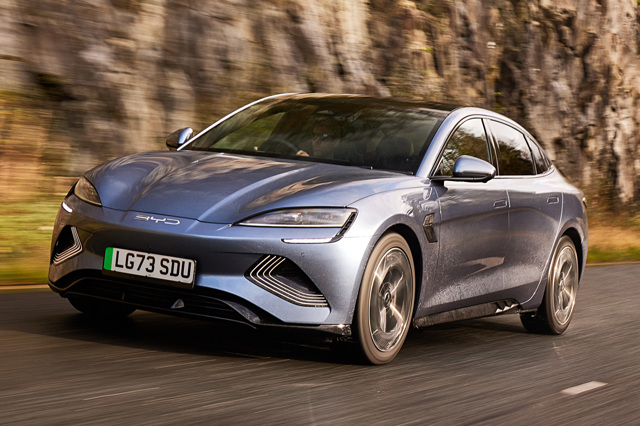
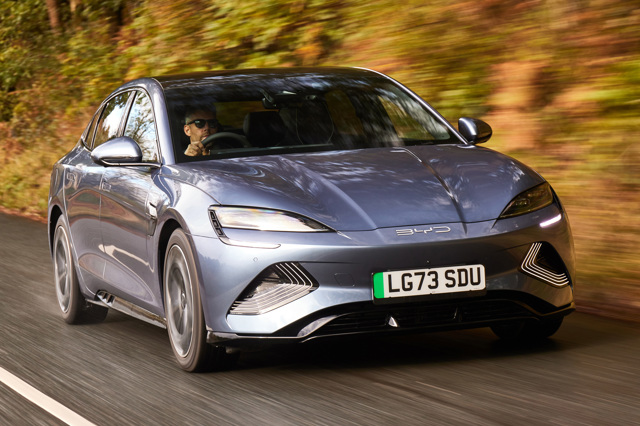
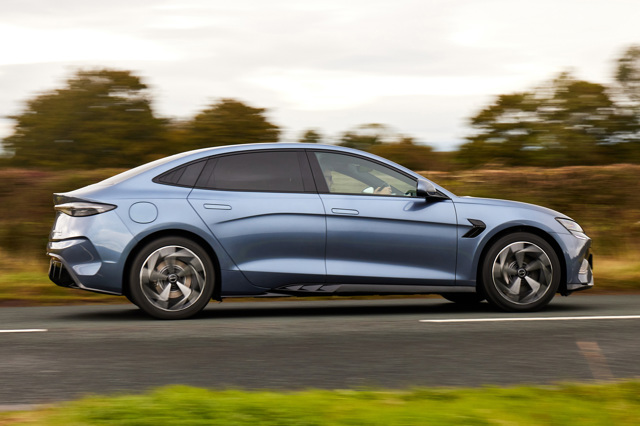
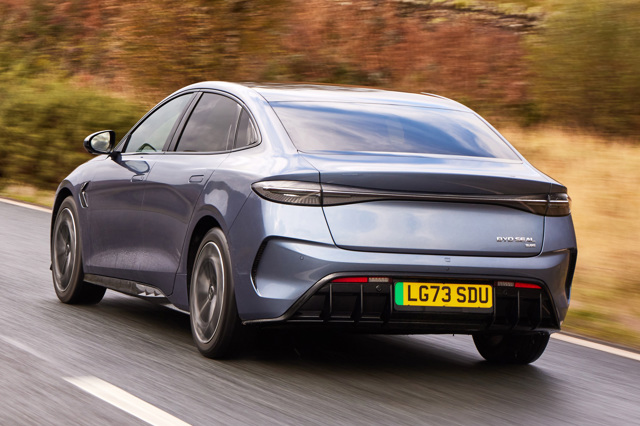

BYD Seal Verdict

 Spacious and comfortable electric car. Impressive range of up to 354 miles. Long list of standard equipment.
 More expensive than established competitors. Not as practical as hatchback rivals. Lacks the badge kudos of a Tesla.
Find out more about the BYD Seal
|
 Driven, tested and rated by:
 BYD Seal at a glance:
- Body type: Saloon
- Price range: £45,730 - £48,730
- Battery range: 323-354 miles
- Number of seats: 5 (2 Isofix)
- Boot capacity: 400 litres
- Insurance groups: 46-48
BYD Seal: Everything you need to know
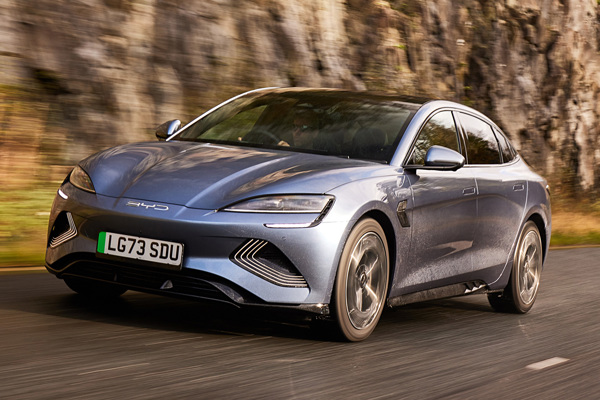
The BYD Seal has the potential to shake up the electric car market in the same way the Tesla Model 3 did when it arrived in 2019. We think this electric saloon is desirable enough to tempt buyers away from the Hyundai Ioniq 6 and even the BMW i4... but should you spend your money on one? Read our full 2026 BYD Seal review to find out.
BYD is a Chinese vehicle manufacturer that you might never heard of. But it’s actually got some serious clout as a battery manufacturer: its clients include big names such as Tesla and Apple, while its electric buses and trucks have been on sale in Europe for more than 20 years.
The brand decided to expand into the passenger vehicle market in 2023, with the BYD Atto 3 and affordable BYD Dolphin.
The BYD Seal represents a noticeable shift upmarket from those cars. As BYD doesn’t want to be a budget car manufacturer, it prices the Seal against established competitors and has the premium brands in its sights.
So what do you get for your £45,000 plus? Well, there are two models available: the BYD Seal Design and the BYD Seal Excellence AWD.
Both are generously equipped: so much so, you’d struggle to tell the two apart. Only a slightly cringey ‘3.8S’ badge on the back of the range-topper identifies it as a dual-motor model; this is a nod to its fairly swift 0-62mph time.
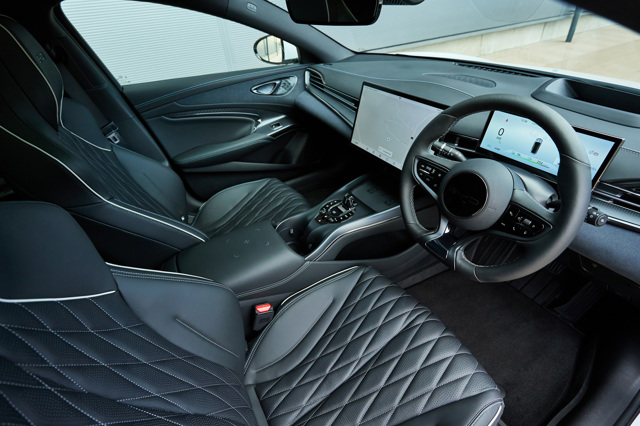
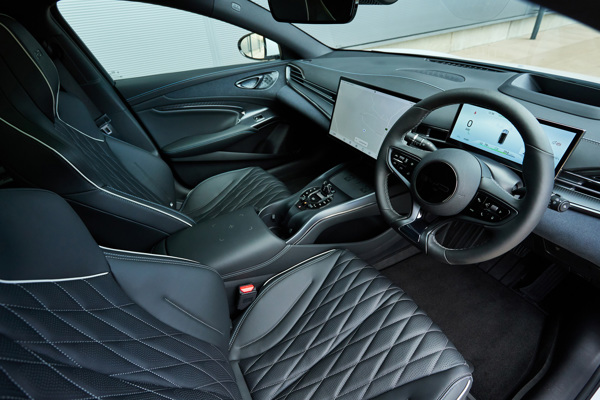
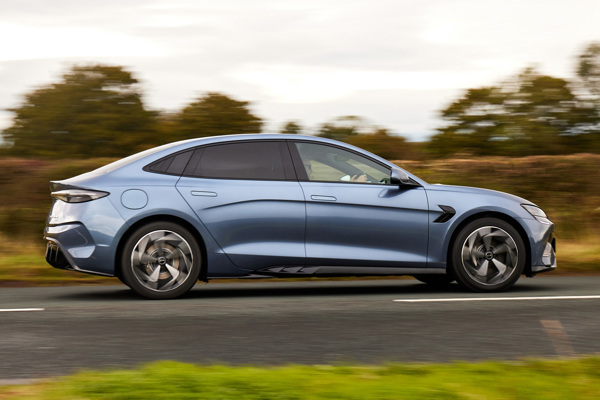
The BYD Seal’s interior is lovely. Apparently inspired by marine life, you’ll find a range of exotic materials and quality finishes.
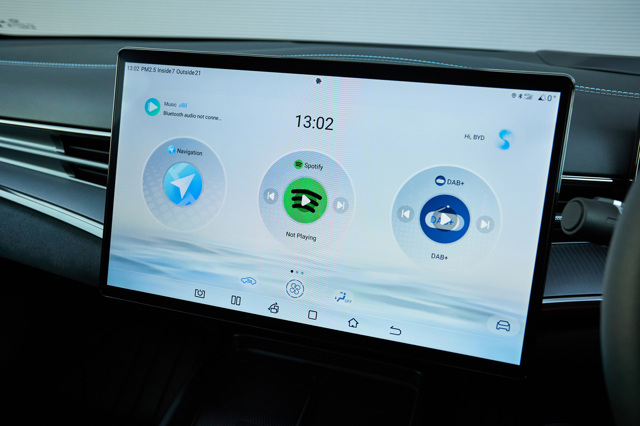
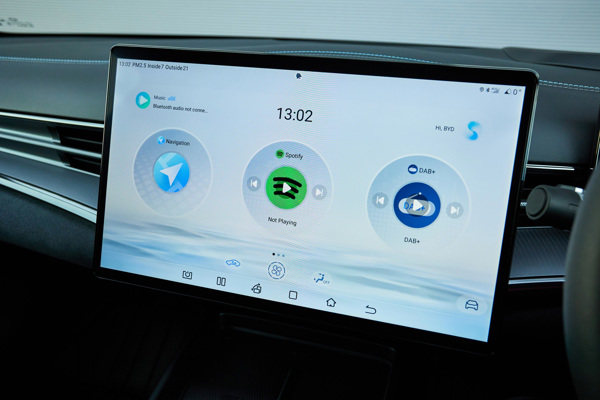
There’s also a rotating infotainment screen – something of a BYD trademark – which is bit unnecessary, but also an undoubted talking point.
BYD’s battery expertise means the Seal is fitted with a very narrow battery pack, which doesn’t eat considerably into interior space.
As such, you sit lower than in a lot of EVs, while there’s plenty of room for both front- and rear passengers. It’s a shame, though, that luggage space is restricted by the Seal’s narrow boot opening.
On the road, the BYD Seal is pretty sprightly. We reckon the more affordable model will be fast enough for a lot of buyers, while it can also travel slightly further between charges.
How we tested the BYD Seal
We've driven the BYD Seal on a number of occasions. As well as seeing what it's like out on the road in both of its various forms, we've also brought our families along for the ride to see how it copes with everyday family life.
"A lot of electric car buyers will be sceptical about the BYD Seal, but this scepticism is not necessarily justified"
|
Is the BYD Seal a good car?
A lot of electric car buyers will be sceptical about the BYD Seal, but this scepticism is not necessarily justified. We think it’s a bold alternative to the Hyundai Ioniq 6 and Volkswagen ID.7, while BYD’s worldwide presence ought to put your mind at rest about buying from a brand that's still a little obscure in the UK.
Still want to learn more about the BYD Seal? You can carry on reading below, where we go into more detail about the BYD Seal's motors, batteries, interior, driving characteristics and more.
BYD Seal Range
| BYD Seal Design | 354 miles |
| BYD Seal Excellence AWD | 323 miles |
Both versions of the BYD Seal have the same 82.5kWh battery pack, but the big difference in power output between the two versions results in a significant difference in range. The Design has 312PS and will take you 354 miles on a charge according to official figures, whereas with the Excellence AWD, you have a whopping 530PS, but the range falls to 323 miles.
BYD Seal Charging times
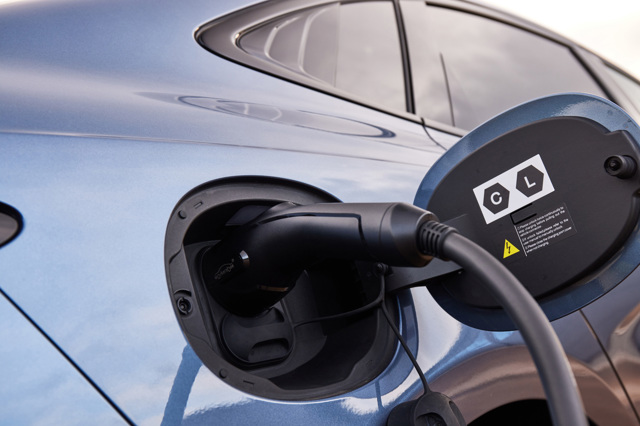
The BYD Seal's 82.5kWh battery has a maximum DC charging speed of 150kW, so it can take on 10-80% charge in around 37 minutes if you can find a powerful enough charging station. A full charge on a conventional 7kW home wallbox charger, meanwhile, will take around 12 hours.
Reviews for BYD Seal's top 3 rivals
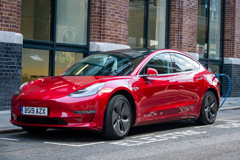

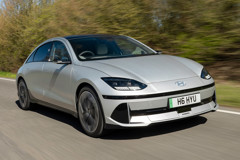

.jpg?width=240&height=160&rmode=crop)
BYD Seal handling and engines

BYD Seal 2026: Handling and ride quality
In a world of overweight electric SUVs, the BYD Seal puts a refreshing focus on actually being good to drive.
It’s still a heavy chunk of metal, but its low centre of gravity and eager steering means it feels more enjoyable to drive than, say, a Volkswagen ID.5.
We’ve spent the most time in the all-wheel-drive BYD Seal Excellence, and it handles well, with reassuring grip levels and communicative steering. A BMW i4 perhaps has the edge in overall dynamic polish, but the Seal feels sporty nonetheless.
And that doesn’t come at the expense of comfort. It copes surprisingly well with bumpy road surfaces: helped further by the adaptive dampers that are fitted to the more expensive model.
BYD Seal Review: Batteries and motors
Buy the more affordable BYD Seal Design and you’ll get a single electric motor driving the rear wheels.
With a power output of 313PS and 0-62mph acceleration figure of 5.9 seconds, it feels really rather quick, especially if you’re not used to the instant acceleration of an electric vehicle.
For pacier performance, you’ll need the dual-motor BYD Seal Excellence. With four-wheel drive and a 530PS power output, this can sprint to 62mph in just 3.8 seconds.
It actually doesn’t feel all that dramatic, such is the impressive refinement of the BYD Seal, but it’s up there with the fastest electric cars on sale.
BYD Seal 2026: Safety
As you’d hope for a futuristic electric car, the BYD Seal is fully loaded with driver-assistance and safety technology.
It’ll do everything in its power to keep you safe: keep you in your lane, remind you of the speed limit and even apply the brakes to prevent a collision.
Pleasingly, this tech doesn’t feel excessive, though: unlike a Hyundai Ioniq 6, for example, it doesn't beep and hassle you to the point of distraction.
The BYD Seal has scored a maximum five stars in Euro NCAP crash tests, including scores of 89% and 87% for adult- and child occupants, respectively.
What is the BYD Blade Battery? Reliability and safety explained
BYD’s ‘Blade’ battery uses lithium-iron-phosphate chemistry, which isn’t all that unusual, but has distinct advantages over other types of battery. It’s cheaper, it contains no cobalt or nickel, and it is generally considered safer.
BYD has demonstrated that the cells can be penetrated by a nail without emitting smoke or fire, where other types of battery - such as nickel manganese cobalt (NMC) cells - can react more violently. The Blade battery gets its name because it uses long-slim cells of almost a metre long, rather than being made up of modules packed with smaller pouch or prism cells like most other batteries.
BYD Seal 2026: Towing
Both versions of the BYD Seal are rated to pull an unbraked trailer of up to 750kg, which is pretty standard. The same limit applies to braked trailers on the Design version, which is pretty poor, as many EVs are. The Excellence AWD version does much better, though, with a braked towing capacity of 1500kg.
| Engine | MPG | 0-62 | CO2 |
|---|---|---|---|
| 82.6kWh | - | 3.8–5.9 s | - |
BYD Seal interior
| Dimensions | |
|---|---|
| Length | - |
| Width | - |
| Height | - |
| Wheelbase | 2920 mm |
BYD Seal 2026: Practicality
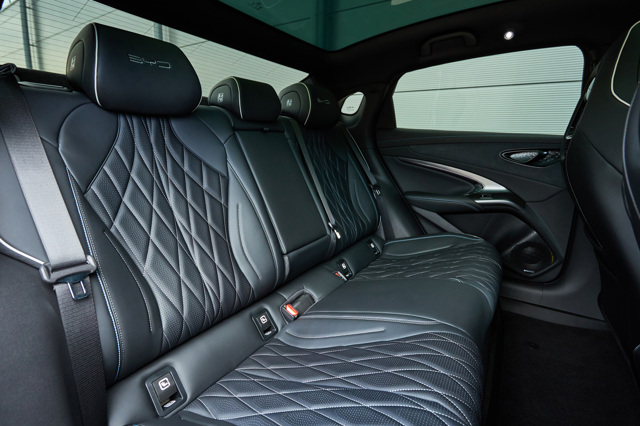
There’s loads of room inside the BYD Seal for passengers, while the narrow ‘Blade’ battery fitted to the BYD Seal means you don’t sit uncomfortably high, either.
The standard-fit panoramic sunroof gives the cabin an airy vibe and doesn’t eat into headroom like some sunroofs do.
There’s plenty of space in the cabin for storing your odds and ends (including a deep central cubby box as well as generous door bins), while there’s also an extra 53 litres of storage under the bonnet.
Is the BYD Seal boot too small? Practicality and interior space
The BYD Seal’s boot isn’t all that small at 400 litres, but it’s not all that large compared with rivals, either. The bigger problem with it is access: the saloon bodystyle means a much smaller opening than you’d get with a hatchback, so you might struggle to load bulky items.
If you’re planning to drop the seats and do an Ikea run on a regular basis, you might want to look at the BMW i4 instead.
BYD Seal Dimensions
The BYD Seal measures 4800mm long, 2150mm wide (including door mirrors) and 1460mm tall. The wheelbase is given at 2920mm.
BYD Seal 2026: Quality and finish
Interior quality is exceptional, with an impressive mix of materials and high-grade finishes.
It feels more special inside than a Hyundai Ioniq 6, thanks in part to the bold design choices: BYD says the Seal's cabin was inspired by the ocean, which is an interesting take on car interiors.
The BYD Seal features leather seats (with intricate stitching detail) as standard, while double-glazed windows in the front improve refinement and add to the feeling of quality.
There’s no doubt that the BYD Seal feels like a premium product.
BYD Seal 2026: Infotainment
The BYD Seal's infotainment screen is a chunky 15.6-inch display with a magic trick: it can rotate at the touch of a button.
This is a bit gimmicky; you’ll soon decide which way around you prefer it (we like it in landscape mode), but it’s certainly a talking point.
It’s responsive, easy to use and the graphics are sharp: all important attributes in an expensive EV’s infotainment system. You get Apple CarPlay and Android Auto as standard, too, so you can use apps from your phone on the move.
BYD Seal value for money
BYD Seal 2026: Prices
This review was last updated in March 2026, and the table below shows the prices of the BYD Seal at that point in time. However, prices, change regularly, so please only use these as a guide, and check pricing for yourself on BYD's website.
| Design | £45,730 |
| Excellence AWD | £48,730 |
Is the BYD Seal good value compared to rivals?
The BYD Seal is not a cheap electric car: you can pick up a Tesla Model 3 for a chunk less. A more affordable entry-level model might make its way to the UK in the future but, for now, you’re limited to just the two variants with their premium price tags.
On the plus side, even the cheapest BYD Seal is well kitted out. The rotating 15.6-inch infotainment is standard, as are a 360-degree camera and panoramic sunroof, and there’s a range of colours to choose from. The limited line-up (and few options) means delivery times should be short, meanwhile.
BYD Seal: Used Car Prices
While it's not cheap as a new car, the Seal gets much, much cheaper as a used car. EVs often have quite shaky residual values, and the Seal's are perhaps made shakier because it comes from a relatively little-known Chinese brand, but it results in used examples being much, much cheaper than new ones.
We've seen several entry-level cars of a year old on sale for less than £30,000. And it's not like these are super-high-mileage examples, either: that money will get you a car with around 5,000 miles on the dial. For what is very light usage previously, that's one heck of a discount. Excellence AWD models can be had for similar money, too: mileages will be a little higher at around 15,000 miles, but that's still hardly crazy.
BYD Seal 2026: Reliability and running costs
Both BYD Seal models use an 82.5kWh battery pack, which can be fully charged in around 12 hours using a 7kW home wallbox.
The cost of doing so will depend on your home electricity tariff, but expect to pay around £23 if your domestic power is billed at the UK's national average rate. If you're smart, though, you'll get yourself on a variable tariff that charges much less for off-peak electricity, and charge your car overnight (which you'll probably do anyway). Do so, and you'll like find a charge costing around a third of what you were paying before.
For this, you’ll officially get a range of 354 miles from the Seal Design or 323 miles from the Excellence. The BYD Seal’s real-world range will be slightly less than this, especially in winter, but longer journeys should be perfectly manageable.
If you do need to travel further than the BYD Seal can manage on a charge, a quick blast at a rapid charger will provide a speedy boost in range. An 150kW charger will top it up from 10% to 80% in less than 40 minutes. However, charging that way will be much more expensive: expect to pay upwards of £50 for such a charge.
Insurance won't be cheap, which isn't that surprising given the amount of power that the car has. If you didn't already know, car insurance groups run from 1 to 50, with group 1 cars being the cheapest to insure and group 50 cars being the most expensive. The Design version of the BYD Seal sits in group 46, while the Excellence AWD sits in group 48.
With both versions costing more than the £40,000 threshold for higher-rate VED road tax, you'll find yourself lumbered with the higher charge on the BYD Seal. On top of the £195-per-year flat rate, you'll also pay an additional £425 per year between years two and six of the car's life. And you won't swerve that by buying used, because that liability is passed to subsequent owners.
BYD Seal: Frequently Asked Questions
Is BYD a reliable car brand?
BYD hasn’t been operating in the UK long enough for there to be a whole lot of data in that area. We can tell you, however, that the firm’s cars come with a six-year, 93,750-mile (that equates to 150,000km) warranty, which indicates plenty of confidence from the manufacturer.
How much does the BYD Seal cost in the UK?"
There are two versions of the BYD Seal offered in the UK. The entry-level one, the Design, costs from around £46,000, while the more powerful Excellence AWD version costs around £49,000.
Does the BYD Seal have a front boot (frunk)?
Yes it does. There’s a 53-litre space beneath the bonnet, which is useful for carrying your charging cable in. It’s especially useful because that cable won’t eat into the already-rather-limited 400 litres of boot space you get in the Seal.
Satisfaction Index
 What is your car like to live with?
We need your help with our latest Satisfaction Index, so that we can help others make a smarter car buying decision. What's it like to live with your car? Love it? Loath it? We want to know. Let us know about your car - it will only take a few minutes and you could be helping thousands of others.
Help us with the Honest John Satisfaction Index nowBYD Seal models and specs
There are two versions on the BYD Seal, the Design and the Excellence AWD. Standard equipment on the entry-level BYD Seal Design is already generous, and includes:
- 19-inch alloy wheels
- High-beam assist
- Metallic paint
- Panoramic sunroof
- Electric tailgate
- Heated leather steering wheel
- 10.25-inch digital instrument cluster
- 15.6-inch rotating infotainment screen (with Apple CarPlay and Android Auto)
- Wireless phone charging
- Leather seats (heated and ventilated in the front)
- Ambient lighting
- Dual-zone air-conditioning
- 360-degree camera
- Front- and rear parking sensors
- Automatic vehicle hold
- Keyless entry/start
- Electronic parking brake
- Adaptive cruise control
Not only does the BYD Seal Excellence AWD add the extra electric motor for all that extra power and the four-wheel drive, but it also adds:
- Head-up display
- Semi-adaptive suspension dampers
More articles you might be interested in:


| Dimensions | |
|---|---|
| Length | - |
| Width | - |
| Height | - |
| Wheelbase | 2920 mm |
| Miscellaneous | |
|---|---|
| Kerb Weight | - |
| Boot Space | - |
| Warranty | |
| Servicing | - |
| Costs | |
|---|---|
| List Price | £45,640–£48,640 |
| Insurance Groups | - |
| Road Tax Bands | A |
| Official MPG | - |
| Euro NCAP Safety Ratings | |
|---|---|
| Adult | - |
| Child | - |
| Pedestrian | - |
| Overall | - |
| Saloon | |||
|---|---|---|---|
| Version | List Price | MPG | 0-62 |
| Design 313 Electric Auto 82.5kWh 4dr | £45,640 | - | 5.9 s |
| Excellence 530 Electric Auto 82.5kWh 4dr | £48,640 | - | 3.8 s |
Model History
- September 2023: BYD Seal specs confirmed, prices start at £44,990
- February 2026: New tech, storage and paint choices for 2026 BYD Seal, but prices unchanged, starting at £45,730
September 2023
BYD Seal specs confirmed, prices start at £44,990
BYD has confirmed prices and preliminary specs for its new electric Seal saloon. Seal prices start at £44,990 for the Design RWD, rising to £47,990 for the Excellence AWD. First deliveries are scheduled to begin in the fourth quarter of 2023.
Featuring BYD's Ocean Aesthetics design language, the Seal is built on the firm's electric-only Platform 3.0 and all models use BYD's 82.5kWh Blade battery.
The 313PS single motor rear-wheel drive model has a claimed range of 352 miles and can complete the 0-62mph sprint in 5.9 seconds. The twin-motor all-wheel drive model has 530PS and has a 0-62mph time of 3.8 seconds, but range drops to 323 miles.
Equipment includes a 15.6-inch rotatable centre screen, voice control and Android Auto or Apple CarPlay. A 10.25-inch screen delivers digital dials, while there a 12-speaker Dynaudio Performance Audio System available.
February 2026
New tech, storage and paint choices for 2026 BYD Seal, but prices unchanged, starting at £45,730
BYD has announced details of the 2026 model year Seal. Three years after originally going on sale in the UK, the upgraded Seal is now available to order, priced from £45,730.
Updates include new 19-inch alloys, revised badges and the choice of three new paint colours - Ruby Red, Obsidian Black and Lavender Grey - which join the current Polar White, Indigo Grey and Atlantis Grey.
On the inside, the Seal gets tweaks to the seat headrests, the boot has gone up in size from 400 litres to 485 litres, while the frunk grows 19 litres, to 72 litres.
Tech upgrades include the addition of a Driver Monitoring System, which can detect the driver’s attention to the road, and a smartphone-based keyless entry system.
As before, there are two trim levels - Design and Excellence - with both models using the same 82.5kWh battery. Design models are single motor and rear-wheel drive and have a range of 354 miles.
Equipment includes LED headlights, a panoramic glass roof, a Dynaudio 12-speaker sound system, two 15-watt wireless charging trays, heated and ventilated front seats and a fixed 15.6-inch high-definition touchscreen.
Excellence models feature a head-up display, variable frequency dampers and feature a two-motor all-wheel drive powertrain, with a range of 323 miles.
Prices start at £45,730 for the Design and £48,730 for the Excellence – unchanged from the existing Seal.
