
Honda e:Ny1 long-term test: is Honda’s first electric SUV worth the money?
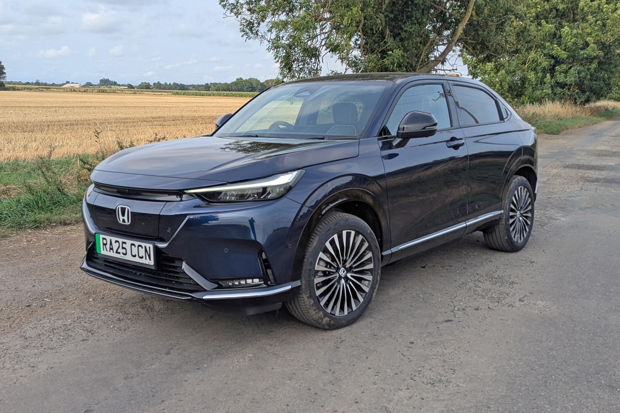
Honda e:Ny1 Advance
- Run by: Dan Harrison since Sept 2025
- Price when new: £42,890
- Power: 150 kW (~204PS)
- Torque: 310 Nm
- Battery: 68 kWh
- Claimed range: 256 miles on a full charge
Report 1: Appreciating Honda's unpronounceable EV SUV
Honda's electric small SUV - the e:Ny1 joins - the HJ fleet. The name is a mouthful, but what else have we got to say?
Date: 18 September 2024 | Current mileage: 1569 | Claimed range: 256 miles | Actual range: ~200 miles
I’ve had the Honda e:Ny1 on my driveway for a couple of weeks and already I’ve realised two things. First, Honda has built a really appealing, comfortable and tech-filled family SUV. Second… I’ve got a few questions about efficiency and range that I’ll be digging into over the next few months.
Wait, How Do You Even Say It?
Before we get into the details, let’s address the name: e:Ny1. How do you pronounce it? “E-N-Y-1”? “En-y-one”? “Anyone”? Even after explaining it to friends several times this week, I’m still not sure.
Confusing name aside, the Honda e:Ny1 is Honda’s first dedicated electric SUV, effectively the EV sibling of the Honda HR-V hybrid.
Prices start at £44,995 for the Elegance trim and rise to £47,195 for the top-spec Honda e:Ny1 Advance, which is the version I’m running. Options are minimal, beyond paint (£650 for anything other than black) and some cosmetic tweaks, there isn’t much to add. Surprisingly, even a heat pump isn’t available (as was fitted to the Volkswagen ID.3 that I previously ran), which could become a factor when winter arrives.
With a 68.8kWh battery (62kWh usable) and a single 201bhp electric motor driving the front wheel, plus an official WLTP range of 256 miles, the Honda e:Ny1 looks very promising indeed.
It’s late summer now and - for the first few weeks at least - the range has been around 220 miles and appears to be pretty genuine. If there’s 220 miles on the dashboard you get 220 miles. But I’m aware that temperatures are still mild and that will be having a positive effect on its performance. But, so far so good with a consumption of around 3.3-3.5 miles per kWh.
Of course, it’s early days and my driving recently has included a lot of motorway miles. But the absence of a heat pump nags at the back of my mind - will things get worse when winter sets in? The Volkswagen ID.3 I had previously had one fitted and it made a tangible difference in winter.
Charging: Fine, But Not Fast
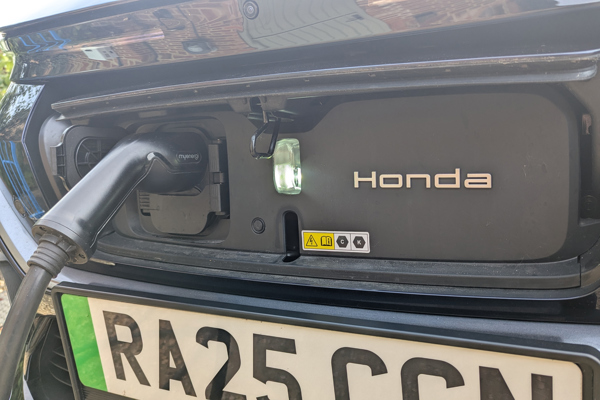
When you do need to plug in, the Honda e:Ny1 supports DC fast charging up to 78kW. That’s… okay, but hardly competitive when rivals like the Kia Niro EV can charge much faster. On long motorway trips, that’s going to mean longer coffee breaks than I’d like. In reality, I'm seeing somewhere between 65kW and 70kW even on the very fastest chargers.
Here’s the thing: despite these niggles, I’m really enjoying living with this car so far.
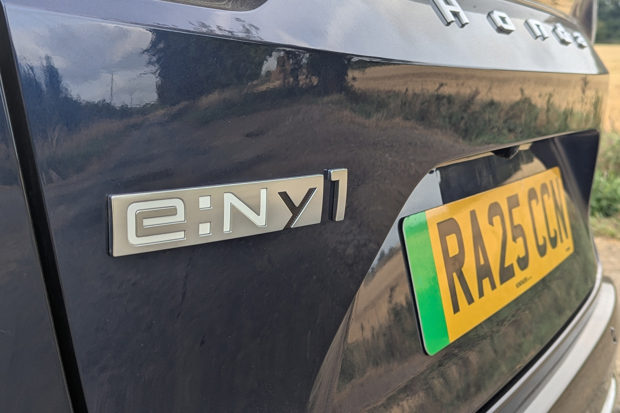
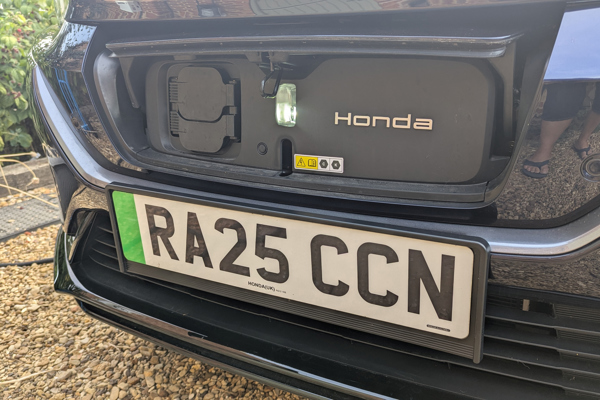
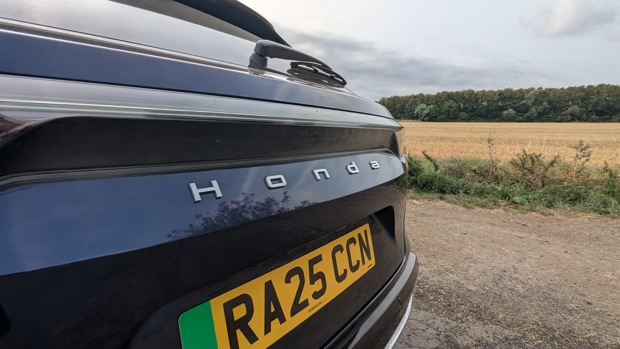
I like the design, it’s clean and modern without being shouty. Honda’s replaced the traditional grille with a smooth, blocky panel that hides the charging flap. Subtle touches like the white Honda badges and lowercase boot lettering help distinguish it from the HR-V. It’s understated in a good way.
It also feels like a Honda, which is a good thing. If you didn’t know what the badge was on the front, there’s a strong chance that you would be able to have a stab at this being a Honda from behind the wheel, because of the non-nonsense style, use of buttons over touchscreen simplification and that everything just feels solid.
It's inside where the Honda e:Ny1 really shines. The cabin feels airy and spacious, with excellent rear legroom for the kids. The panoramic glass roof is a treat, flooding the interior with light and giving longer journeys an open, relaxed feel.
The materials are generally high quality, too, with plenty of soft-touch plastics and a reassuring lack of squeaks or rattles. My only gripe so far is the piano-black trim around the centre console, which attracts fingerprints - particularly from children - faster than I can wipe them away.
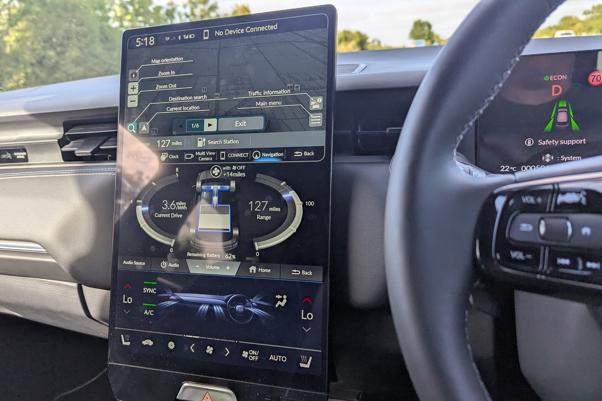
Then there’s the 15.1-inch portrait touchscreen, the centrepiece of the cabin. I’ll admit, I’m usually sceptical about giant screens, but Honda has nailed this one. It’s cleverly divided into three sections: navigation or Apple CarPlay at the top, drive and media controls in the middle, and permanent climate controls at the bottom. No endless menu diving just to turn the heater up.
In Advance trim, there’s plenty of other useful kit, too. Adaptive cruise control, wireless charging, electrically adjustable heated seats, a powered tailgate and a multi-view parking camera. There’s even a Parking Pilot system that can park the car for you, though I haven’t dared try it yet.
After a few weeks with the e:Ny1, I’m impressed by its comfort, quality, and tech, but concerned about its efficiency and charging speeds. Over the next few months, I’ll be putting it through its paces:
- Long motorway trips: A regular 250+ mile trip to London and back and a few longer jaunts too.
- Cold-weather testing, when the lack of a heat pump could make a noticeable difference.
- Family life testing, from school runs to weekend getaways, to see if it genuinely works as a versatile family SUV.
For now, the Honda e:Ny1 is a car I want to love. It’s comfortable, it’s packed with ki, and it looks good.
First update verdict: Promising, but plenty of questions left to answer...
Report 2: How is the e:Ny1 standing up to family life?
Small electric SUVs tend to have a reputation for being a bit cramped when it comes to interior space - is that the case here?
Date: 2 October 2024 | Current mileage: 2876 | Claimed range: 256 miles | Actual range: ~200 miles
I’ve started to look at cars differently since having a child in the past few years. The care-free days of not even thinking about space and just chucking a few bags in the back if we were going for a few days are long gone.
My questions now look more like … Will the pushchair fit in the boot, is everything wipe-clean and am I likely to put my back out while fitting a child seat?
So In the first month that I’ve had the Honda e:Ny1 I’ve been impressed with the quietly brilliant case it’s making as a family car, as you can tell it has been thought through for the messy, everyday realities of life with children.
Let's start with child seats. You get two Isofix points on the outer rear positions, clearly marked and with reasonable access without much digging under cushions. The doors open wide and the seat bases are at a sensible height, so you’re not bending at awkward angles to click in a heavy car seat … or grappling with a wriggling toddler as you’re trying to seat them.
The flat floor helps you kneel inside while you’re tightening straps, and there’s an abundance of headroom if you’re trying to clip-in a bulky rear-facing seat. Crucially, a rear-facing i-Size seat fits without forcing the front passenger right up against the dash - handy on long trips when an adult also needs legroom.
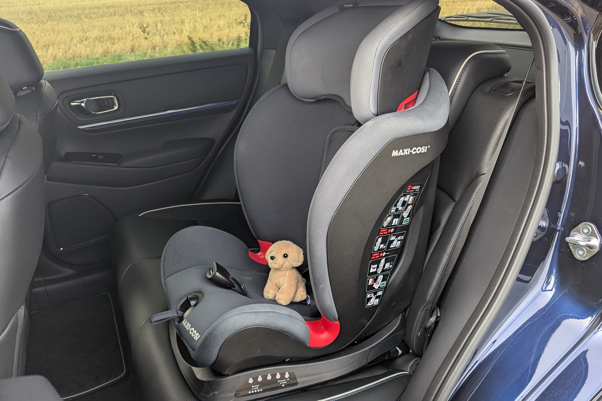
Once the seat (or seats) are in, day-to-day kid wrangling is refreshingly straightforward. The rear bench is shaped for support rather than swoopy style, so high-back boosters sit flush and don’t wobble. Top-tether anchors are easy to spot on the back of the seats and the belt buckles are on semi-rigid stalks that small hands can find.
Bigger family? Even with two big seats installed, it’s still possible to squeeze in a slim booster seat in the middle for occasional use - like if you have an extra passenger in the school run car-share. The flat centre floor leaves more foot space than you might expect for three across, even if shoulder width will be the limiting factor for teenagers.
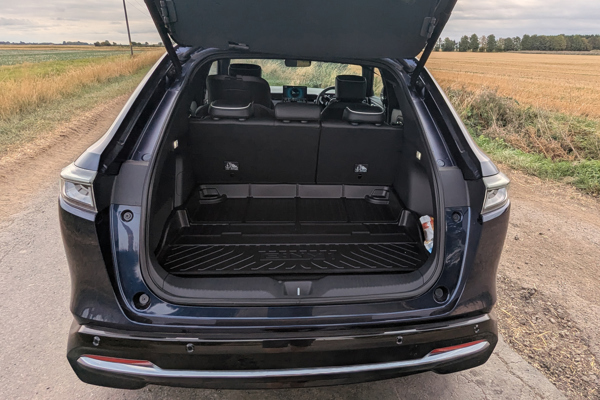
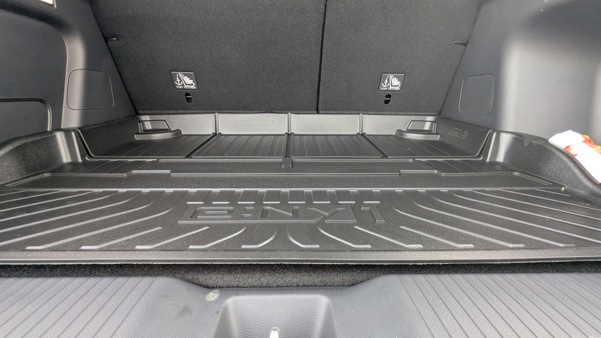
Pushchair duty is another area that the Honda e:Ny1 can claim as a strong suit. The boot opening is broad and the loading lip is low, so you can lift in a folded buggy without wrestling it over a high sill. The load bay is usefully square, which matters more than raw litres when you’re packing a pram frame plus all the other paraphernalia that comes with a modern-day child form simple changing bag to scooters and small bikes….
There’s additional under-floor space that’s perfect for charging cables or muddy wellies, keeping the main floor clear for the pushchair. Drop the 60/40 rear backrests and you get a near-flat extension for the rare IKEA dash or to lay out a travel cot and suitcase for a weekend away. Because the Honda e:NY1 is an EV, there’s no exhaust to worry about when you sit a child on the bumper for shoe-tying duty.
On the move, the car is brilliantly calm and relaxed. Electric drive means quiet, smooth, jerk-free pull-away - gold dust when your toddler has just nodded off. One-pedal driving reduces the head-bob in stop-start traffic and the cabin’s low noise helps you chat to kids in the back without shouting.
Honda’s driver-assist suite (including automatic emergency braking, lane-keeping and adaptive cruise on most trims) adds a safety net on busy dual carriageways and a clear rear camera spares your nerves (and blushes) in packed nursery car parks.
And to top it off, there’s a wide spread of storage bins for sippy cups, a flat wireless-charging pad that doesn’t fling your phone, durable seat fabrics, and climate controls that are simple enough to set without digging through screens.
Range and charging are more than sufficient for multiple school runs, clubs and a weekend visit to grandparents. As winter draws in, I know that we’ll also be making use of the feature that allows you to pre-condition the cabin on cold mornings so everyone climbs into a warm car with clear windows. In short, the Honda e:NY1 is sized, shaped and ideal for family life - without the faff.
Report 3: What has left our e:Ny1 felling a little zapped?
Issues with charging and a few software gremlins have taken the shine off our time with the Honda e:Ny1 so far. So what's going wrong?
Date: 16 October 2024 | Current mileage: 3930 | Claimed range: 256 miles | Actual range: ~200 miles
After several months and a few thousand miles with the Honda e:Ny1, one thing has become clear: it’s an easy electric SUV to live with in most respects - quiet, smooth, and perfectly sized for urban family life. But when it comes to charging, the story gets a little more complicated.
The e:Ny1’s behaviour at the plug, both at home and on the road, has proved more fussy than we’d hoped, and that fussiness has shaped our experience in ways worth unpacking.
Our Honda e:Ny1 spends most nights plugged into a Zappi wall box, a popular charger among EV owners, especially those of us with solar panels. The Zappi’s big selling point is its Eco and Eco+ modes, which modulate the charging current depending on how much surplus solar power is available.
In theory, it’s the perfect system for low-cost, sustainable charging. In practice, the Honda isn’t a fan. When using Eco mode, the Zappi will pause charging when a cloud passes or when household consumption spikes, then restart when solar output increases again.
Most EVs take this stop-start routine in their stride. The Honda e:Ny1, however, tends to throw a tantrum. After one or two interruptions, it declares “charging complete” or “charging delayed” and refuses to resume until you physically unplug and reconnect the cable.
It’s the first EV I’ve ever experienced to do this. We also have a SEAT Mii - very much a first generation EV - and a Nissan Leaf that’s a few years old and both work incredibly well with this charger.
It’s a frustrating quirk, particularly for those who’ve invested in solar charging to make the most of home-generated power. The likely culprit is that the Honda’s systems go into a kind of sleep mode when current is interrupted too often. Once that happens, the car won’t “wake up” to accept more power without manual intervention. The only reliable “fix” - if you can call it that - is to force the charger into “Fast” mode, which provides a steady, unbroken current - but that defeats the purpose of dynamic, solar-friendly charging.
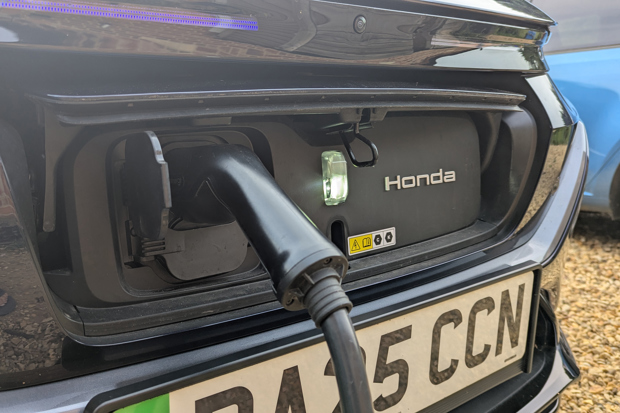
Once locked in Fast mode, home charging is consistent and predictable. The Honda e:Ny1’s 11 kW onboard AC charger means a full battery from empty takes around six hours and forty-five minutes on our three-phase setup, or closer to nine hours on a typical 7 kW single-phase home installation.
That’s fine for overnight top-ups, but not particularly brisk compared with rivals that can draw 22 kW from AC sources. Forget to plug in overnight and you won’t recover much range from a quick lunchtime top-up.
Public charging is another area where expectations need managing. The e:Ny1’s DC fast-charging limit of 78 kW feels distinctly mid-tier in 2025, especially when rivals such as the Hyundai Kona Electric and Volvo EX30 can charge at well over 100 kW.
Honda quotes a 10–80% charge in 45 minutes, but in reality, the car only sustains its peak rate for a short period - typically between 10 and 50% state of charge - before it tails off noticeably. In colder weather or after a long motorway run, charge rates drop further as the battery’s thermal management system reins things in.
On a 50 kW charger, still common in many areas, a 10–80% top-up can take closer to an hour. Just a few years ago, that would have been reasonable performance from an EV, but in 2025 with 100kW, 200kW and 300kW chargers springing up all over the place, it feels pretty galling when you’re limited to well under 100kw and often watching other drivers turn up, charge at twice the rate and then on their way while you’re still waiting.
For the typical owner who charges overnight and drives 30 to 40 miles a day, none of this is a dealbreaker. The car’s real-world range of around 220 miles means most people will rarely need to rely on rapid charging. However, for families hoping to maximise solar charging or those who travel longer distances and depend on public chargers, these quirks can become genuine irritations.
Honda has reportedly issued software updates to improve charging stability, but as of this test, there’s still no fix for the Zappi Eco issue or the car’s reluctance to resume interrupted sessions. A recall for related charging communication problems has also been discussed on owner forums, suggesting the brand is aware of the issue.
Another frustration has surfaced with Android Auto, which has recently shown a tendency to freeze or crash mid-journey. Several owners have reported similar glitches, often triggered when using navigation and streaming apps simultaneously.
In our car, the system would sometimes lock up entirely, leaving the touchscreen unresponsive until the ignition was cycled. Honda has since issued a software update to address the issue, which appears to improve stability and responsiveness, though occasional lag and random disconnections still occur.
It’s a reminder that even well-finished systems in modern EVs are now as dependent on software reliability as they are on mechanical soundness and that updates can make or break the ownership experience.
The Honda e:Ny1 remains a well-engineered, refined family EV, but its charging behaviour - and now its software gremlins - feel a generation behind its rivals. It’s happiest when treated simply: plug it in, give it a steady current and let it get on with the job uninterrupted.
If your home setup is designed for smart, solar-optimised energy management, or if you depend on rapid public chargers for long trips, you’ll need a little extra patience and planning. It’s not that the Honda e:Ny1 can’t charge or connect — it just prefers to do both on its own terms. Aand for a car this polished in every other respect, that’s an oddly disappointing caveat.
Report 4: Why UK owners forgive the Honda e:Ny1’s flaws — and still love it
This EV Honda seems to be a hit with real buyers
Date: 31 October 2024 | Current mileage: 5126 | Claimed range: 256 miles | Actual range: ~200 miles
Whenever I have a car for an extended period, I like to get a rounded view on what others who have put their hands into their pockets think - naturally from reading our very own owner review, but also from around the wider internet. Sometimes a strong consensus can be seen and at other times owners bring different viewpoints. It’s particularly interesting with Honda e:Ny1 owners, their stories tend to begin the same way: they didn’t buy it for excitement or because it led the spec sheet, they bought it because it felt pleasantly normal. “It’s just a really easy car to live with,” one early adopter wrote in a UK EV owners’ group. “Quiet, smooth, and it feels like a proper Honda - which is what I wanted.” Another said, “It doesn’t try to be clever, and that’s exactly why I like it. You just get in, it does its thing, and it’s nice to drive.” That line about “feels like a proper Honda” certainly chimes with me and I used a similar line in my first update.
Those first impressions come up again and again. Owners say it’s one of the few EVs that feels “like a petrol car but without the noise, something that I certainly concur with. “The ride is described as ‘softer than expected,’ and several mention how silent it is even on poor roads. One owner in Kent wrote, “It’s easily the quietest car I’ve ever driven. The silence is uncanny, like the old Honda Jazz Hybrid but turned up to eleven.” Others notice how easy it is to adapt to. “The regen isn’t over the top, so it feels natural straight away. I didn’t need to learn a new driving style.”
Inside, owners describe an unexpectedly premium feel. The big portrait touchscreen divides opinion - “I like it, my partner hates it,” one post admits - but the general quality earns praise. “Everything you touch feels solid. No squeaks, no rattles, even after a few thousand miles,” says one owner from Bristol. People appreciate the clean design and the comfort, though rear space gets mentioned a lot. “It’s fine for the kids, but the boot is small. You realise that the first time you try to pack for a weekend.”
Charging, however, is where the conversation starts to branch. For owners who simply plug in overnight on a fixed cheap tariff, most of the stories are uneventful - and that’s precisely the point. “I just tell it to start charging after midnight and it’s done by 4 am. Never had a problem,” says a homeowner in Leeds. Another adds, “Honestly, I read all these horror stories about smart chargers and solar setups, and I’m glad I just use a dumb schedule. It’s never failed once.” These users are the happiest, partly because their experience matches their expectations: the car charges overnight, delivers 180–210 miles depending on weather, and costs pennies to run. One describes it as “the most boringly reliable EV experience ever - and I mean that as a compliment.”
But for those trying to make the e:Ny1 part of a more complex home-energy system - particularly the UK’s growing solar and “smart charging” crowd - the tone changes. On the myenergi forum, where many British owners gather, there are multiple threads about the e:Ny1 refusing to resume charging after interruptions. One poster explained, “When the charging stops because a cloud goes over or the Octopus schedule pauses, it won’t start again. The charger says ‘car full’ but it’s only on 50%. You have to wake the car or unplug it.” Another owner replied, “Exactly the same here. It’s fine if I just set it to charge for a block of time, but Eco+ mode kills it every time.”
The pattern repeats across threads: the e:Ny1 is fine with continuous charging but struggles when sessions stop and restart. A solar owner in Norfolk wrote, “I bought the car thinking I’d use all my surplus PV to charge it - 4.5 kW array, perfect match - but it just doesn’t like stop-start charging. The Zappi throws its hands up and says ‘car full’. I’ve given up and just export my solar and charge overnight.” Others say the same, often in resigned tones. “It’s ridiculous that it can’t handle this when cheaper cars can,” wrote one, “but at least the rest of the car is great.”
That last sentence sums up a lot of the mood: mild irritation wrapped around genuine fondness. Many owners go out of their way to say they still like the car. “I can live with the quirks,” says one forum regular, “because it’s just nice to drive.” Another admits, “I wish the range was better, but I’m averaging 4 mi/kWh in summer, 3.2 in winter, and that’s enough for me.” A driver in Scotland adds, “The cold hits it pretty hard, but that’s all EVs. Around town, it’s perfect. It’s the motorway that eats it.” Few are getting anywhere near the official 256 mile figure, but most seem content with 190–220 miles real-world. “If you accept that, it’s fine. If you expect a Tesla, you’ll be disappointed,” one writes.
Public charging stories are rarer, mostly because most owners home charge, but the reports that do appear follow the same mild-tempered tone. “It’s picky about some chargers,” says a driver from the Midlands, “especially Gridserve ones. Sometimes it won’t start the first time, but once it’s going, it’s fine.” Another comments, “I’ve had a couple of handshake fails, but nothing dramatic. Just unplug, plug back in, and it goes.”
Depreciation still stings. “Bought for £42k, offered £29k trade-in after six months,” one owner posted in disbelief. Another wrote, “If I hadn’t got the crazy lease deal, I’d be furious. But at £300 a month it’s a lot of car for the money.” That trade-off - affection for the car, frustration at the numbers - runs through nearly every thread. “I don’t regret it,” wrote one early adopter. “It’s my first EV and I love driving it. I just wish Honda would update the software and admit the charging bug.”
Toward the end of one long thread about solar-charging problems, an owner summed up the mood more gently than most: “It’s a lovely car, just not a very clever one. Once you know what it likes, it’s no trouble.” That line could stand as the e:Ny1’s unofficial UK owners’ verdict. For those who treat it like a conventional car - plug in, charge overnight, drive within its range - it’s dependable, quiet and even charming. For those who try to make it a fully integrated piece of their home energy system, it can be a little stubborn. But even those owners, after venting about charging quirks or handshake errors, almost always circle back to the same sentiment: “Despite everything, I’d still buy it again. It’s just easy to live with.”
In that sense, the e:Ny1 has carved out an identity among UK owners that’s both modest and enduring. It’s not the fastest, not the longest range, and certainly not the flashiest EV in its price bracket. But it’s a car people describe with words like calm, comfortable, and honest - and even as they troubleshoot smart-charging bugs, most seem genuinely content. As one owner put it: “I’d rather have a car that drives beautifully and charges awkwardly than one that charges perfectly and drives like a fridge. The Honda still feels like a car made by people who care.”
