
Nissan Leaf Review 2026

Nissan Leaf At A Glance
 Switch from hatchback to SUV should broaden appeal. Long range and motorway efficiency are promising. Bye-bye Chademo, hello CCS.
 Many key details remain unconfirmed for now.
For a variety of reasons usually anchored in marketing, new generations of cars typically retain not only the name of their predecessors, they possess a familiarity that’s amplified by the newbie looking like a mildly modernised version of the model that’s just gone off sale. All of that makes glow-ups like this a sadly all-too rare occurrence — rub your eyes again because you really are looking at the latest Nissan Leaf.
By dint of being the first electric car of modern times, the original Nissan Leaf’s curiously lumpy hatchback styling was what people tended to picture in their mind when EVs came up in conversation.
Roll forwards to 2018 and it was clear that many car buyers were having a tough enough time getting their heads around electric cars’ engine-less drive systems without the additional hurdle of unconventional design to tackle, hence why the Mk2 Nissan Leaf’s looks were normalised — even though beneath the bodywork it was little more than a light freshen-up.
It trudged on in the face of an increased roster of ever-more talented rivals, production ending in summer 2024, with remaining stocks trickling out of showrooms into the new year. If it was going to be replaced, whatever came next would need to be an appealing car first and an EV second.
That’s why this third-era Nissan Leaf has ditched its humble hatchback origins and followed where car buyers are spending their money — it’s now an SUV. Its maker has successful form here and will be hoping it can repeat what it did the best part of 20 years ago when the original Nissan Qashqai family SUV replaced the slow-selling Nissan Almera line-up.
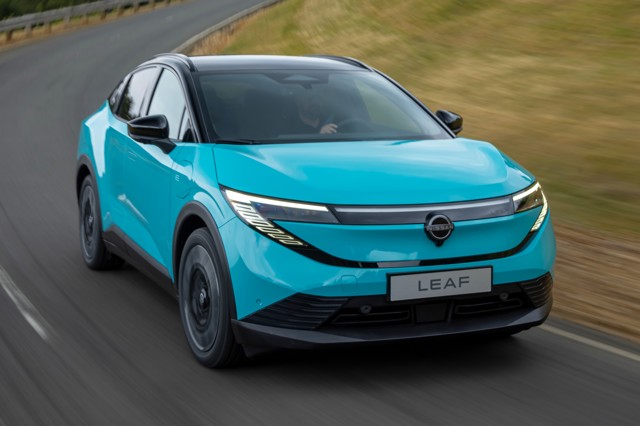
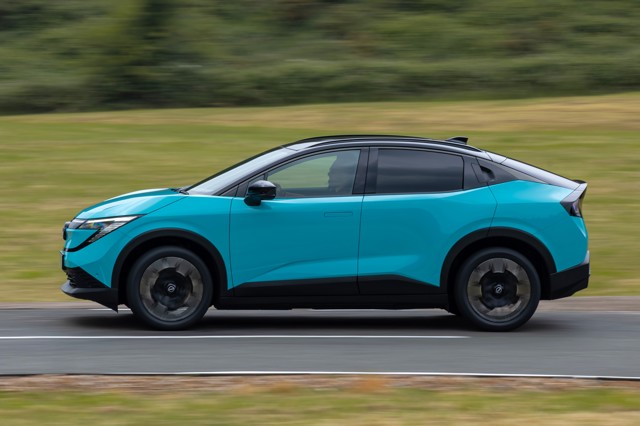
An electric SUV it now may be but Nissan’s gone for a smooth and slinky shape for the latest Leaf that contains a variety of details that add visual interest without being overtly polarising. Its nose features an LED light signature that frame a body-coloured blanked-off grille, while its sides are subtly sculpted and — at first glance — seemingly free of door handles.
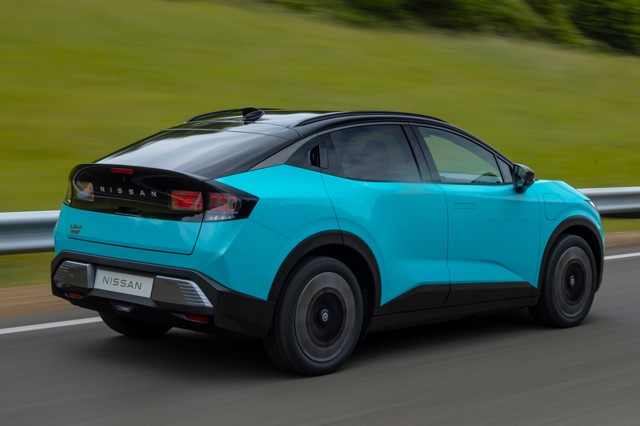
They are there, of course — the front ones pop-out and the rear ones are mounted just behind the rear window, just as they are on the latest Nissan Micra.
From behind, the Nissan Leaf looks borderline sporty thanks to the way in which its tapered roofline flips up with a gloss black-finished ducktail spoiler that melds into a panel below containing 3D-look LED tail lights. The Leaf’s rear is especially reminiscent of the latest incarnation of the Nissan Z sports coupe, a model no longer sold in the UK.
Underpinning the British-built Leaf is a development of the electric-only platform used by the larger Nissan Ariya. A notable development that’s part and parcel of that switch is the Leaf’s changeover from Chademo to CCS for DC rapid charging, making the search for the appropriately equipped public chargers far less challenging.
Two battery choices are available for the Nissan Leaf, labelled Standard and Extended. The former’s capacity is 52kWh giving a provisional WLTP Combined cycle range of 270 miles, while the latter’s 75kWh tally increases that potential to 375 miles. While EVs are generally far less efficient at motorway speeds, Nissan’s boldly claiming just over 200 miles can be covered at the legal limit before you’ll need to charge the Leaf up again.
Pending homologation, Nissan claims the Leaf’s 150kW on-board DC charger can deliver up to 260 miles of additional range to the larger battery option when plugged in for 30 minutes. As an extra-cost option, a vehicle-to-load (V2L) adaptor enables the Leaf to be used as a power source to plug external electrical devices into, as useful on touring holidays as it is while parked on your drive.
There’s no official word yet on the Nissan Leaf’s motor choices or power levels, let alone detailed rundowns of the expected trio of trim levels and their associated standard equipment, aside from 18-inch alloy wheels being fitted to all barring the most expensive model which rides on 19s.
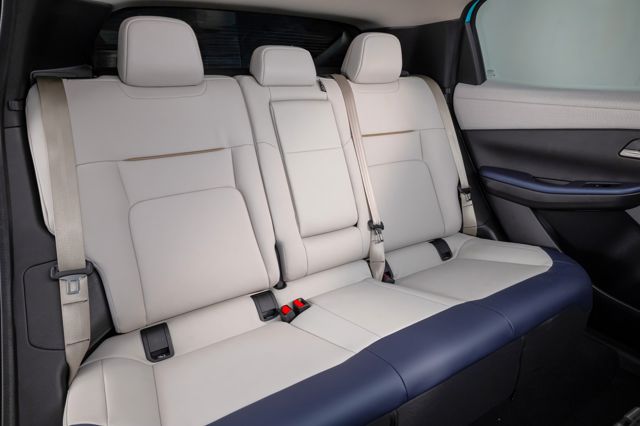
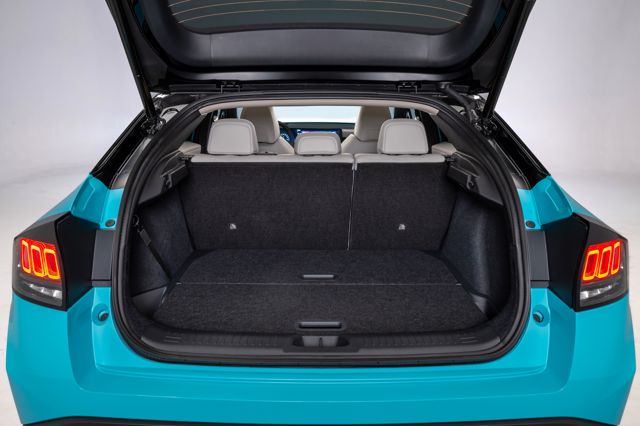
Interior space should be fine for five people but will likely be more comfortable for four, while the 437-litre boot space when the rear bench is in use should be ample for most families’ needs, despite being lower than the 470-litre capacity of both the Ford Explorer and Skoda Elroq, as well as the more compact Kia EV3’s 460-litre volume.
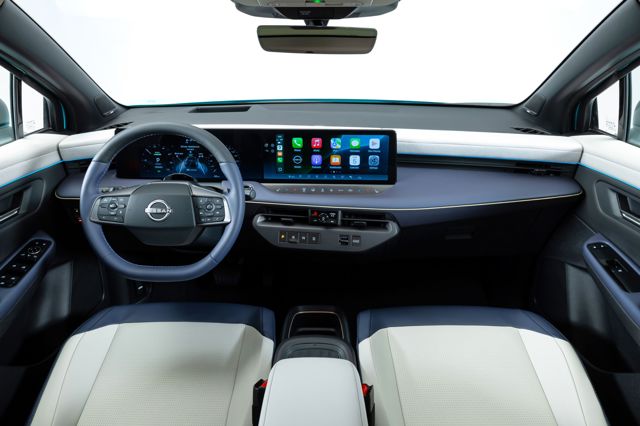
Echoing the Leaf’s unfussy exterior is its minimalist dashboard design which features a full-width horizontal plane with a dual 14.3-inch display panel positioned atop, the centrally sited one being a touchscreen for the multimedia system and doubtless a host of other functions.
That uncluttered approach results in the physical controls count being on the low side inside the Nissan Leaf. While it’s positive to see the temperature adjusters for the climate control system are permanently displayed on a touch-sensitive panel instead of buried within multimedia menus, it seems baffling that push buttons are used instead of a lever or rotary knob for selecting drive.
Other noteworthy features that will be available for the Nissan Leaf include an eight-point 360-degree camera system with an extra-wide front camera to aid manoeuvring out of areas with poor lines of sight, integral Google Assistant and Maps, plus a Bose Personal Plus audio package with a microphone and speaker set into the driver’s head rest to enabling calls to be made while other passengers continue listening to music.
Pricing and exact specifications for UK market Nissan Leaf models won’t be revealed until later in 2025, with the first cars reaching customers the following spring
Keep this page bookmarked further news on this important new range and to read our forthcoming full and comprehensive Nissan Leaf review in the months ahead.
Reviews for Nissan Leaf's top 3 rivals



Model History
November 2025
Nissan Leaf on sale now, priced from £32,349 including Electric Car Grant
The Nissan Leaf is now on sale, priced from £32,349. Built in the UK, the Leaf qualifies for the maximum £3750 government Electric Car Grant. First deliveries will take place in February.
The Leaf has a range of 386 miles from its 75kWh battery, while a 52kWh battery model, with a range of up to 271 miles, will be added to the range at a later date.
Four trim levels will be available - Engage, Engage+, Advance and Evolve. Engage includes a heat pump, satnav, 18-inch alloys, an 11kW AC charger and twin 12.3-inch displays.
Engage+ adds Google Services, heated front seats, a heated steering wheel, 14.3-inch screens and wireless phone charging.
Advance includes a panoramic roof, head-up display, powered tailgate, uprated head and tail-lights and synthetic leather upholstery.
Top-spec Evolve adds a BOSE nine-speaker audio system, V2L connector, 19-inch alloy wheels, power front seats and a massage function for the driver.
Nissan Leaf prices
Leaf Engage £32,249
Leaf Engage+ £33,149
Leaf Advance £34,249
Leaf Evolve £36,249
