
Hyundai i10 Review: Price, specs and boot space
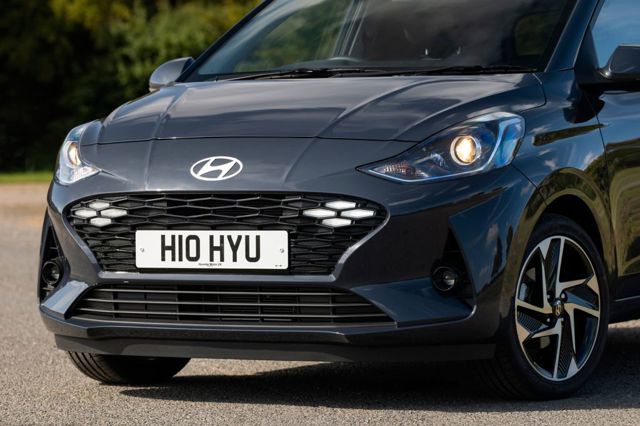

Hyundai i10 Verdict

 Much more refined, spacious and fun-to-drive than it needs to be. Packed with standard equipment. It’s a joy to own.
 Difficult to justify its high prices. Whines on the motorway like a huffy teenager. Never quite as good as the VW Up was.
Find out more about the Hyundai i10
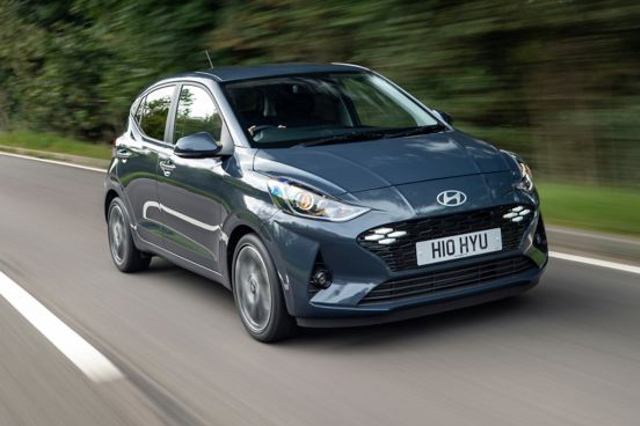
Small cars such as the Hyundai i10 are dying out — for some manufacturers, they're dead already. That's partly because of the whole electric cars switch, partly because people like their cars to look like SUVs now, including tiny ones — we see you Toyota Aygo X and partly because car-makers are also money-makers. Historically, little cars and profitability don't go hand-in-hand, which also explains why production of this model's now ended. Find out if it's worth finding a new one before they disappear with our full Hyundai i10 review.
Right now you can still pick up a brand new Hyundai i10, but probably for not much longer. Its production run started in 2019 and lasted until the end of 2025, so your choice is what's left in stock rather than a factory order.
To be honest, we wouldn’t necessarily recommend buying a box fresh i10 anyway. It’s a great little car, for sure — the perfect first car or second runabout — but the cheapest new one starts at around £18k and if you want it with a traffic-jam-friendly automatic gearbox, that'll be another £1000. Ouch.
Still, the Hyundai i10 is in almost every way the best new city car money can buy — apart from the Kia Picanto, which is essentially the same car and is still in production.
We’d also suggest that neither of Korea’s two city cars are quite as good as the Volkswagen Up, which was the modern city car perfected. It went to pasture in 2023, outlasting its SEAT Mii and Skoda Citigo siblings, but its ostensible simplicity and all-round brilliance mean it would still feel the pick of the bunch if it were still on sale new.
As they aren't available any more, what else are you left with besides the Kia and Toyota? Well, the Citroen C3 is a good shout, if a little larger — the same goes for the Fiat Grande Panda, which shares the same platform.
But if you’re still interested in an i10, you should know that it’s very difficult to fault the little Hyundai. Ergonomically it’s far above what you probably expect from a small car, which is to say you’ll actually fit into it and feel comfortable if you’re anything less than 6 feet 8 inches tall. Which you probably are, statistically.
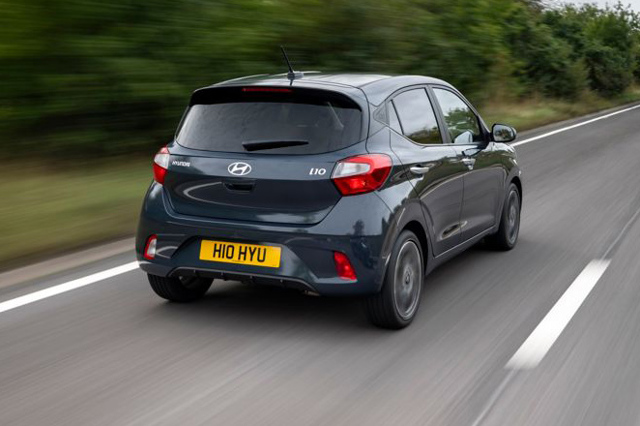
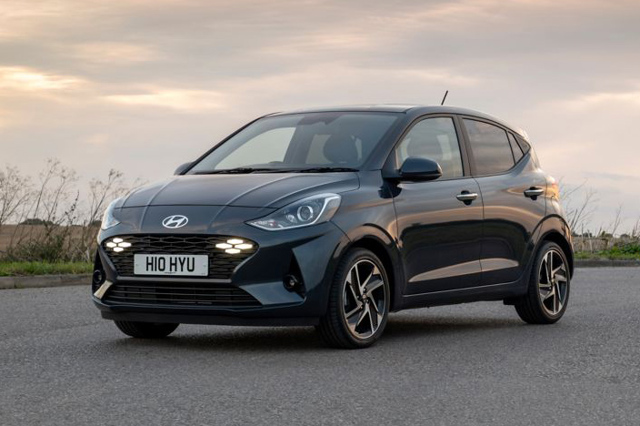
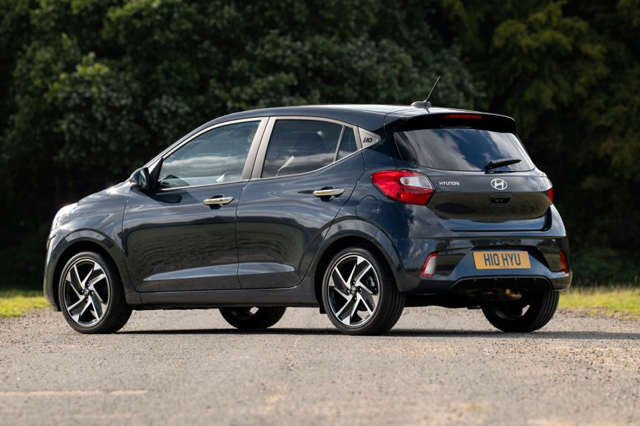
Its tall roof, big windows and five-door layout make it feel very spacious for a car with the same footprint as a matchbox. The boot isn’t ideal — put a couple of bags for life in there and that's all your floor space gone — but that’s because the focus has been on cabin room. A wise move.
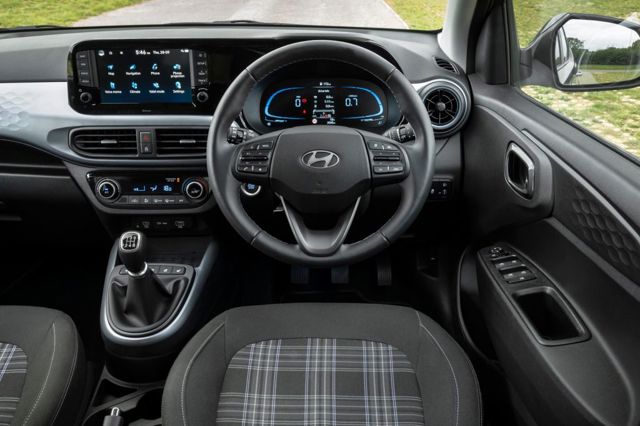
You could criticise the cabin quality for its use of hard, scratchy plastics, but that’s like criticising Primark for not making its underpants from real silk. It is what it is. It looks great, it’s hardwearing and — most importantly — all the controls are in the right place, so you can get to grips with it quickly and easily.
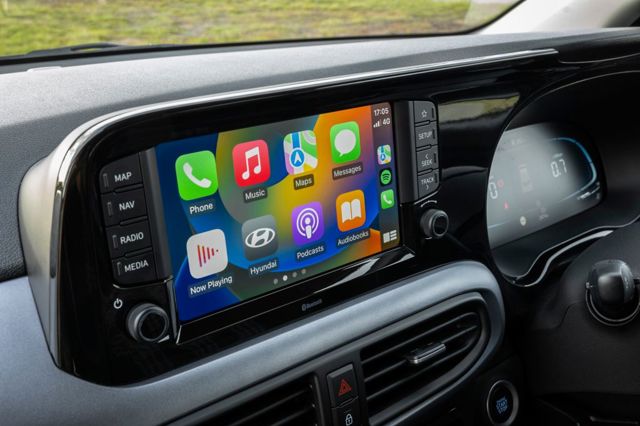
Really though, one of the reasons this is such a joyful little car is because it all feels second nature. Big air con controls, physical shortcut buttons for the touchscreen and infotainment software that’s easy to comprehend. In fact, we found that it links to multiple phones better than any other software we’ve experienced, seamlessly switching between them. If you have kids who like to listen to their dreadful music in the car, you’ll know how much of a hassle it can be switching the connection from your phone to theirs.
So it’s easy to live with. Thankfully, driving it is the same. The pedals and gearbox have a lovely smoothness, and on the road the Hyundai i10 strikes a fine balance between soft comfort and controlled body movement when cornering.
Actually, we’d argue that this is one of the most fun-to-drive cars you can buy. Really. The basic simplicity of it all gives you a sense of ‘feel’ that’s almost impossible to find in more complex cars, even expensive sportscars.
If you’re a bit older, the i10 will remind you of how cars used to feel — slightly bouncy, slightly noisy, slower than an episode of Better Call Saul, but for all those reasons tonnes of fun to thrash around. Unless you're really into acceleration of any sort. There's not much of that.
It’s not a car to buy if you spend a lot of time on the motorway. Neither the little engine nor the noise suppression can cope. But if you’re just looking for a way to get to the shops and that, and you can live with the price, the Hyundai i10 is proper, proper good.
Reviews for Hyundai i10's top 3 rivals

Hyundai i10 handling and engines
- Engines range from 1.0 63 AMT to 1.2 MPI
- Readers report Real MPG to be between 41–61 mpg
Hyundai i10 2026: Handling and ride quality
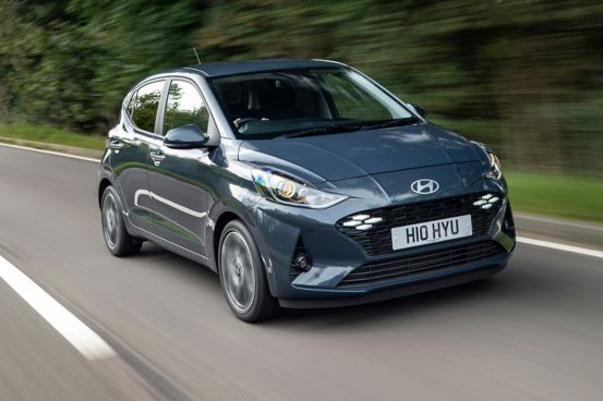
The Hyundai i10 is designed primarily for city driving, feeling more at home there than anywhere else. But what makes it great is that it also feels like a high quality car, rather than a compromised small car built down to a price.
Its small footprint, excellent visibility and teeny turning circle make it fantastic in high-traffic areas. Which is to say that it’ll fit into tight parking spaces and leave enough room to get in and out comfortably, nor will you be terrified of scraping the bumpers on your way out of a multi-storey car park.
It’s only really on the motorway where the i10 feels like a small car, but then you’d expect that so it’s no big deal. It’s far from frustrating but you’ll find yourself dealing with significant cabin noise from 60mph upwards — mostly from the tyres and wind — and that’s coupled with a sense that it isn’t as firmly planted as, say, an average family SUV. Still, because it’s fundamentally comfy, you will be able to do a couple of hundred miles in an i10 and come out feeling okay.
In a city or on a B-road, things are much better. The i10 pulls off the neat trick of being soft and supple enough to be comfy, without bouncing its occupants around like they’re trapped in a cement mixer. It makes the i10 equally as adept at pootling around a city centre as it is being driven enthusiastically in the countryside.
Hyundai i10 2026: Engines
Surprisingly for a small car line-up there are five petrol engine and gearbox combinations currently available for the Hyundai i10. Manual and automatic-style transmissions can be matched to the two lowest-powered engines, but the punchiest is manual-only.
The i10's five-speed manual really suits the nature of the car, whereas the five-speed automated manual transmission (AMT) isn't as smooth as a traditional automatic. Although it changes gears itself, it operates with an automatic clutch, which is a cheaper way of producing a self-shifting transmission.
We’d only recommend it if you know that traffic jams will be an ever-present feature of your daily commute. It’s quite crude in operation, being clunky, slow to change gear and produces a significant amount of body vibration when doing its job. Unless your licence is automatic-only, we say stick with the manual.
The best setup is the most basic, we reckon. That's the 1.0-litre, three-cylinder engine paired with a manual gearbox. On paper it looks hopeless with 63PS of power and 93Nm of torque, taking 15.6 seconds to crack 62mph from a standstill. Yet on the road, it’s actually very good. It feels quicker than it is and it makes that characteristic three-cylinder ‘growl’ when you push it, while costing less to fuel than a lawnmower.
Opt for that 1.0-litre engine with the AMT automated gearbox and that 0-62mph stretches out to a very leisurely 18.4 seconds.
The 1.2 petrol gets an extra cylinder to develop 79PS and 112Nm of torque, but it loses character and never actually feels that much quicker than its smaller alternative. With the manual gearbox the 0-62mph sprint takes 13.2 seconds, while the AMT auto requires 16.6 seconds to do the same.
Sportiest, relatively speaking, is a turbocharged version of the 1.0-litre unit, producing 90PS and a far more urgent 171Nm of torque. Those increases are evidenced with it's brisker 11.4-second 0-62mph sprint and its adeptness at overtaking with greater confidence.
Hyundai i10 2026: Safety
The Hyundai i10 comes with more safety kit than you might expect for a little, ‘basic’ car. All versions get automatic headlights with main beam assist, which dips the beam when oncoming vehicles are detected. Cruise control is also fitted as standard, along with a comprehensive package of safety tech that prevents the i10 from straying out of its lane.
It will also automatically apply the brakes if the system thinks an impact is imminent, or urge the driver to take a break if it detects poor driving caused by fatigue — and it does so subtly, occasionally reminding you that you might be tired, rather than bonging at you every few seconds like some newer cars do.
But you can’t cheat physics — when the Hyundai i10 was last crash-tested by Euro NCAP in 2020 it only scored three stars out of five. Since then the standards have become even more stringent.
Hyundai i10 2026: Towing
Unsurprisingly, the Hyundai i10 is not a car designed for towing heavy loads. It's intentionally very small and light and as a result, it's rated to pull just 310kg regardless of whether your trailer is braked or not.
That’s basically enough for a couple of kayaks or an empty trailer — less pulling power than a former Love Island contestant, then.
| Engine | MPG | 0-62 | CO2 |
|---|---|---|---|
| 1.0 MPI | - | 14.6–17.3 s | 114–126 g/km |
| 1.0 T-GDi | - | 10.5 s | 123 g/km |
| 1.2 MPI | - | 12.6–15.8 s | 124–130 g/km |
Hyundai i10 interior
- Boot space is 252–1050 litres
| Dimensions | |
|---|---|
| Length | 3670 mm |
| Width | 1961 mm |
| Height | 1480 mm |
| Wheelbase | 2425 mm |
Hyundai i10 2026: Practicality
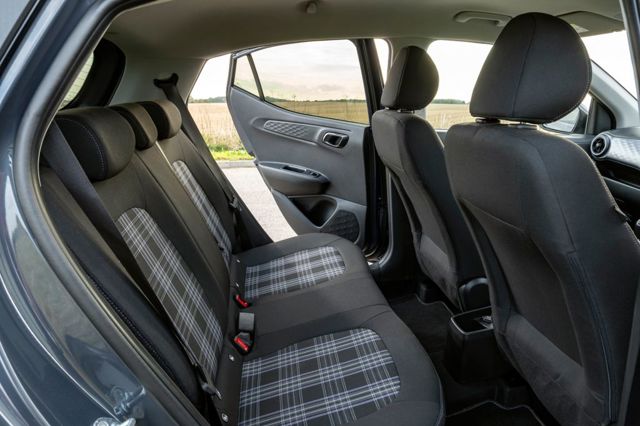
What really makes the Hyundai i10 stand out against most other city cars is its rear seat space. You can actually fit four adults into a car this small in comfort. Impressive.
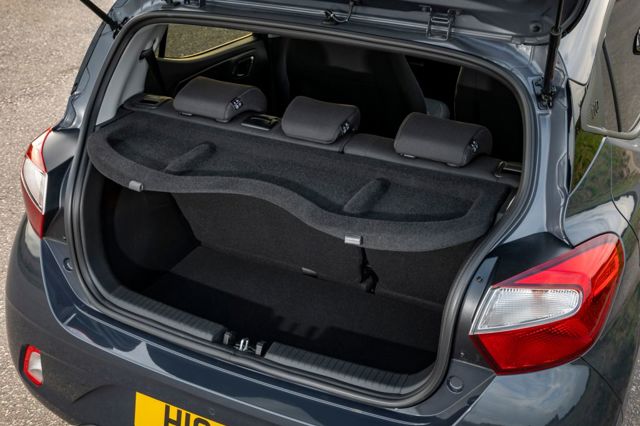
Its boot volume of 252 litres means the i10 has enough space to carry two large suitcases, albeit there’s not much floor space as it's short but deep. You’ll be stacking your bags for life on top of each other if you use this for the weekly shop. Still, the rear seats have a 60/40 split and can easily be lowered, so if you’re on your own, there’s actually a good deal of space for stuff.
But like a Clark's welly, it’s a basic boot. You’ll find none of the hooks, nets or hidden storage compartments that you would in a higher-priced hatchback — the i10 has a space and that’s about it. Its high boot lip and narrow opening make it a little awkward to make the most of the space, while the non-adjustable boot floor means you have to lean in to lift out heavy objects.
Interior storage is decent, if unsurprising. Decently sized door pockets will hold multiple old crisp packets, the cupholders will hold the base of a Stanley cup (just) and the glovebox is a useful oblong of air.
Hyundai i10 2026: Quality and finish
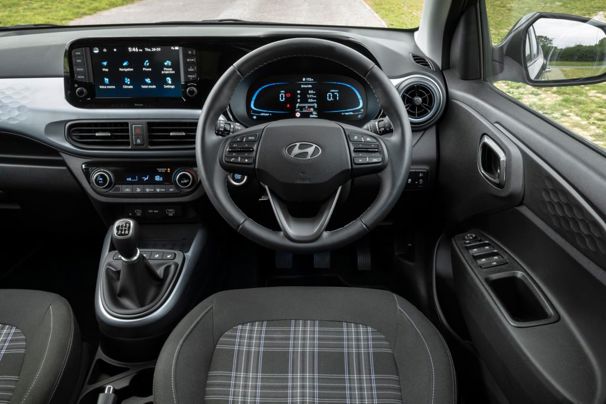
A decent job's been made of making the Hyundai i10's plasticky interior look appealing. The surfaces are textured and there’s even a couple of shades of grey in there. It’s all hardwearing and easy to clean, yet it certainly doesn’t feel cheap — especially now that all versions come with an 8.0-inch touchscreen, which takes up most of your focus.
Only cloth-upholstered seats are available in the i10 but they’re textured nicely and — much more importantly — they’re very comfortable. Their firm padding and wide base support the lower back and upper legs very well. After 200 miles on the M1 your body will be more comfy than your ears are.
Hyundai i10 2026: Infotainment
Not too long ago, basic Hyundai i10s came with a black and white radio display, making the whole thing feel like something you were only driving because your own car was being repaired at some back street garage.
That’s no longer the case, with all models getting the same 8.0-inch touchscreen but with menus supplemented by — drum roll, please — physical buttons. It’s not the flashiest system on the market but honestly, we reckon it’s one of the best. Easy to use on the move, it uses the screen space well and connects to multiple phones very easily. Wireless Apple CarPlay and Android Auto make it feel as modern as anything else out there.
Thankfully, operating the heating and air conditioning controls is easy too, with Hyundai retaining traditional buttons and rotary knobs below the touchscreen.
Hyundai i10 value for money

Hyundai i10 2026: Prices
The Hyundai i10 no longer looks cheap — you can get the similarly sized electric BYD Dolphin Surf for less money, for instance — but it remains a good value new car.
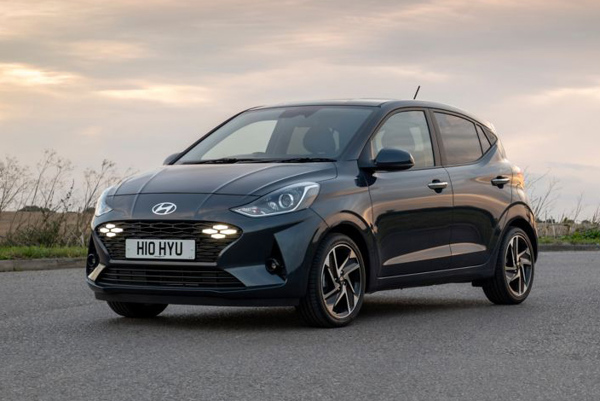
Brand new prices start at £18,350 for the entry-level Hyundai i10 Advance with the excellent 1.0-litre 63PS engine and a manual gearbox. The upgrade to Premium trim does get you some desirable kit but adds £1300 to the price. For us, although the bigger 16-inch wheels and nicer tartan upholstery make the look a little better, it doesn’t feel worth it. Especially when the basic engine is the pick of the range.
Upgrading both the i10 Advance and Premium to the 1.2-litre 79PS engine adds £800 to the bill, while both engine sizes can be fitted with an optional automated gearbox for £650 more.
Topping the range is the Hyundai i10 N Line 1.0T 90PS, with a zippier engine and sportier looks to match — it weighs in at £20,950.
Of course, you can save more by buying a used example — Hyundai's excellent warranty package of five years with unlimited mileage, means that most i10s of this generation will still have some cover left for extra peace of mind. A budget of half what you’ll pay for a new one will get you a vast choice of examples, without many miles on the clock.
Hyundai i10 2026: Reliability and running costs
Despite the Hyundai i10 packing engines that are hardly at the cutting-edge of fuel-saving tech — there's no hybridisation here — they will prove cheap to run. This is a small, light car with small, light engines. They all have start/stop as standard, which is especially useful in a car that will probably spend a lot of its time stopping and starting in built-up environments.
Hyundai claims up to 55.4mpg from the 1.0-litre engine with the manual gearbox, but you should be in the high 40s mpg-wise in the real-world, especially if you’re mostly doing lower speed city driving. The automatic version reduces efficiency down to a best of 53.3mpg officially, the same as the 1.2-litre manual and the turbocharged 1.0-litre in the i10 N Line. Adding the auto to the 1.2 engine trims its best efficiency figure down to 51.4mpg.
You're unlikely to feel the i10's that expensive to run because the fuel tank is 36 litres, meaning it’s only going to cost you around £40 to brim the tank.
Lack of power, lack of complication and, let’s face it, lack of desirability to thieves means the Hyundai i10 doesn’t cost much to insure either. It’s in groups 2-5 on the 1-50 scale, so you’re looking at premiums akin to insurance for a fancy dog. Great first car, this.
Satisfaction Index
 What is your car like to live with?
We need your help with our latest Satisfaction Index, so that we can help others make a smarter car buying decision. What's it like to live with your car? Love it? Loath it? We want to know. Let us know about your car - it will only take a few minutes and you could be helping thousands of others.
Help us with the Honest John Satisfaction Index nowHyundai i10 models and specs
Three trim levels are available for the Hyudai i10 — Advance, Premium and N Line.
Standard equipment for the Hyundai i10 Advance includes:
- 15-inch alloy wheels
- Body-coloured bumpers and door mirror housings
- Rear spoiler
- LED daytime-running lights
- Automatic main beam
- Electrically adjustable and heated door mirrors
- Electric windows front and rear
- Rear parking sensors
- Reversing camera
- Driver's LCD instrument cluster
- 8.0-inch multimedia touchscreen
- Integral navigation system
- Bluetooth device connectivity
- Wireless Android Auto and Apple CarPlay phone connectivity
- Four-speaker audio system
- USB-C charging sockets front and rear
- Height-adjustable driver's seat
- Black cloth upholstery with white stripe
- Leather-wrapped steering wheel and gearknob
- Manual air-conditioning
- Cruise control
- Hill-start assist
Additional features for the Hyundai i10 Premium include:
- 16-inch alloy wheels
- Automatic bi-function projection headlights
- Front fog lights
- Electrically adjustable, folding and heated door mirrors
- Dark-tinted rear privacy glass
- Keyless entry and starting
- Wireless smartphone charging pad
- Heated front seats
- Black cloth upholstery with tartan-pattern inserts and purple stitching
- Heated steering wheel
- Automatic climate control air-conditioning
- Blue interior ambient lighting
Using the Advance as its starting point, the following features are standard on the Hyundai i10 N Line:
- 16-inch N Line-specific alloy wheels
- N Line Design Package exterior styling
- Automatic bi-function projection headlights
- Front fog lights
- Electrically adjustable, folding and heated door mirrors
- Gloss Black door mirror housings
- Wireless smartphone charging pad
- Heated front seats
- Black and Red N Line design cloth upholstery with N logo
- Heated steering wheel
- Automatic climate control air-conditioning
- Blue interior ambient lighting
| Dimensions | |
|---|---|
| Length | 3670 mm |
| Width | 1961 mm |
| Height | 1480 mm |
| Wheelbase | 2425 mm |
| Miscellaneous | |
|---|---|
| Kerb Weight | 993–1045 kg |
| Boot Space | 252–1050 L |
| Warranty | 5 years / Unlimited miles |
| Servicing | 12000 miles |
| Costs | |
|---|---|
| List Price | £14,590–£18,855 |
| Insurance Groups | - |
| Road Tax Bands | C–D |
| Official MPG | - |
| Euro NCAP Safety Ratings | |
|---|---|
| Adult | - |
| Child | - |
| Pedestrian | - |
| Overall | - |
Currently on sale
| Hatchback | |||
|---|---|---|---|
| Version | List Price | MPG | 0-62 |
| 1.0 MPI 67ps Premium 5dr | £14,590 | - | 14.6 s |
| 1.0 MPI 67ps Premium Auto 5dr | £16,550 | - | 17.3 s |
| 1.2 MPI 84ps Premium 5dr | £16,850 | - | 12.6 s |
| 1.2 MPI 84ps Premium Auto 5dr | £17,350 | - | 15.8 s |
| Advance 63 MPi AMT Auto Start/Stop 5dr | - | - | - |
| Advance 63 MPi Start/Stop 5dr | - | - | - |
| Advance 67 MPi AMT Auto Start/Stop 5dr | £16,405 | - | - |
| Advance 67 MPi Start/Stop 5dr | £15,755 | - | - |
| Advance 79 MPi AMT Auto Start/Stop 5dr | £17,555 | - | - |
| Advance 79 MPi Start/Stop 5dr | £16,555 | - | - |
| Advance 84 MPi AMT Auto Start/Stop 5dr | £16,605 | - | - |
| Advance 84 MPi Start/Stop 5dr | £15,955 | - | - |
| N Line T-GDi 100 Start/Stop 5dr | £15,965 | - | 10.5 s |
| N Line T-GDi 90 Start/Stop 5dr | £18,355 | - | - |
| Premium 63 MPi AMT Auto Start/Stop 5dr | £18,055 | - | - |
| Premium 63 MPi Start/Stop 5dr | £17,055 | - | - |
| Premium 79 MPi AMT Auto Start/Stop 5dr | £18,855 | - | - |
| Premium 79 MPi Start/Stop 5dr | £17,855 | - | - |
On sale until June 2023
| Hatchback | |||
|---|---|---|---|
| Version | List Price | MPG | 0-62 |
| 1.0 MPI 67ps SE Connect 5dr | - | - | 14.6 s |
| 1.0 MPI 67ps SE Connect Auto 5dr | - | - | 17.3 s |
| 1.2 MPI 84ps SE Connect 5dr | - | - | 12.6 s |
| 1.2 MPI 84ps SE Connect Auto 5dr | - | - | 15.8 s |
On sale until April 2023
| Hatchback | |||
|---|---|---|---|
| Version | List Price | MPG | 0-62 |
| 1.0 MPI 67ps SE 5dr | - | - | 14.6 s |
Model History
- September 2019: Hyundai i10 revealed
- September 2019: Hyundai i10 N-Line announced
- December 2019: Hyundai i10 prices and specifications confirmed
- July 2020: Hyundai i10 N Line priced from £16,195
September 2019
Hyundai i10 revealed
The new Hyundai i10 has made its debut ahead of its official reveal at the 2019 Frankfurt Motor Show.
With a lower roof and wider body than its predecessor, Hyundai says the i10 has a 'young and dynamic design'. Customers can choose from 10 exterior colours including three new ones: Dragon Red, Brass and Aqua Torquoise. Buyers will also be given the option of a two-tone roof in either Black or Red.
The interior offers four different interior colour combinations as well as more space, thanks to an increased wheelbase compared to its predecessor. There's a 252-litre boot which is easily accessed thanks to a lip that's been lowered by 29mm. The rear seats can also be dropped using one hand.
There's a host of new connectivity features, allowing drivers to locate their car using an app on their phone, as well as send points of interest to the car's in-built navigation system. The car will also be available with Apple CarPlay and Android Auto, as well as wireless phone charging.
The new i10 will be available at launch with two engines: a 1.0-litre MPi three-cylinder petrol with 67PS and 96Nm torque, as well as a 1.2-litre MPi four-cylinder with 84PS and 118Nm torque.
Both engines are available with two transmission choices, which consist of a five-gear manual transmission and a five-gear automated manual transmission - a replacement for the traditional auto gearbox used in the old model.
September 2019
Hyundai i10 N-Line announced
Following the recent unveiling of the new i10, Hyundai has announced a sporty N-Line model, set to go on sale in Europe next summer.
Exterior design enhancements include redesigned bumpers and grille, along with exclusive 16-inch alloy wheels and LED Daytime running lights. Other exclusive design features include the N Line emblem, i10 sign in red font, as well as a skid plate and diffuser. Customers can also choose from a total of six exterior colours which can be combined with a two tone roof.
Inside, the i10 N-Line features an N-branded steering wheel and gear shift lever, as well as red air vent rings and metal pedals. Meanwhile, the sporty seats offer more support for performance-oriented driving precision.
The i10 N Line offers an exclusive 1.0-litre T-GDi 3-cylinder with 100PS and 172Nm torque. This is in addition to the 1.2-litre MPi 4-cylinder with 84PS and 118Nm torque. Both engines are available with a five-gear manual transmission.
December 2019
Hyundai i10 prices and specifications confirmed
Hyundai has announced the pricing and specification of the new i1 ahead of it going on sale on the 18th January.
Going into its third generation, Hyundai says the new i10 will offer a comprehensive upgrade over previous models, with a substantial make over in exterior and interior design, equipment and driving dynamics. A brand new car from the ground up, the new i10 will reposition the model within the A segment and will offer many USP’s against its competitors with a focus on technology, segment leading connectivity and safety features and a full five-seat configuration.
Exterior design has evolved from the previous generation, with the i10’s dynamic and sleek design offering a contrast between its soft surfaces and sharp lines. Compared to its predecessor, the new i10 has enhanced proportions, with its visual stance improved by a lowered roof (20mm), wider body (20mm) and longer wheelbase (40mm). These enhancements can be complemented by newly-designed optional 16-inch alloy wheels.
All new i10's interior design further demonstrates the repositioning of the model when compared to the previous generation, without losing any of the i10’s reputation for real world convenience and usability. The entry level S specification of the previous model is now no longer available; with customers now enjoying the increased specification of SE trim at the starting point of the new i10 range.
The i10 SE 1.0 MPi 67PS 5 speed manual is available from £12,495. Standard equipment includes DAB radio with 3.8-inch display, Bluetooth, air conditioning, electric windows, leather steering wheel and gear lever, electric mirror adjustment and cruise control. Standard safety equipment includes Lane Keep Assist (LKA), Driver Attention Alert (DAA), High Beam Assist (HBA) and Forward Collision Warning System (FCWS) with integrated Autonomous Emergency Braking (AEB), Lane Departure Warning System with Lane Keep Assist (LKAS) and eCall, which can automatically dial emergency services in the event of a serious accident, shortening response times and improving post-accident protection.
The i10 SE Connect trim starts at £13,495 with the 1.0 MPi 67PS 5 speed manual. Specification enhancements over the SE include 15-inch alloy wheels, an 8-inch touchscreen display audio, rear view camera, subscription free Apple CarPlay and Android Auto, Bluetooth with voice activation and 2 rear speakers. The i10 SE Connect is also available with a 1.2 MPi 84PS four cylinder engine, with both powertrains available as a 5 speed manual, or a new 5 speed automated manual transmission.
The i10 Premium 1.0 MPi 67PS 5 speed manual starts from £14,495 and includes 16” alloy wheels, halogen bi-function headlamps with integrated position light, LED daytime running lamps, front fog lamps and privacy glass. Interior specification is further enhanced with heated front seats and steering wheel, as well as a unique to Premium honeycomb design to the dashboard, door and gear lever surround trims. The i10 Premium is also available with a 1.2 MPi 84PS four cylinder engine, with both the 5 speed manual, or new 5 speed automated manual transmission available.
Customers choosing the Premium specification can also choose the optional Tech Pack which offers a wireless charging pad for compatible handheld devices and adds an 8” touchscreen navigation with Bluelink® telematics, giving owners the ability to locate the vehicle via GPS, LIVE services and additional navigation services such as the ability to send navigation instructions via smartphone and remotely lock the vehicle. In addition to the driver convenience features, Bluelink® also serves as a convenient diagnostic tool which will notify the driver of any vehicle maintenance issues that require attention. The Tech Pack also adds the intelligent speed limit warning function that provides the driver with a visual indication of the current speed limit. The Tech Pack is a £1000 option on Premium models.
July 2020
Hyundai i10 N Line priced from £16,195
The i10 N Line introduces a number of external and internal design features influenced by the lauded i30 N, as well as chassis enhancements specific to the model. i10 N Line also introduces the 1.0 T-GDi petrol engine, offering 100PS and 172Nm of torque from only 1500rpm.
N Line styling changes over the rest of the i10 range include exterior features such as a bespoke N Line front grille with integrated LED daytime running lamps, unique design N Line 16” alloys, N Line badging to the front wings, dual chrome exhaust tips, rear LED combination lamps and red stripe finishing to the front and rear bumpers. Interior design features include N branded steering wheel and gear stick, N Line cloth seats with red stitching, rear privacy glass, black roof liner and red air vent details.
As well as styling, i10 N Line also introduces a number of powertrain and chassis changes over the standard model. These include the introduction of the 3 cylinder 1.0 T-GDi petrol engine with 100PS and 172Nm of torque, giving a 0-62 time of 10.5 seconds and a 115mph top speed. Chassis changes for i10 N Line include an increased spring rate, longer rear bump stops and new rear shock absorbers with enhanced compression control.
i10 N Line is available in a choice of 4 colours, with a no cost option solid finish and a choice of 3 pearl finishes for £550. An additional two tone finish is available for £500:
