
Volkswagen ID.Buzz Review 2026

Volkswagen ID.Buzz At A Glance

 The most stylish electric van around. Refined and composed driving experience. Fastest charging VW electric vehicle. Good value seven-seat option.
 Premium pricing of passenger version. Frustrating climate control buttons.
The Volkswagen ID.Buzz is the first electric van/MPV that appeals to the heart as well as the head. Its funky styling and bold colour options mean it'll stand out, and the cabin is impressive in terms of its space, style and quality. But what is it like to drive and live with? Read on for our full Volkswagen ID.Buzz review.
Volkswagen calls the ID.Buzz its "most emotional electric car yet". That doesn't mean it'll cry on command, but it does mean it's been designed from the start to be brimming with character and desirability.
It's also a firm nod to a core part of VW's history. The world-famous Type 2 was more than a simple van with an air-cooled engine: it became a lifestyle for many. Whether you're a hippy keen to relive the Swinging Sixties, a camping enthusiast, or just after a simple, stylish classic with room for the family, you'll understand that car's global appeal.
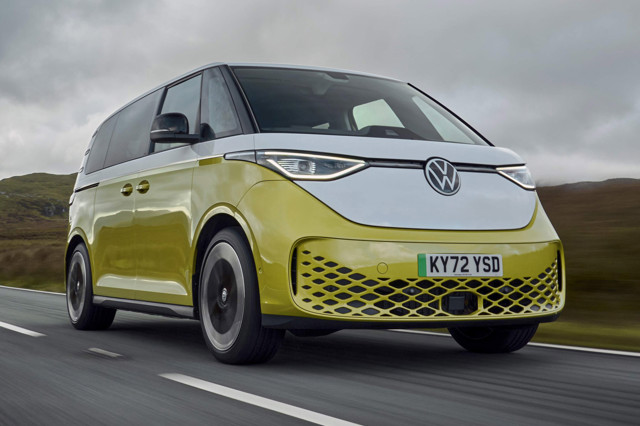
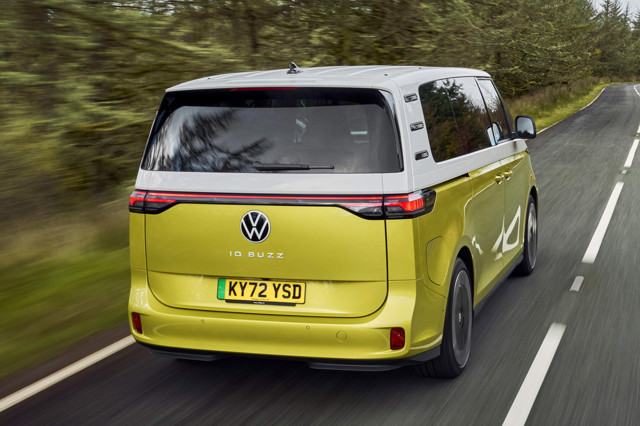
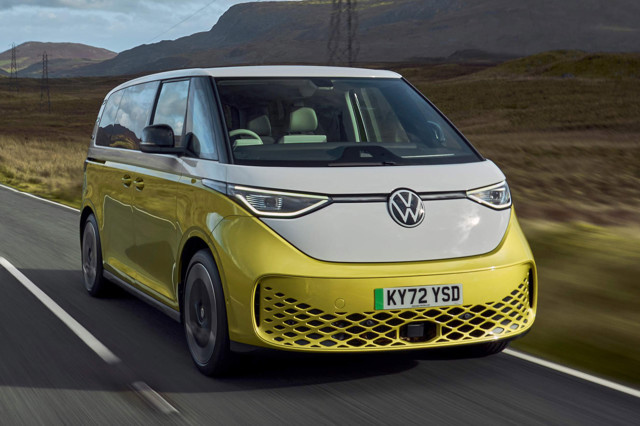
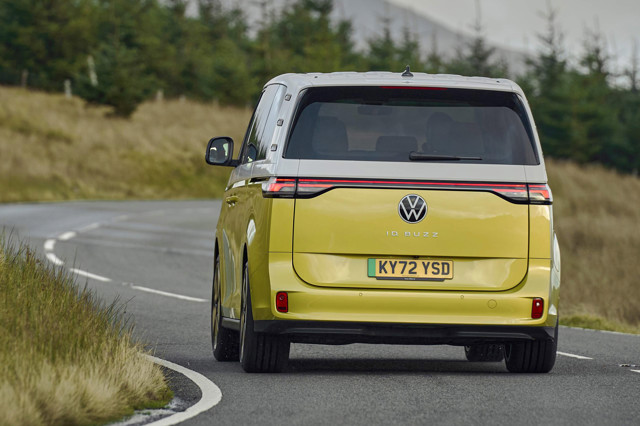
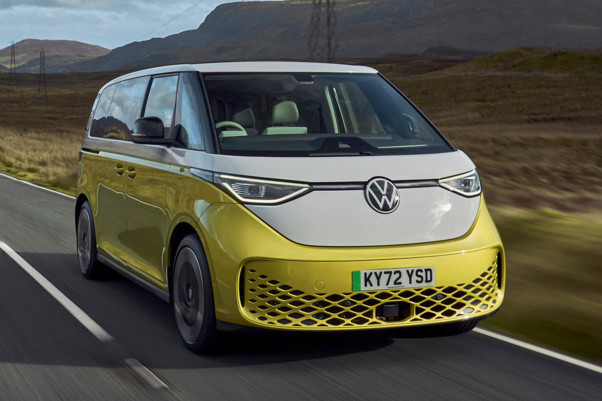
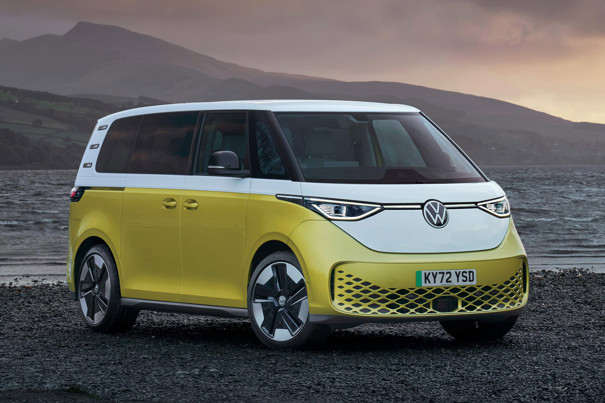
The ID.Buzz is Volkswagen's attempt to revive that spirit, and the car's retro-modern styling is seriously cool, no matter how cynical you might be towards such tactics. It's a design that's cohesive and brilliantly judged.
Bold colour schemes and two-tone paint jobs are available, and the bolder you are, the better the ID.Buzz looks. The ID.Buzz is also available as a panel van as well as a passenger car, and the commercial version looks very nearly as cool, and so could very well lend your business some street cred if such a thing is desirable.
And despite the old-school design, the all-electric powertrain beneath is anything but. The precise specs have chopped and changed a bit over the years that the car has been on sale (it was first released in 2022), but regardless of the vintage and spec of your ID.Buzz, you can expect performance that ranges from brisk to borderline bonkers, and an official range of somewhere between 250- and 300 miles, although don't expect that in the real world.
It was initially offered only in five-seater short-wheelbase (SWB) form, which didn't really maximise its MPV proportions, although the space inside was still truly exceptional. That changed in 2024, though, when a new long-wheelbase (LWB) version was brought to market, with the option of six- or seven seats, and this made the ID.Buzz into the car it arguably always should've been.
At the same time, Volkswagen brought in some significant upgrades in powertrain output, battery capacity and equipment specification (although all versions - even the entry-level Life trim - have always been well equipped), and a new range-topping GTX trim was also introduced, with four-wheel drive and considerably more power than the rest of the range.
You might also be surprised, given its MPV shape, with how enjoyable the Volkswagen ID.Buzz is to drive. It's based on the same MEB underpinnings as the ID.3, ID.4 and ID.5, but if anything, the Buzz is even more fun thanks to superb visibility, a raised driving position and a proper wheel-at-each-corner stance. It's comfortable, too: surprisingly so, as heavy electric cars can often struggle when you hit a pothole.
The Buzz's cabin is also a delight, with a bold mix of colours and a genuinely special feel on high-end versions. Quality is good, there's plenty of tech and there's space for an adult in every seat, regardless of how many you have. Boot space is also very impressive.
No, it most certainly isn't cheap. However, the VW ID.Buzz has a rare level of both charm and competence, and as a result, feels worth the money you pay.
Volkswagen ID.Buzz: Range and charging times
| Volkswagen ID.Buzz SWB | 275-283 miles |
| Volkswagen ID.Buzz GTX SWB | 339 miles |
| Volkswagen ID.Buzz LWB | 283-293 miles |
| Volkswagen ID.Buzz GTX SWB | 282 miles |
The ID.Buzz's range depends on the vintage of car you're talking about, because there have been changes to the car's spec during its life. When it first went on sale, it was available exclusively with 204PS rear-wheel drive powertrain fed by a 77kWh battery. This delivered you a range of up to 258 miles in Life trim, or up to 255 miles when paired with Style trim (the difference comes down to the larger wheels and the extra weight of the extra equipment in Style cars).
That changed in 2024 with the arrival of both the long-wheelbase (LWB) version and the sporty GTX variant, and in a variety of ways. The battery in the existing short-wheelbase (SWB) car was uprated from 77kWh to 79kWh: this gave new improved range figures of up to 283 miles in the Life, up to 275 miles in the Style, and up to 339 miles in the GTX (in each case, cars with the six-seater configuration got a few miles less - we're talking single-digits, here - than their five-seater equivalents). These improved figures were despite the rear-drive powertrain being uprated from 204PS to 286PS (quite a jump!) at the same time, while powertrain in the new GTX model was a twin-motor all-wheel-drive affair with a whopping 340PS.
Meanwhile, all long-wheelbase models, regardless of power output or trim level, got a larger 86kWh battery. This gave range figures of up to 293 miles for the Life, 283 miles in the Style, and 282 miles in the GTX (in a similar way to before, seven-seater versions got a few miles less than their six-seater counterparts).
The cheapest way of charging your car will be to do it at home, and the most time-efficient way of doing that will be on a 7kW home wallbox charger. A charge of the 77kWh battery will take around 8.5 hours on such a connection, a few minutes more for the 79kWh battery, while the 86kWh battery will take around 9.0 hours.
The quickest way of charging is to use a public DC rapid charger, but this will also be by far the most expensive way of charging. The different battery packs have different maximum DC charging speeds. The 77kWh battery's maximum is 170kW, getting you a 5% to 80% charge in 30 minutes at an appropriately powerful charger. Meanwhile, the 79kWh battery can take on DC charge at a maximum rate of 185kW, while it's 200kW for the 86kWh battery: either way, a 10% to 80% top-up should take 26 minutes.
Reviews for Volkswagen ID.Buzz's top 3 rivals


Volkswagen ID.Buzz handling and engines

Volkswagen ID.Buzz 2026: Handling and ride quality
Nobody will look at the Volkswagen ID.Buzz and think "yes, I want to fling that into a tight corner at breakneck speed". But as it's based on a car platform (the same MEB platform as other ID models) it's actually surprisingly nimble to drive.
Around town, its sheer width is its only real restriction, being as wide as a Range Rover. But it's easier to thread through traffic than your average large SUV because you know exactly where the extremities are (it's a big box after all) and you have excellent all-round visibility and tiny overhangs. You also get a decent turning circle of 11.2 metres, or 11.8 metres with the LWB car.
The ID.Buzz also has a comfortable ride whatever speed you're doing. It feels a touch softer than other ID models, with a smooth, isolating feel, even with 20-inch wheels fitted. Even so, body movements are well tied down enough that that the car doesn't float and bob untidily on an undulating road.
Granted, the can leans a bit as you turn a corner, but not as much as you might think because the floor-mounted batteries keep the centre of gravity low. It's certainly more confidence-inspiring than a traditional van-based model, with relatively precise and accurate steering. We only found the limits of its grip levels by briefly pushing it beyond what any owner is likely to do.
Volkswagen ID.Buzz 2026: Engines
When the ID.Buzz first went on sale, it had a 77kWh battery pack that fed a a rear-mounted 204PS electric motor that drives the rear wheels. With a torque output of 310Nm, it'll go from 0-62mph in 10.2 seconds whether you go for the passenger or Cargo version, although in our experience, the lighter Cargo feels ever so slightly quicker.
The on-paper figures will hardly blow you away in a world where a seven-seat Tesla can get from 0-62mph in under three seconds. But in reality it feels plenty fast enough for a near 2.5-tonne bus, with perky about-town performance and enough higher speed grunt to not frustrate on a motorway.
Powertrain improvements were made in 2024 with the arrival of both the LWB version and the sporty GTX range-topper. The previous 204PS rear-mounted motor was upgraded to a 286PS one, trimming the 0-62mph time to 7.6 seconds on the SWB car and to 7.9 seconds on the LWB car. That's quite a difference, and it really feels it, with a very sprightly character, especially off the mark.
The GTX, meanwhile, gained an additional motor on the front axle to give it four-wheel drive, and a total output of 340PS. It'll sprint from 0-62mph in 6.1 seconds in SWB format, or 6.4 seconds in LWB form. We haven't tried the GTX yet, but in a car like the ID.Buzz, we can't imagine anyone wanting it to go faster than the GTX does.
It's worth noting that at the same time the powertrain changed were made, changes happened with the batteries as well. The 77kWh pack in the SWB model was upped to 79kWh, while LWB models had a larger 86kWh pack.
The VW ID.Buzz Cargo can be had with both the powertrains available in the passenger version, and the lower-spec Commerce version can also be had with a 170PS RWD powertrain, fed by a 59kWh battery, that we've not tried.
Volkswagen ID.Buzz 2026: Safety
Euro NCAP first crashed the Volkswagen ID.Buzz into big, heavy things at speed in 2022, awarding it the full five-star rating. Impressively, this overall score was maintained when the ID.Buzz was re-tested in 2025.
There's an extensive roster of safety kit on the Volkswagen ID.Buzz. You get the usual multiple airbags including a new centre airbag between the two front seats (not available on the Cargo model due to the three-seat layout), plus plenty of safety assist tech.
This includes standard lane keeping assist, adaptive cruise control with Intelligent Speed Assist, automatic emergency braking and with pedestrian and cyclist detection. You lose adaptive cruise control on the base Cargo Commerce, though.
Optional on all models is the Assistance Package Plus, which brings a further suite of aids. Standard on all passenger models is all-round parking sensors and a reversing camera, while higher spec versions get Park Assist Plus with a memory function. This allows you to preset five of your most common parking manoeuvres for the car to complete by itself, although we've yet to try it.
Volkswagen ID.Buzz 2026: Towing
Like many electric cars, the Volkswagen ID.Buzz is not especially adept at towing. The unbraked towing capacity is just 750kg on all versions, rising to between 1000kg and 1200kg when braked on all regular versions. The GTX does a little better, with a limit of 1600kg on LWB versions and 1800kg on SWB cars.
| Engine | MPG | 0-62 | CO2 |
|---|
Volkswagen ID.Buzz interior
| Dimensions | |
|---|---|
| Length | 4712 mm |
| Width | 2212 mm |
| Height | 1927 mm |
| Wheelbase | 2989 mm |
Volkswagen ID.Buzz 2026: Practicality
In standard form, the Volkswagen ID.Buzz's dimensions are 4712mm long, 1985mm wide (without door mirrors) and 1927mm tall, with a wheelbase of 2989mm. It's not far off the width of a Range Rover, then, and quite tall, but it's not much longer than a typical family estate. The Long Wheelbase (LWB) version that came along in 2024 is 250mm longer, bringing the car's overall length up to 4962mm, and all of that extra length goes into the wheelbase - rather than the rear overhang - increasing that measurement to 3239mm.
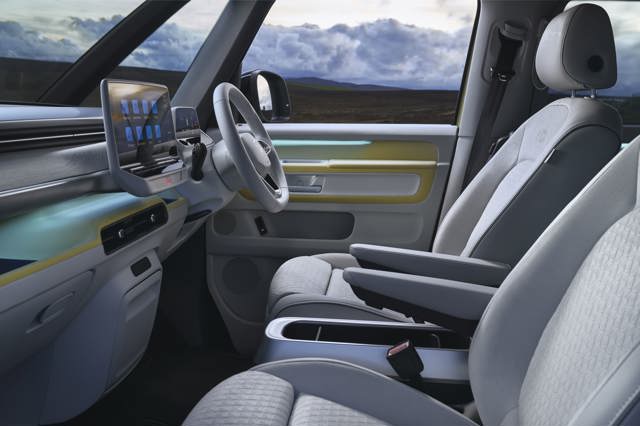
Either way, the Volkswagen ID.Buzz is very impressive up front, with loads of head and legroom and a really airy feel. Thank the deep windscreen that's nearly vertical, the tall side windows, and the little quarterlight windows splitting the windscreen pillars, for that.
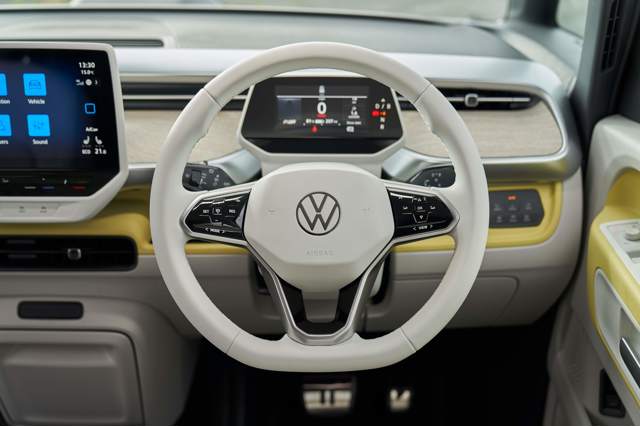
Adjustment in the seats and steering column is plentiful, with the digital dials mounted to the moving steering column. Electric seat adjustment was initially optional unless you went for limited-run 1st Edition trim, and this feature was later made standard on GTX when that trim arrived. The ID.Buzz Cargo feels just as roomy up front, avoiding the legroom restriction some vans with partitions behind the seats suffer from.
There's also an excellent amount of storage up front, with dual pockets in each door, various rubberised compartments in the dashboard (including the neatly integrated wireless phone charging pad), a decent-sized glovebox and a removable centre console with cupholders, two further cupholders in a fold-out cubby, and a deep drawer. The ID.Buzz Cargo does away with the latter when fitted with three seats, but makes up for it with a huge crevice across the top of the dash with additional cupholders.
In the back of the SWB passenger ID.Buzz, you'll find plenty of leg- and headroom, and the wide cabin plus the lack of a transmission tunnel means three can sit comfortably. We're disappointed that there's not three individual seats: rather it's a simple bench, but it does split 60/40 allowing you to slide part of the bench forwards or backwards, or recline the seat backs.
In the LWB ID.Buzz, there are two extra individual rear seats that fold up from the boot floor, and these are also removable for when you need to maximise cargo space. They are rather heavy, but they to have a handle to make the easier to muscle about. The extra seats bring a seven-seater layout, or a six-seater layout can be had as well, with two individual seats being provided in the middle row. The six-seater layout can also be had in the SWB car (we've not encountered a car in this form yet), but the seven-seat layout can't.
In tge LWB car, the middle row feels just as roomy as the rear seats in the SWB car, and behind those, there's also plenty of space surrounding the third-row seats. There's easily enough room for a reasonably tall adult to fit, and they'll travel comfortably for a good length of time.
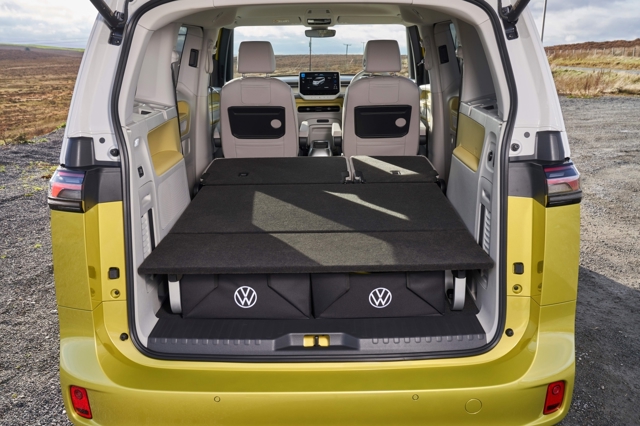
With all seven seats in place, the LWB car has a boot space of 306 litres. In five-seat mode, that grows to a whopping 1340 litres. The five-seater SWB can has a 1121-litre loadbay with all five seats in place. In two-seat mode, the SWB car has a van-like loadbay of 2205 litres, while the LWB does even better with 2469 litres.
The Volkswagen ID.Buzz SWB has a boot capacity of 1121 litres with all five seats in place. That's pretty van-like (well, it is a van), but you can expand it to a huge 2205 litres if you fold down the seat backs.
Both wheelbase configurations could (this option seems to have disappeared from the pricelist these days) be optionally specified - on Style trim and above - with a 'Multi-Flex Board'. In place with the seats folded, it creates a totally flat floor big enough for two to sleep on (we advise bringing a mattress or airbed), with a storage area underneath.
The ID.Buzz Cargo has a load space of 3.9m cubed, which is acceptable, and a maximum payload of 650kg, which is pretty off the pace compared with similarly sized vans. Still, it's a design-led product, and VW expects enough businesses to sacrifice a bit of payload for that cool factor.
A useful tech feature found on the Volkswagen ID.Buzz is bi-directional charging, like you get on Kia and Hyundai EVs. Essentially, this allows you to use the car's battery to power household electrical devices, slow charge other EVs in an emergency and even (with the right wallbox) power your home if you're caught in a power cut.
Volkswagen ID.Buzz 2026: Quality and finish
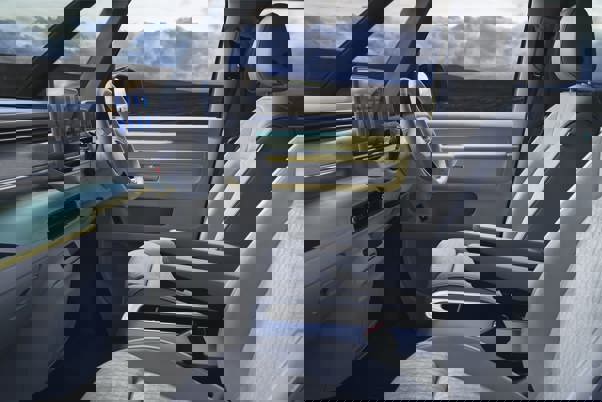
Given the premium price tag, you'd expect a step up in quality compared to the ID.3 or ID.4. And the Volkswagen ID.Buzz succeeds there, providing a high quality cabin that raises the bar compared to van-based alternatives. Inside, you'll find a mixture of hard-wearing plastics and plusher trims, soft-touch door armrests and (on higher spec models) a splash of wood and textured finishes on the dashboard.
We also like the white dashboard and colourful seat fabrics available, which give a splash of character. It's worth noting that the more basic ID.Buzz Cargo has a mostly black colour scheme, and is gloomier as a result, but at least there's a big glass area to bring light in.
There are no animal products used in the interior of the ID. Buzz. You'll either find recycled plastics or a special material called Seaqual, which is partly made from plastics recovered from the ocean.
Volkswagen ID.Buzz 2026: Infotainment
To begin with, all regular versions of the passenger-carrying Volkswagen ID.Buzz got the same central infotainment screen mounted on a plinth so it was within the driver's line of sight. It was a 10.0-inch display of the same design you found in other Volkswagen ID models. The limited-run 1st Edition models had a bigger 12.0-inch screen, and this was optional in the rest.
While the display is reasonably responsive and crisp to look at, the software was prone to glitches. However, the controls were our biggest gripe with the system. Just like in other electric VWs, the temperature controls and volume sliders below the screen were irritatingly imprecise to use on the move, and they weren't backlit, either, so you couldn't even see them in the dark, let alone use them. We're weren't keen on the touch-sensitive buttons on the steering wheel, either.
When the LWB version arrived in 2024, VW took the opportunity to make some general improvement to all versions of the ID.Buzz, and the infotainment was one of the areas addressed. In came a new 12.9-inch screen with faster responses and more logical menus. It's still far from perfect, but it is an improvement. The irritating touch-sensitive controls on the steering wheel remain, as do the air-con sliders, but at least the latter controls are now backlit. Upgrade from Life trim to Style or GTX, and you get a head-up display and a Harman Kardon sound system.
Whichever system you have, navigation is standard, as well as wireless Android Auto and Apple CarPlay should you prefer to use Waze or Google Maps instead. You also get a simple but effective 5.3-inch digital dial display on every version as well as wireless phone charging and seven USB-C ports.
Volkswagen ID.Buzz value for money

Volkswagen ID.Buzz 2026: Prices
Those hoping the Volkswagen ID.Buzz would cost about the same as the electric Stellantis small vans and MPVs (the Citroen e-Berlingo, Peugeot e-Rifter and Vauxhall Combo-e) will be sorely disappointed. This is a premium product, and it's priced accordingly.
On-the-road prices for the entry-level Life model start at around £60,000, while the Style-trimmed car costs around £65,000. The GTX will set you back around £69,000, meanwhile.
It's interesting to note, however, that there's barely any cost difference between the SWB and LWB versions trim-for-trim - we're talking a shade over £500 here - despite the fact that the LWB has a bigger battery as well as a lot more bodywork. That means, for us, it's an absolute no-brainer to have the larger car, with its superior range and extra space and practicality, and just choose the amount of seats you want, six or seven.
And, when comparing the ID.Buzz to the Stellantis-built rivals that we've already mentioned, do bear in mind that the Volkswagen gives you nearly 100 miles more range on a charge than those, plus a more upmarket interior, a bespoke EV chassis, and that design. The entry-level Volkswagen ID.Buzz Life is well-equipped, too. In character, the ID.Buzz feels more of a match for the Mercedes-Benz EQV, and that thing starts at more than £90,000. The big Vee-Dub doesn't look quite so expensive now, does it?
As ever the used market holds the key to some fairly enormous savings f you don't insist that your car is brand new. A 2023 SWB Life-trimmed car with the old 204 PS powertrain and less than 20,000 miles on the clock can be had for around £36,000. If you want a seven-seater, you'll be looking at more like £46,000, but do bear in mind that it'll be newer (it wasn't released until 2024) and its mileage will be lower at around 10,000 miles.
The ID.Buzz Cargo panel van costs quite a bit less than the passenger version. The Commerce starts at around £44,000, the Commerce Plus costs around £52,000, while the 4 Motion (the one with the GTX powertrain) costs around £50,000 in Commerce trim and £54,000 in Commerce Plus trim.
Again, used prices on the Cargo panel van are much lower. You'll get a two-year-old Commerce with around 20,000 miles on the dial for around £23,000.
Volkswagen ID.Buzz 2026: Running Costs
The ID.Buzz should hopefully offset its relatively high purchase price with cheap running costs.
Assuming that you pay the UK's national average rate for your domestic electricity (around 28p/kWh), then a full charge of the 77kWh battery will cost around £21, the 79kWh battery will be around £22, while the 86kWh battery will be around £24.
However, smart owners will get themselves on a domestic power tariff that allows them to charge their car overnight (which you'll probably do anyway) on heavily discounted off-peak power. Do that, and the price of a charge will probably be less than a third of the figures quoted, meaning super-low fuelling costs.
By contrast, using public DC rapid chargers will be by far the most expensive way of charging your car. Prices of around 90p/kWh aren't uncommon on these chargers, meaning that you can pretty much treble the amounts we quoted earlier, at which point running the ID.Buzz is no cheaper than running a petrol or diesel MPV. So, only use these chargers when it's a nailed-on emergency.
The not-so-great news is that as of April 2025, EVs are no longer exempt from paying VED road tax. That means you'll be lumbered with the same annual flat rate of £195 per year as drivers of petrol and diesel cars. On top of that, the car's lofty price means that you'll also be stung for the 'luxury car surcharge' on VED, meaning that you'll pay an additional £425 per year between years two and six of the car's life. Ouchie.
Insurance groupings for the car range from 31 to 42 depending on the version, so premiums won't be all that cheap, either.
Satisfaction Index
 What is your car like to live with?
We need your help with our latest Satisfaction Index, so that we can help others make a smarter car buying decision. What's it like to live with your car? Love it? Loath it? We want to know. Let us know about your car - it will only take a few minutes and you could be helping thousands of others.
Help us with the Honest John Satisfaction Index nowVolkswagen ID.Buzz models and specs
When it first went on sale in 2022, the ID.Buzz was available in Life, Style and limited-run 1st Edition trims.
The cheapest Volkswagen ID.Buzz Life came equipped with:
- 19-inch alloy wheels
- LED headlights
- illuminated door handles
- privacy glass
- gloss black mirrors
- ambient interior lighting
- a heated synthetic leather wheel
- heated front seats
- sat-nav, voice control
- wireless phone charging
- two-zone climate control
- adaptive cruise control
- heated windscreen
- keyless start
- rear-view camera
- all-round parking sensors
- Park Assist
The mid-range Volkswagen ID.Buzz Style added kit such as:
- Matrix LED headlights with Dynamic Light Assist
- LED tail-lights
- 20-inch alloys
- 30-colour ambient cabin lighting
- a white dashboard with upgraded dash trim and inserts
- upgraded cloth seats
- electric tailgate
Topping the two-wheel-drive passenger range was the Volkswagen ID.Buzz 1st Edition, which came with:
- 21-inch alloys
- upgraded front seats with electric adjustment
- larger 12.0-inch touchscreen infotainment system
Changes were made in 2024. The LWB seven-seater version arrived, and Life and Style trims were joined by the new range-topper, the sporty GTX. At the same time, VW decided to make some improvements to the more basic trim levels.
The Volkswagen ID.Buzz Life now comes equipped with:
- 19-inch alloy wheels
- LED headlights and rear lights
- heated, power adjusting, and power folding door mirrors
- heated windscreen
- sliding rear doors
- automatic lights and wipers
- heated front seats
- heated multifunction steering wheel
- cloth upholstery
- 10-colour ambient lighting
- 12.9-inch touchscreen infotainment system with nine speakers
- dual-zone climate control air-conditioning
- power tailgate
- adaptive cruise control
- all-round parking sensors
- 360-degree cameras
The mid-range Volkswagen ID.Buzz Style now has:
- 20-inch alloy wheels
- LED matrix headlights with automatic headlight control
- front light bar between headlights
- rear lights with dynamic turn signal
- head-up display
- Harman Kardon sound system
- electric sliding side doors
- opening rear windows (powered)
- 30-colour ambient lighting
As well as a more powerful twin-motor powertrain with 340PS and four-wheel-drive, the sports-focused Volkswagen ID.Buzz GTX gets:
- 21-inch alloys
- sports front seats with power adjustment
- microfleece upholstery
- power front seat adjustment
- electrically dimmable panoramic glass roof
The Cargo comes in two versions; a relatively basic entry-level ID.Buzz Commerce, and the ID.Buzz Commerce Plus, which has broadly similar equipment to the passenger ID.Buzz Life.
| Dimensions | |
|---|---|
| Length | 4712 mm |
| Width | 2212 mm |
| Height | 1927 mm |
| Wheelbase | 2989 mm |
| Miscellaneous | |
|---|---|
| Kerb Weight | 2486–2510 kg |
| Boot Space | - |
| Warranty | |
| Servicing | - |
| Costs | |
|---|---|
| List Price | £57,060–£63,660 |
| Insurance Groups | - |
| Road Tax Bands | A |
| Official MPG | - |
| Euro NCAP Safety Ratings | |
|---|---|
| Adult | - |
| Child | - |
| Pedestrian | - |
| Overall | - |
On sale until November 2024
| Medium MPV | |||
|---|---|---|---|
| Version | List Price | MPG | 0-62 |
| Life 204 Pro Performance 77kWh Battery Auto 5dr | £57,060 | - | - |
| Style 204 Pro Performance 77kWh Battery Auto 5dr | £63,660 | - | - |
On sale until August 2024
| Medium MPV | |||
|---|---|---|---|
| Version | List Price | MPG | 0-62 |
| 1st Edition 204 Pro Performance 77kWh Battery Auto 5dr | £62,940 | - | - |
Model History
- July 2022: New Volkswagen ID.Buzz: prices and specs announced
- June 2024: Volkswagen ID.Buzz LWB announced, prices start from £59,545
- September 2024: Range-topping 340PS VW ID.Buzz GTX available to order, priced from £67,435
July 2022
New Volkswagen ID.Buzz: prices and specs announced
The ID.Buzz is Volkswagen Commercial Vehicles’ first all-electric vehicle and features a 77kWh lithium-ion battery, supplying 150kW (204 PS) to a rear-mounted electric motor that develops 310Nm of torque and is capable of an all-electric driving range of up to 258 miles.
The new ID.Buzz launches with three trim levels: Life, Style, and a 1st Edition. The entry-level Life starts at £57,115* and offers LED headlights, heated windscreen, the Buzz box removable storage, Discover Pro navigation and infotainment with 10” colour touchscreen, and wireless charging. Style, priced from £61,915* adds the ‘IQ. Light’ LED matrix headlights and adaptive interior ambient lighting and tailgate surround lighting.
The range-topping 1st Edition is priced at £62,995*. This specification includes a full range of safety, security and convenience features, including 21” ‘Bromberg’ alloy wheels, Discover Max navigation system with 12” colour touchscreen and comfort seats with memory function
All ID.Buzz variants feature a digital cockpit and are available with the iconic two-tone paint option. With up to eight USB interfaces, including three USB-C ports for rapid charging supplied as standard, Hello ID. voice control and online functionality via We Connect and We Connect Plus, the ID.Buzz is prepared for the future.
Sustainability is also an integral part the new ID.Buzz, from design, to manufacturing, to the road. The interior features recycled synthetic material and leather-free, in addition to the all-electric powertrain. The ID.Buzz is manufactured using sustainable components: battery housings and wheel rims are made from green aluminium and tyres from low-emission production.
Customers were able to place a deposit during a pre-booking window in June to secure a priority spot in the order book and these customers will now be invited to spec their car. Order books for the ID.Buzz Cargo van will open soon.
June 2024
Volkswagen ID.Buzz LWB announced, prices start from £59,545
Volkswagen has announced the latest addition to the ID.Buzz line-up, the ID.Buzz LWB, or long wheelbase. LWB models have a longer wheelbase for increased luggage capacity, a standard seven-seat layout and a larger 86kWh battery for greater range.
The ID.Buzz LWB has seven seats as standard, with five- and six-seat versions available as an option. On seven-seat models, the third row of seats can be removed completely.
Measuring 4,962mm long, compared to 4,712mm for the normal wheelbase version, the LWB benefits from an increased wheelbase of 3,239mm, up 250mm from the standard model. The sliding rear doors have grown by 192mm on the LWB for enhanced access, too
In the five-seater configuration, the ID.Buzz LWB offers a luggage compartment volume of 1,340 litres, compared to 1,121 litres in the normal wheelbase model. This increases to 2,469 litres with the second and third-row seats folded. With all seven seats in place, boot space is 306 litres.
The 86kWh ID.Buzz Life LWB 286PS starts at £59,545 and has a range of 291 miles. The 86kWh ID.Buzz Style 286PS costs from £64,345 and has a range of 286 miles.
September 2024
Range-topping 340PS VW ID.Buzz GTX available to order, priced from £67,435
Volkswagen has announced that orders are open for the ID.Buzz GTX and ID.Buzz GTX 7-seat. Prices start from £67,435 for the regular model, and £67,945 for the seven-seater, and first deliveries will be from the winter.
The ID.Buzz GTX are the most powerful ID.Buzz models, and have two electric motors that deliver 4MOTION four-wheel drive and have a total output of 340PS.
The ID.Buzz GTX comes with a 79kWh battery, giving a range of 262 miles and the ability to accelerate from 0-62mph in 6.1 seconds. The longer seven-seat version uses an 86kWh battery for a 295-mile range, and completes the 0-62mph sprint in 6.5 seconds.
The GTX has a towing capacity of 1,800kg, and 1,600kg for the long wheelbase.
VW has also confirmed that the seven-seat version of the ID.Buzz is now available to order, priced from £59,545, and with deliveries beginning in early autumn. The ID.Buzz 7-seat is powered by an 86kWh battery, giving a range of up to 291 miles.
