
Back to the future: Audi Duo — the forgotten 80s plug-in hybrid that was decades ahead of its time

Mon, 02 Mar 2026
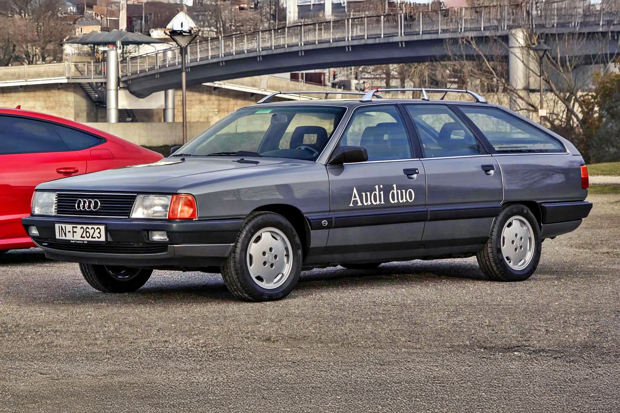
The idea of plug-in hybrid power seems like a relatively new concept, but Audi was championing it as far back as 1989.
Based on the Audi 100 Avant, which was one of the most aerodynamic cars of its time, the Audi Duo was Audi’s response to growing concerns about urban pollution, fuel consumption and the finite nature of fossil fuels.
It featured a five-cylinder petrol engine driving the front wheels, while a separate electric motor powered the rear wheels. The set-up allowed the car to operate in three different modes: petrol-only, electric-only, or a combination of both.
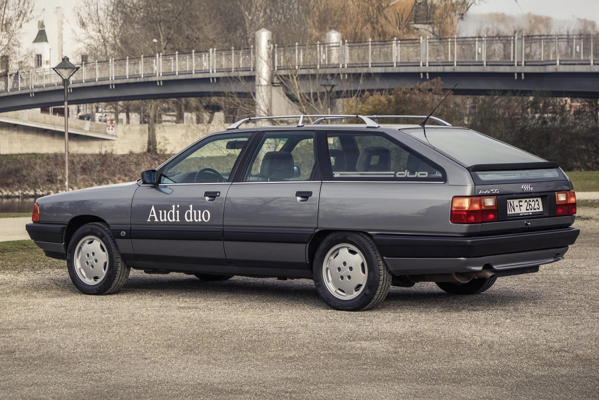
The electric motor was powered by a set of nickel-cadmium batteries, located in the rear of the vehicle. These batteries could be recharged by plugging the car into a standard electrical outlet, a feature that was remarkably ahead of its time.
The petrol engine was a 2.3-litre, five-cylinder unit developing 134bhp and powering the front wheels. At the rear, a 12bhp e-motor from Siemens, drawing power from a 9kW nickel-cadmium battery mounted under the boot floor, drove the back axle. It was capable of about 24 miles on EV-power alone, which isn’t that far off the range of a modern PHEV in electric-only guise.
The driver could switch between modes using a dashboard control, enabling short trips in zero-emission electric mode — ideal for city driving — and longer journeys with the conventional engine. It was unveiled at the 1989 Frankfurt Motor Show and caused quite a stir.
The electric mode was for urban use only, though — it could reach speeds of up to 31mph (50km/h), but to go any quicker than that, you had to put it back into petrol mode.
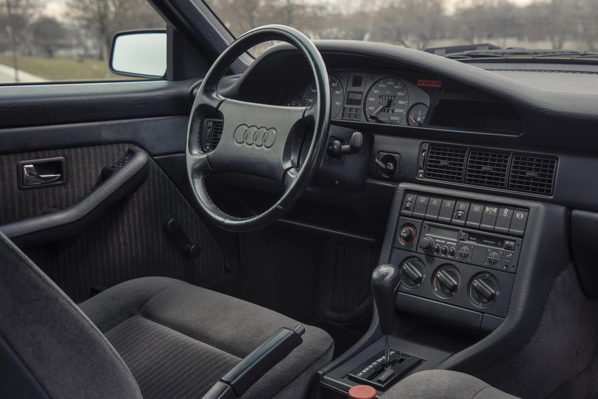
But it also came with additional features that are commonly seen on modern EVs but were practically unheard of at the time. For example, it also had regenerative braking, while solar panels on the roof helped to keep the battery topped up.
Ten Duos were built for testing and one was even trialled as a taxi in Audi’s hometown of Ingolstadt — but none were ever sold commercially.
That wasn’t the end of the experiment, however. Eight years later, in 1997, Audi launched its second Duo, this time based on the A4 saloon.
The Audi A4 Duo, which Audi claims to be the first production plug-in hybrid, combined a 90bhp 1.9-litre diesel engine with a 29bhp e-motor. Like modern PHEVs it could run at slow speeds for a short while on e-power alone, with charging both from regenerative braking, like a modern mild-hybrid, and from a standard domestic plug socket.
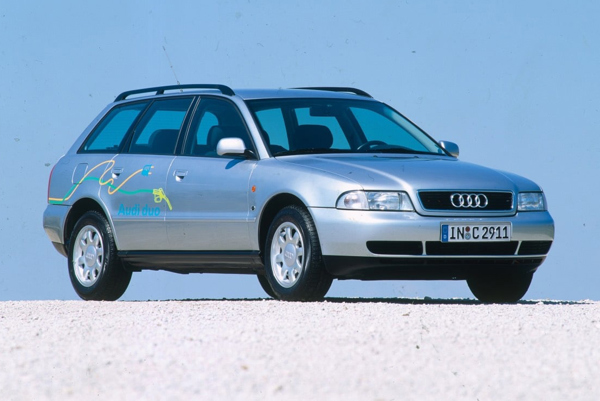
The 1997 Duo could travel up to 50 km (31 miles) using only electric power at speeds up to 80 km/h (50mph), after which the diesel engine would take over.
The car was sold through selected Audi dealers in urban areas and the company’s ambition was to sell 500 cars a year. By the time it was withdrawn two years later, it had made a total of just 60 — the world wasn’t ready for what turned out to be an incredible glimpse into our future motoring habits — perhaps because the list price was more than twice that of a standard A4 TDI…
Get the latest car news and expert advice. Sign up for the Honest John newsletter
