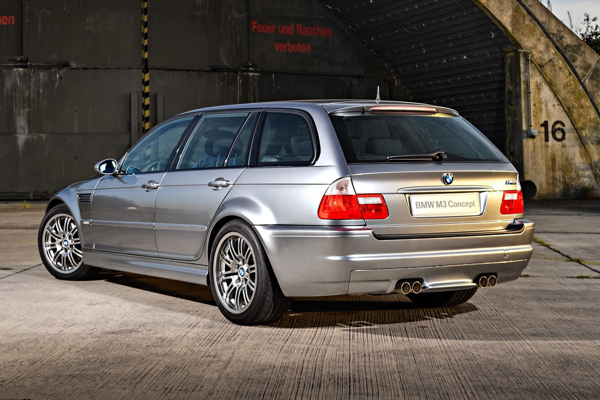
Back to the future: BMW E46 M3 Touring - the secret V8 rival that never was

Mon, 09 Feb 2026
At the turn of the 21st century, the BMW E46 3 Series was a very desirable car indeed. The most popular company car in the UK was a handsome beast, beautifully engineered, well-packaged and smartly proportioned, with a wide choice of body styles to suit everyone.
The mainstay of the range was, naturally, the four-door saloon, while spin-offs included the fine-looking Touring estate, a coupe, a cabriolet and the truncated Compact, for those who couldn’t quite run to the king-size model.
Then there was the M3, with a scorching naturally aspirated 340bhp fed through its rear axle, fat arches, wide wheels and a choice of saloon, coupe or soft-top body styles. It was a performance car par excellence and one that felt special just to sit inside, with its figure-hugging Alcantara sports seats and M-Sport steering wheel.
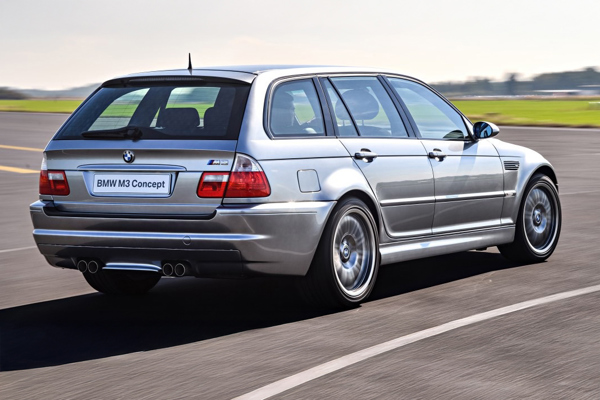
Fire up the normally-aspirated straight six and you were greeted by a lovely metallic burble from the M-Sport stainless exhaust. Show it a fast flowing A-road and there were few cars more rewarding. The M3 was brilliant - brutally quick, easy to drive, instantly rewarding and extremely smooth. It was one of the last truly versatile M Cars, before they got silly and started to chase power output at the expense of drivability.
A Touring model, though, was never officially sold, despite the fact that arch-rivals Audi and Mercedes both offered hot versions of their own estate cars in the form of the RS4 Avant and C32 AMG.
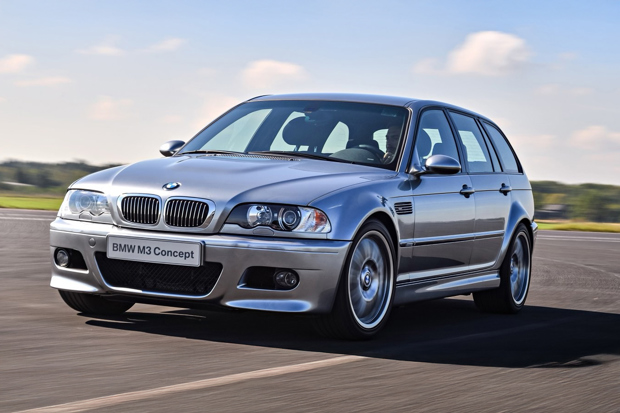
A BMW M3 Touring would have been a natural rival and it was one that came close to production. Very close indeed.
In 2000, BMW invited a group of global automotive media out to Munich to evaluate a one-off M3 Touring that it had built as a feasibility study. The challenge for the brand was that, unlike its fellow German rivals, the M3 had a different bodyshell to the more mainstream models and beneath those fat rear arches sat a different rear suspension set-up that would require more than just a few bolt-on, bolt-off parts to make it work.
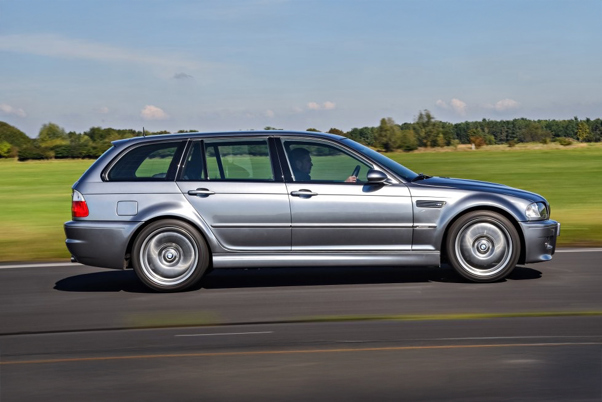
"Initially, the M3 Touring served entirely in-house purposes"” said Jakob Polshack, head of vehicle prototype building and workshops at BMW M Division. "This prototype allowed us to show that, from a purely technical standpoint at least, it was possible to integrate an M3 Touring into the ongoing production of the standard BMW 3 Series Touring with very little difficulty.
"One important thing we needed to demonstrate was that the rear doors of the standard production model could be reworked to adapt them to the rear wheel arches (of the M3) without the need for new and expensive tools.
"Once it had passed through the assembly line, the M3 Touring required only minimal manual follow-up work to fit the M-specific add-on parts and interior details, for example."
So why did the M3 Touring not reach production - after all, while the engineering was more complex than its rivals, Polshack’s team had proven that it could be done and without too much expense – certainly no more so than the work that the M Division had already done to incorporate those changes into the similarly low volume cabriolet model.
The simple answer lies with customer clinics. While the journalists that attended the evaluation drive in 2000 were almost universally complimentary towards the M3 Touring, the feedback from existing owners was impassive. There was, deemed BMW, no real market.
It’s interesting, then, that an M3 Touring is an integral part of the line-up today – a missed opportunity, perhaps?