
Volvo XC90 T8 long-term test: living with a 7-Seat PHEV SUV in 2026
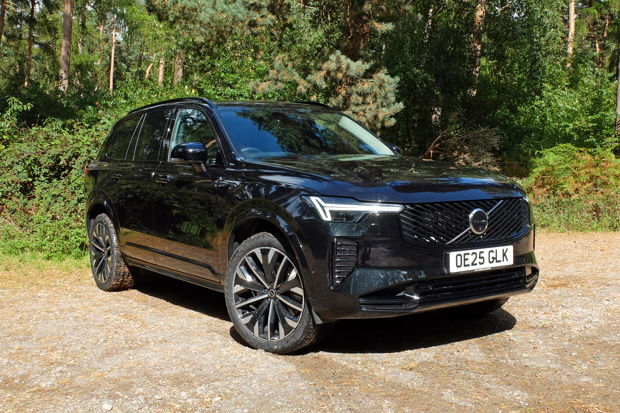
Volvo XC90 T8 Ultra
- Run by: David Ross (since September 2025)
- Price when new: £84,260 (£85,055 with options)
- Power: 455PS
- Torque: 709Nm
- Battery capacity: 18.8/14.7kWh (nominal/usable)
- Claimed economy: 201.8mpg
- EV Range: 42.9 miles
- 0-62mph: 5.4 seconds
- Report 1: Switching from Audi A6 e-tron to the Volvo XC90 T8 PHEV
- Report 2: Volvo XC90 7-seater practicality for families and dogs
- Report 3: Real world economy — does it hit 42 miles of range?
- Report 4: Volvo XC90 infotainment quirks and screen brightness issues
- Report 5: Volvo XC90 v Hyundai Santa Fe — which is the better 7-seater PHEV?
- Report 6: Long-haul reality — 400 miles, five people and an empty battery
Report 1: Switching from Audi A6 e-tron to the Volvo XC90 T8 PHEV
We're switching from an EV to a PHEV. But with the added bonus of seven seats as we get the keys to the Volvo XC90 T8 which replaces the Audi A6 Avant e-tron.
Date: 22 September 2025 | Current mileage: 2435 | Claimed economy: 201.8mpg | Actual economy: 68.3mpg
Amazingly it's been 10 years since this generation of the Volvo XC90 was first introduced. And yet the big Volvo shows no signs of slowing down. While Volvo may have recently launched its electric equivalent, the Volvo EX90, the XC90 continues to sell well having recently been updated.
Perhaps this should come as no surprise though. The previous generation Volvo XC90 had a similarly long life, selling consistently well for 13 years. And with many manufacturers holding off replacing their big SUVs - the Audi Q7 has also been on sale since 2015 and won't be replaced until 2026 - there would appear to be a few good years left in the Volvo XC90 yet.
Indeed, in September last year Volvo revised the XC90 with a new front end, a larger central touchscreen and tweaks to the interior. It has slimmed down the range too so now there are no diesels available, just the B5 petrol mild hybrid or the T8 plug-in hybrid which we've gone for.
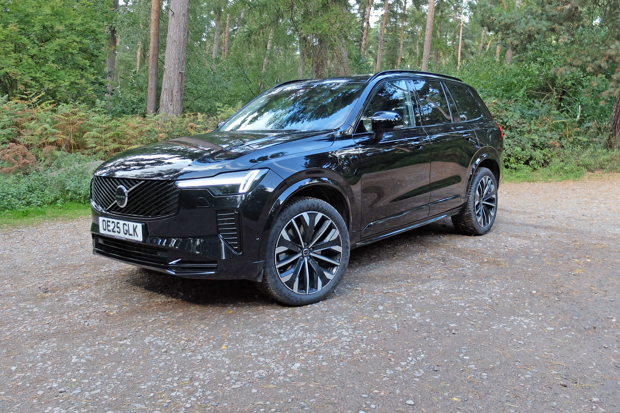
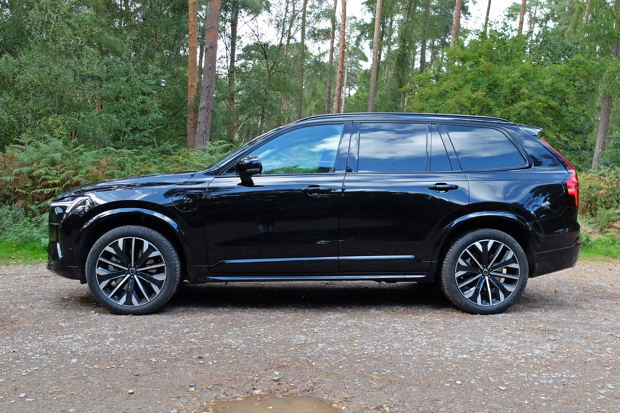
Our Volvo XC90 T8 is in top spec Ultra trim so we've not had to add an options aside from £795 for Onyx Black metallic paint. We've stuck with the standard 21-inch alloy wheels and went for the Dark theme which replaces all the usual chrome trim with gloss black. In total the list price is £85,055.
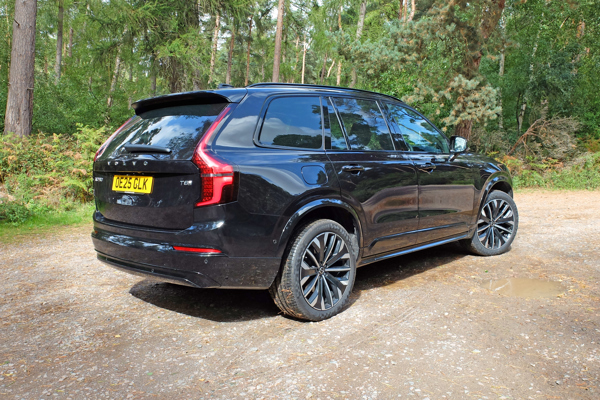
Of course, soon after our car arrived, Volvo introduced the Volvo XC90 Black Edition, which we would have chosen given the chance as it adds black badging, all black wheels and an all black grille. Confusingly you can also get the Black Edition in blue and grey.
This isn't the first time we've run a Volvo plug-in hybrid. A few years we go we ran a Volvo V60 Polestar Engineered but where as that was more about performance, the Volvo XC90's forte is really practicality. Despite being a bigger car, the 42-mile EV range of the XC90 is a considerable step up from the 28 miles in the V60. So far we've not had to dip into the petrol tank thanks to lots of short local journeys, so it's been running on electric only. Question is, is it one of the best PHEVs for 2026? We shall found out.
It will certainly be interesting to see how much that range drops in cold weather. It's been enjoyable mild of late, meaning prime conditions for EV batteries. We will see whether that 42-mile range remains when temperatures are close to freezing. Still, it does have a heated steering wheel, so that's a bonus.
With three children and a dog, the seven seats of the Volvo XC90 is already proving a godsend. It means our eldest will sit right at the back and keep the dog company while also stopping the three children from arguing in the back of the car on every journey that's more than 10 minutes. Fun as that is. Here's to the next six months of peaceful journeys...
Report 2: Volvo XC90 7-seater practicality for families and dogs
Having forgotten just how useful a seven seater can be, we're very happy to have one back on the drive and it's proving universally popular.
Date: 22 October 2025 | Current mileage: 2921 | Claimed economy: 201.8mpg | Actual economy: 68.1mpg
Having sold our ageing Audi Q7 last year and replaced it with an Audi e-tron, we've often missed having a seven seat car in the household. Not least because with three children who all like to wind each other up on any given car journey, drives to pretty much anywhere often see someone getting told off...
So the arrival of the Volvo XC90 has been welcomed by everyone in the family. Well, apart from Rosie the dog who usually likes to curl up in the boot and have a snooze while the children argue. Fortunately the XC90 is recognised as one of the best 7-seaters on the market.
On longer journeys, we've taken to having one of the rearmost seats flipped up so our eldest can tuck himself away there with his phone and his headphones (we don't know what he listens to and don't ask...) while the dog sleep next to him. Then our other two get a bit more space in the middle row, helpful when our youngest (4) is still in a car seat. Being a Volvo, it has easy to access Isofix mounts, so no having to feel your way under the seat backs.
If we're just nipping round the corner we'll stick all three in the middle row, but the raised tunnel on the floor (which is also quite wide) means it's pretty cramped for whoever sits there. The older two usually take it in turns. This seems to be a Volvo trait as it was one of the main reasons we didn't buy a Volvo V90 as our family car several years ago.
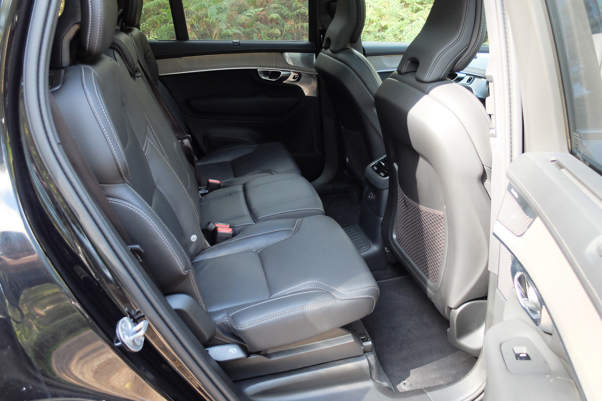
The good news in the Volvo is that there's loads of room in the back row, thanks to its square shape and high roof. And even with those seats up, there's still a decent amount of boot space, handy for all our coats and wellies.
The only real issue we have is with the access. It's easy enough to flip the seat forward using the handle on the top of the seat back, (not the handle lower down as I often do...) but it only slides forward slightly and creates a massive trip hazard. That's fine for our kids as they know it's there but trickier when we've given lifts to their mates, especially in the dark. This is the main reason we don't bother on short journeys as while it's comfortable back there, it's a bit of a faff getting in - and more importantly out.
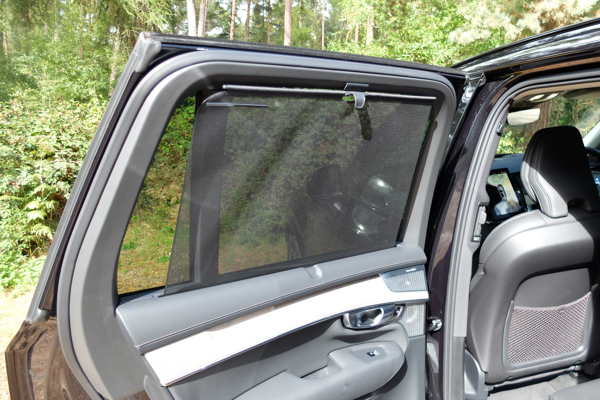
What the kids have discovered is the fact that the middle row gets heated seats (on the outer ones at least). We're pretty sure they'll be whacking those on when winter arrives. For now though, with this unusually mild and sunny autumn, the integrated sunblinds on the doors are proving more useful.
For the last month we've managed to mainly run the XC90 in EV with lots of local trips. But with plenty of 100 mile round trips coming up, we'll be actually using petrol. So it will be interesting to see what fuel economy is like once the battery runs out.
Report 3: Real world economy — does it hit 42 miles of range?
While the claimed economy figures might be north of 200mpg, what is fuel economy and range actually like in the XC90 T8?
Date: 27 November 2025 | Current mileage: 3604 | Claimed economy: 208.1mpg | Actual economy: 64.2mpg
When it comes to official fuel economy figures, PHEVs are best taken with a pinch of salt. Or should that be a large bag. While fuel economy tests have changes over the years to be more realistic, the latest figures known as WLTP (or catchily named worldwide harmonized light vehicles test procedure) were introduced in 2017, the very nature of plug-in hybrid cars has made for some ridiculous mpg figures.
Take our Volvo XC90 T8 for example. With a claimed EV range of almost 43 miles it makes the WLTP test period of 14.5 miles and 30 minutes pretty pointless. This also explains why the Volvo can boast a claimed MPG figure of 208.1mpg. If the test didn't go up to 81mph, it would probably be even higher.
Of course what the claimed figures promise and what owners get in the real world are two very different things. It's why we launched Real MPG in 2011, to give owners and buyers realistic MPG figures. And you won't be surprised to find we've not managed to get 200mpg from our Volvo.
And Real MPG bears out this experience. Volvo XC90 T8 owners are averaging 42.0mpg, which is not a bad figure at all for a big SUV like the XC90. It's just a far cry from that 200mpg.
The issue, as is the case with all PHEVs, is that once the battery runs out, you are not only reliant on a petrol engine, in this case a 2.0-litre four-cylinder, but you have the extra dead weight of the battery and electric motor to haul around. Hence why it weighs almost 2300kg.
No surprise then that when driven with zero battery range, our XC90 T8 averages only 32mpg. As for electric power, Volvo claims an EV range of 43 miles and we're currently seeing around 38 miles from a full charge. In our day to day driving, which is mainly school runs and a few local errands, we manage most of that on battery.
It's at the weekends when we regularly do a 100-mile round trip that we end up having to use the petrol engine more than the battery. Nothing makes my heart sink more than realising I forgot to plug in the Volvo on a Friday night and having to set off on a Saturday morning with no battery.
Like most PHEV drivers, we avoid public chargers completely, it's simply not worth it. Instead we charge at home overnight using our cheap Intelligent Octopus Go EV tariff which drops the rate down to just 7p/kWh. With 19kWh battery it means a full charge costs us just £1.33.
Report 4: Volvo XC90 infotainment quirks and screen brightness issues
While the Volvo XC90 is proving a great family car, there are a few quirks and issues that are taking the shine off things a little.
Date: 23 December 2025 | Current mileage: 4011 | Claimed economy: 201.8mpg | Actual economy: 64.6mpg
The more time you spend with a car, the more small quirks or issues can start to annoy you. As is the case with our Volvo XC90. There's several small things that aren't deal breakers, but have started to become irritations the more time I spend with it.
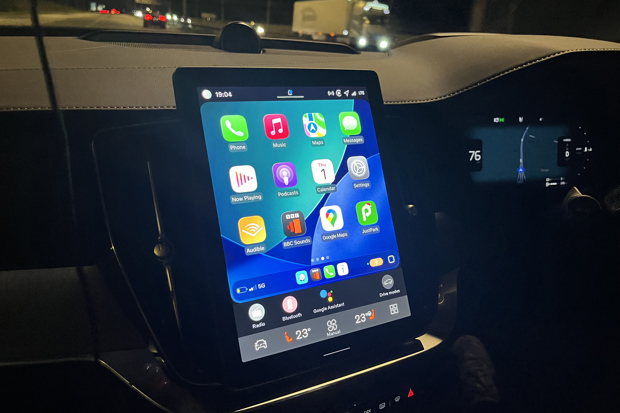
One of the main ones is the screen. Or more specifically the brightness. Because there doesn't seem to be any way to control it and at night it's often incredibly bright. In fact far too bright - see picture above for an example. When you're trying to focus on the road ahead, it's really distracting. The way to mitigate it is to switch to Waze and have it in night time mode so the background is dark grey rather than white.
The screen does automatically adjust brightness as I've seen it do it, but seemingly at random times, such as at 10am on a grey morning. Unless I'm missing something (and I've been through all various menus/settings) the only thing I can adjust is the brightness on the dash display. If any fellow XC90 drivers know a fix, please let me know...
While I like the simplicity of the Volvo infotainment it does seem that - and I never thought I'd say this - it could do with more functions. Most modern cars come with an overload of menus and settings, the majority of which you never change unless you're sat in traffic and bored. But on the Volvo there seems to be a lack of settings for adjusting settings - such as the screen brightness.
The infotainment system also has an odd quirk of going silent sometimes. You'll get in, switch on the car and realise that not only is there no sound from the radio, but not even from the indicators. It's not a noise you really notice, until it's not there. The way to fix it is to do a hard reset, holding your finger down at the bottom of the screen until it completely shuts off and restarts.
Still, that's not great when you're trying to navigate through town on the school run. It requires a similar reset when it doesn't recognise our Apple CarPlay dongle. And there seems to be no rhyme or reason. It can fine one minute, you'll be out of the car for 5 minutes at a shop and when you get back in and start it up, it decides to stop working.
My final annoyance, seeing as this is one of those updates now, is with the electric memory seats. Given I'm tall and my other half is short, we have very different driving positions. So I regularly have the joy of opening the door to jump in the car only to find that the seat is very far forward. But thanks to the memory settings I can get it back to my position.
The only thing is, it does it in a weird way, moving the seatback forward first before moving the seat down and back. It means that if I try and sit in while it's adjusting, I get squashed forward. I've never known another car to do it this way...
Report 5: Volvo XC90 v Hyundai Santa Fe — which is the better 7-seater PHEV?
We pitch our long-term Volvo XC90 against the new Hyundai Santa Fe to see if "premium" still justifies the price tag in 2026.
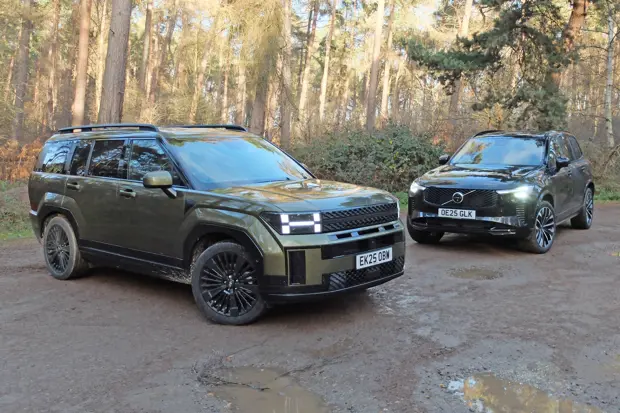
Date: 23 January 2026 | Current mileage: 4601 | Claimed economy: 201.8mpg | Actual economy: 61.8mpg
It’s the question I’ve been asking myself for the past few months: "Is the Volvo really worth thirty grand more than the Hyundai?"
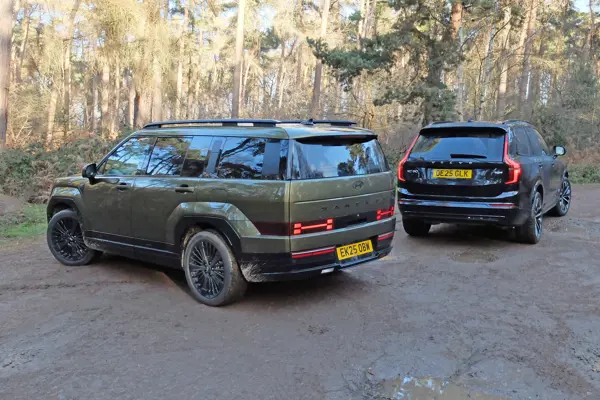
As our time with the Volvo XC90 T8 starts to wind down we spent a week with the new Hyundai Santa Fe PHEV and it's forced a moment of reckoning. Both are seven-seater, plug-in hybrid SUVs. Both promise to whisk your family around in peaceful luxury. But while the Volvo sits firmly in the "aspirational" bracket with a price tag nudging £80,000, the Hyundai is the bold upstart trying to redefine what "premium" actually means.
If you’re buying a seven-seater, the back two rows aren't just for show — they are a key battleground. The Volvo XC90 is a masterclass in packaging. Even in 2026, its "theatre seating" (where each row sits slightly higher than the one in front) means our children don’t feel like they’re sitting in a dark basement.
However, the Santa Fe is simply cavernous. Its boxy Lego brick styling isn't just for aesthetic bravado — it creates a van-like interior. While the Volvo’s third row is perfect for teenagers, the Hyundai’s third row feels genuinely adult-sized. Plus, the Hyundai feels better set up for families with features like the dual wireless charging pad in the front and the neat cupholders (also ideal for phones or pine cones if you're our children) on the rear doors.
On paper, the Volvo has the edge on prestige, but the Hyundai is winning the technical arms race. In the Volvo we’re consistently getting about 40 miles of pure electric range. It’s smooth, silent, and the transition when the 2.0-litre petrol engine kicks in is almost imperceptible.
Despite its sheer bulk, the Hyundai Santa Fe managed a solid 38 miles. Where it loses out slightly is refinement — the 1.6-litre turbocharged engine in the Hyundai is noisier and more intrusive when you ask for a sudden burst of speed on a slip road compared to the Volvo. The Volvo is happier to stick in EV mode for longer too - the Hyundai engine seems muck keener to kick in.
The Volvo’s interior is a sanctuary of Swedish minimalism — lots of crystal glass and recycled wool. But the infotainment is starting to feel its age. It’s a portrait screen that requires a fair bit of menu-diving. This is where the two diverge most.
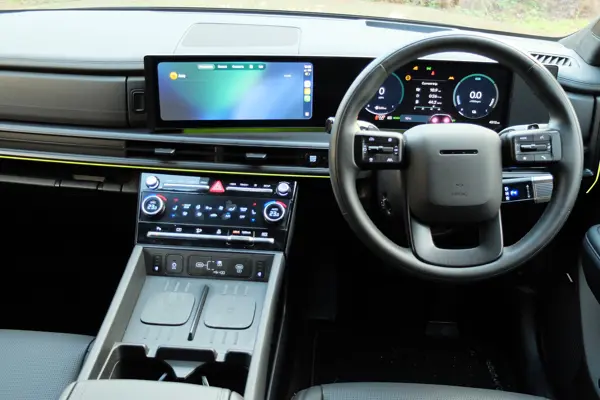
The Hyundai is a button-lover’s dream. It has dual curved screens that look like they’ve been lifted from a high-end gaming setup, yet it retains physical knobs for the air conditioning. In an era where every manufacturer is hiding the "defrost" button behind three sub-menus, the Hyundai feels like the more honest car to use on a daily basis.
If money is no object, the Volvo XC90 still carries a level of "old money" class that the Hyundai can’t quite mimic. It feels more special and it's smoother to drive. Our Volvo costs £85k whereas the Santa Fe Calligraphy we tested here lists at £55k.
But — and it’s a big "but" — if you are actually using all seven seats every day and paying with your own hard-earned money, the Hyundai Santa Fe is the smarter choice. It’s more practical, the tech is more intuitive and that five-year warranty is a massive safety net. The Volvo is the car you want to be seen in, but the Hyundai is the car that actually makes your life easier.
Report 6: Long-haul reality — 400 miles, five people and an empty battery
We take the Volvo XC90 T8 out of its urban comfort zone and onto the M1 for a cross-country family trek. Is the petrol engine up to the task once the electric "safety net" is gone?
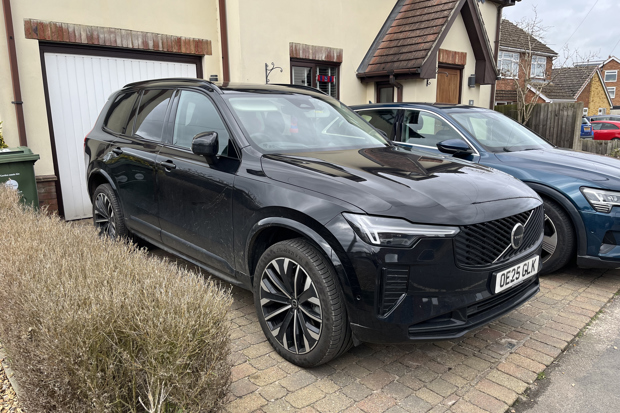
Date: 23 February 2026 | Current mileage: 6014 | Claimed economy: 201.8mpg | Actual economy: 50.2mpg
For the past few months our Volvo XC90 has been living the PHEV dream. Most of our journeys have been short hops to the station or the school run, meaning the petrol engine has barely cleared its throat. We’ve been averaging over 60mpg simply because the 18.8kWh battery was doing all the heavy lifting.
But a half-term family trip provided the ultimate test — a 400-mile round trip on the M1 and A1. This is where the PHEV logic usually starts to crumble. Once those 40-odd miles of electric range are exhausted, you are left hauling a 2.3-tonne SUV using a 2.0-litre petrol engine.
There is no point sugar-coating it — if you don't charge a PHEV, it’s a very expensive way to burn petrol. Once the battery hit 0% the fuel economy settled into a steady 34.2mpg.
For a car of this size and weight, that’s actually not disastrous — it’s roughly what you’d expect from a large petrol SUV without a battery. However, it’s a far cry from the 50mpg+ we used to see in the old D5 diesel XC90 on the same route. With a relatively small 71-litre fuel tank, you’ll find yourself visiting the service station more often than you would in a traditional diesel cruiser.
One area where the Volvo excels is making a three-hour motorway slog feel like a twenty-minute jaunt. Volvo’s Pilot Assist (standard on our Ultra trim) is one of the most natural-feeling systems on the market.
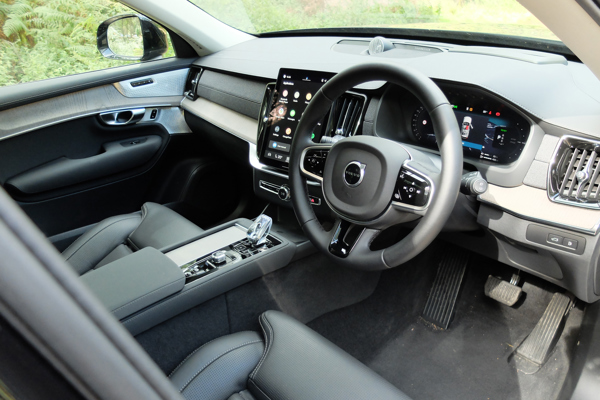
In the 50mph average speed camera zones that seem to have permanently moved onto the M1, the car tracks perfectly. It doesn’t "ping-pong" between the white lines like some rival systems. My only gripe is that it can be a little over-cautious when a lorry in the next lane drifts slightly toward the line — it will often jab the brakes unnecessarily, which can be a bit startling for the passengers.
There’s been a lot of talk about whether a four-cylinder engine belongs in an £85,000 car. On the motorway, you don’t notice it. The soundproofing in the XC90 is so thick that at 70mph, the cabin is a sanctuary.
However, when you need to overtake or merge quickly and the battery is depleted, the 2.0-litre unit has to work hard. The revs climb and that refined premium hum turns into a bit of a strained four-cylinder drone. It lacks the effortless, lazy torque of a six-cylinder Audi Q7 or BMW X5, but it gets the job done.
The XC90 remains the ultimate family long-hauler for comfort. The seats are arguably the best in the industry and after three hours behind the wheel, I felt remarkably fresh. But this trip was a stark reminder. If your life involves 200-mile motorway runs every week, a PHEV might not be the panacea it seems. For the school-run-to-motorway ratio of most families, however, it remains the gold standard for family transport.
