
Jeep Compass Full-Electric Review: Price, range and boot space
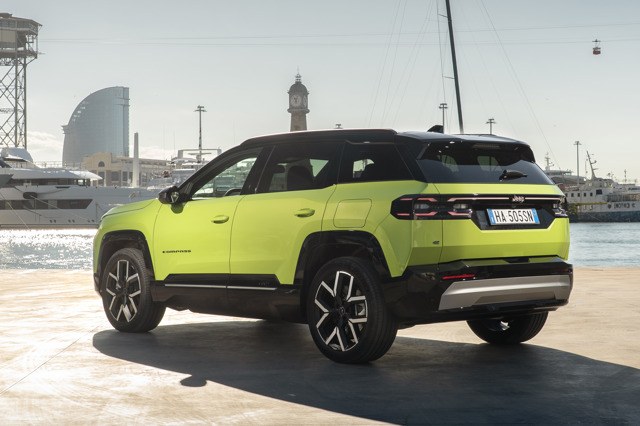

Jeep Compass Full-Electric Verdict
 More relaxing to drive than the ICE versions. Practical cabin with sizeable boot. Recognisable Jeep looks.
 Dual-motor version will be expensive. Ride could be smoother. Won't appeal to die-hard Jeep fans.
Find out more about the Jeep Compass Full-Electric
The huge Stellantis group of manufacturers has birthed another Jeep that's not exactly an all-American hero. Instead, it shares much in common with a Vauxhall Grandland Electric, of all things. Does it make any sense in the crowded SUV market? Find out in our Jeep Compass Full-Electric Review.
It was inevitable that the new Jeep Compass would share much with its Stellantis counterparts. There's already a platform used for the Vauxhall Grandland, the popular Peugeot 3008 and the Citroen C5 Aircross along with the DS No8.
So of course the new Jeep Compass was going to be built using the same. Especially because it allows for mild-hybrid, plug-in hybrid and all-electric power. It's specifically the Jeep Compass Full-Electric we're covering here – if you're more interested in one primarily powered by suck, squeeze, bang and blow, you want our Jeep Compass Review.
Before you get all sniffy about this great American brand being 'sullied' by a bunch of European compontents, we'd like to point out that the previous one was made on a platform that can be traced back to the Fiat Grande Punto. Also, it isn't very good. So, if this Jeep Compass is made using proven ingredients and has an electric version to broaden the appeal, we're all for it.
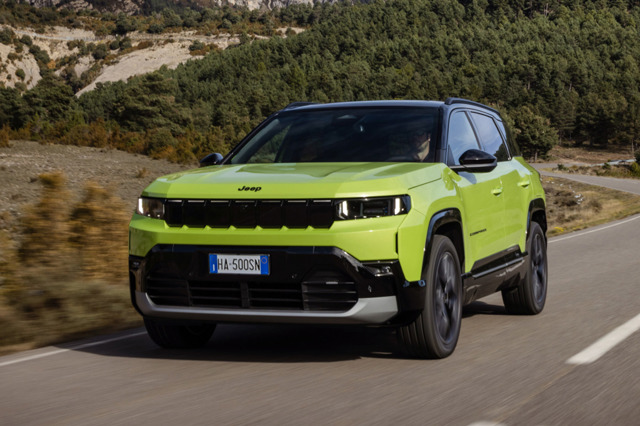
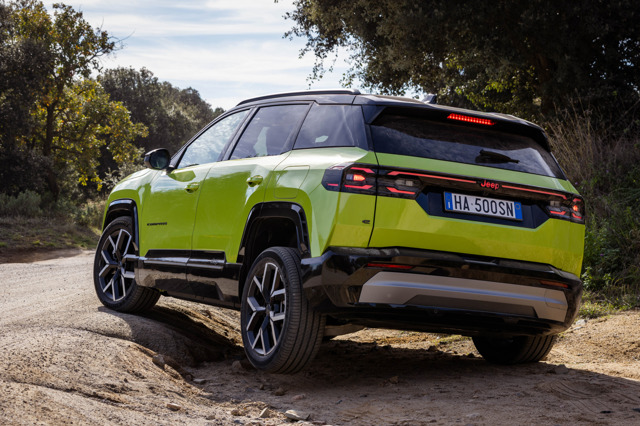
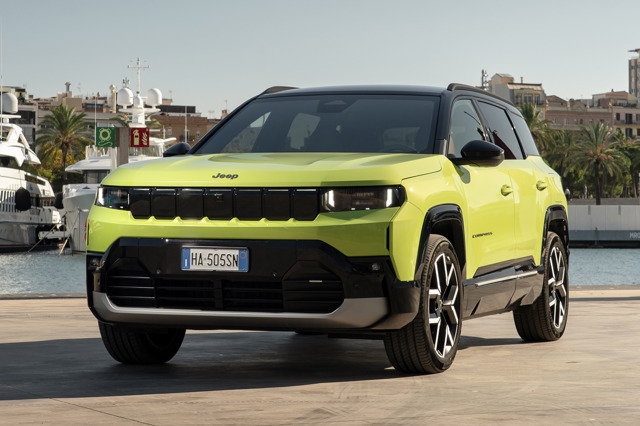
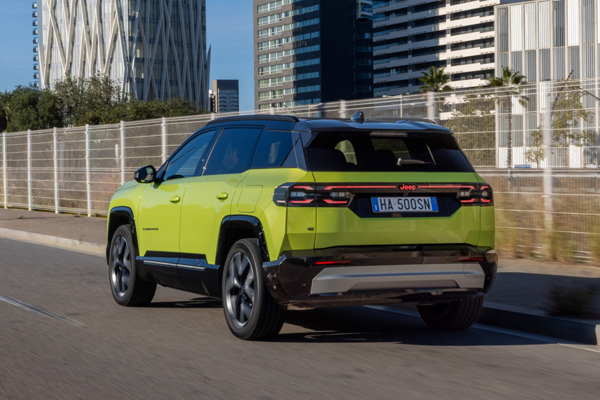
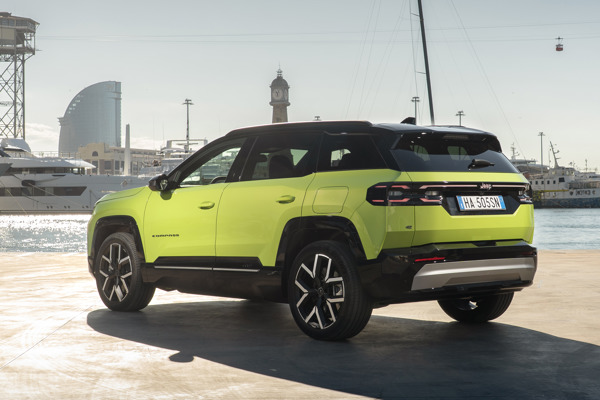
Jeep's take on things still looks, well, like a Jeep, with the seven-slot grille present and correct. Ish. It's technically not a grille at all, containing things like sensors rather than functioning to cool anything down. It's the same for the petrol-powered Jeep Compass, by the way, because the engines only need holes in the lower bits of the bumper to stop them from getting toasty.
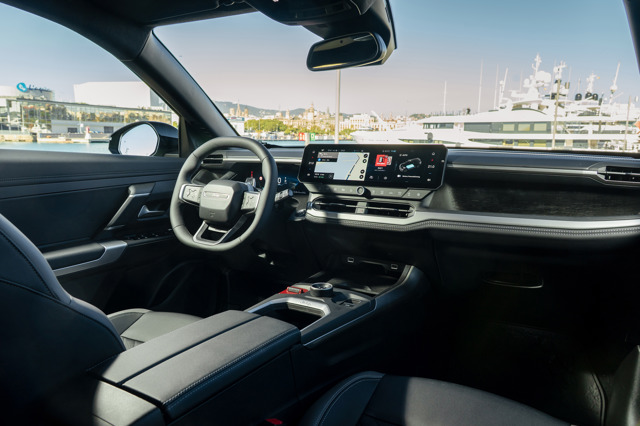
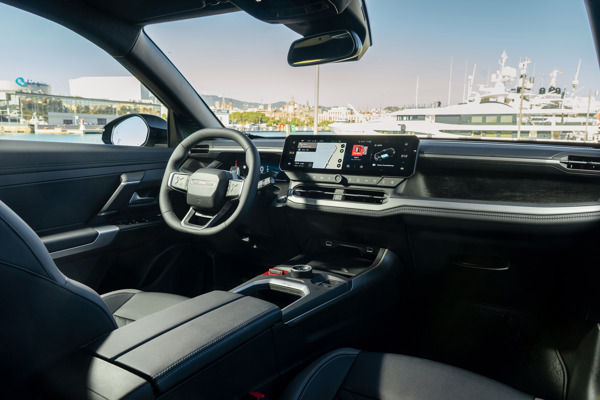
You'll struggle to tell the two apart from the outside and it's the same case on the inside, with all versions of the new Jeep Compass getting a chunkier, more utilitarian aesthetic than its Stellantis cohorts.
Further separating the Compass from the others, there's a 'Selec-Terrain' system with a dedicated mud/sand mode plus an all-wheel drive, dual-motor variant with 375PS and a 96kWh long-range battery. Yes, there's a dual-motor Peugeot E-3008, but it makes do with 330PS and a smaller 74kWh battery.
Dual-motor versions are slightly more capable away from the tarmac, as well, but you won't be tackling anything too gnarly in any version of the Jeep Compass. It's very much a road-focused SUV and it mostly performs well in that setting, although we'd rather the ride was a bit smoother.
That alone isn't a deal-breaker and neither is the cabin material quality being a bit of a mixed bag. The problem is that the Jeep Compass Full-Electric doesn't excel in any one area, which might be a bit of a problem given how crowded this segment is. Along with the closely related Peugeot e-3008, Vauxhall Grandland Electric and Citroen e-C5 Aircross, it has to compete with the likes of the Skoda Elroq, the Ford Explorer and the popular Volkswagen ID.4.
Jeep Compass Full-Electric: Range and charging times
| Jeep Compass Full-Electric 74kWh FWD | 310 miles (provisional) |
| Jeep Compass Full-Electric 96kWh eAWD | 404 miles (provisional) |
The standard Jeep Compass with its 74kWh battery pack can travel up to 310 miles according to its provisional WLTP combined figure. We reckon 250 miles will be a more realistic target to aim for, because these official range figures are always very difficult to replicate in real-world driving situations.
If you want to be able to drive over 300 miles on a charge without trying too hard, you'll be wanting the 96kWh dual-motor Compass Full-Electric, which should be good for 404 miles according to official figures.
The DC rapid-charging capability of 160kW is fairly typical if you look at rival cars and it makes for a 20 to 80% recharge of the smaller battery in 31 minutes. It takes about 10 hours to fully charge the smaller battery from empty using a 7.4kW domestic wallbox and more like 13 hours for the bigger one.
Reviews for Jeep Compass Full-Electric's top 3 rivals



Jeep Compass Full-Electric handling and engines

Jeep Compass Full-Electric 2026: Handling and ride quality
The Jeep Compass Full-Electric smooths out lumps and bumps better than the petrol version, which actually isn't a surprise, because an increase in weight generally helps ride comfort. There is still a bit of a jiggly, unsettled feeling to the ride and the standard-fit 20-inch wheels on Altitude EV models (the petrol-powered versions are fitted with 18s) won't be doing it any favours.
In better news, the body stays relatively flat during the corners and there's plenty of grip and comfort despite the use of Michelin e-Primacy tyres that are geared more towards low rolling resistance as opposed to outright stickiness.
The car also hides its extra weight well, aided by the batteries being mounted nice and low, giving a low centre of gravity. We can't really single the Jeep Compass Full-Electric out for praise in that regard, though, as this is a common theme with EVs.
Although there's no engine noise to compete with road noise, refinement at speed is perfectly acceptable. You hear a bit of wind noise, mostly coming from the mirrors, but not much else.
Jeep Compass Full-Electric 2026: Engines
Initially, the Jeep Compass Full-Electric will only be available in one combination, with a 213PS motor powered by a 74kWh battery pack.
Alongside that will be a 97kWh long-range option that will use a slightly more powerful version of the same motor. Not surprising, because this exact setup can be found on the closely related Peugeot E-3008.
Where the Compass Full-Electric show a bit more individuality is with the dual-motor option, also set to join the range a little later. The dual-motor Compass gets 390PS, much more than the 330PS offered by a dual-motor Peugeot E-3008. In the Jeep i's paired here with the 97kWh battery, whereas the Peugeot makes do with the smaller pack.
For now, though, we've only sampled the 213PS standard-range car. While that might sound like a healthy enough output, we're talking about a 2.2-tonne car here, so it's not exactly a rocketship with its 8.5-second 0-62mph time, while the top speed is limited to 112mph.
The fact that the 345Nm of torque is available very quickly helps, but when you're at a standstill there's a frustrating pause between putting your foot down and anything happening. This is lessened in sport mode, but the delay is still there.
Once you're finally moving, though, the Jeep Compass Full-Electric covers ground with ease. It certainly gets up to speed with a lot less fuss than the three-cylinder mild-hybrid version of the Jeep Compass.
Jeep Compass Full-Electric 2026: Safety
Euro NCAP has assessed and crash-tested the Jeep Compass Full-Electric in order to give it a separate set of results from its Stellantis cousins. Nevertheless, it shares their overall four-star rating from a possible five.
Jeep Compass Full-Electric interior

Jeep Compass Full-Electric 2026: Practicality
You don't lose any boot space by picking the Jeep Compass Full-Electric over its mild-hybrid equivalent. The 550 litres of boot space is exactly the same and matches what's offered by a Vauxhall Grandland. It's quite a bit better than a Skoda Elroq, which can only manage 470 litres.
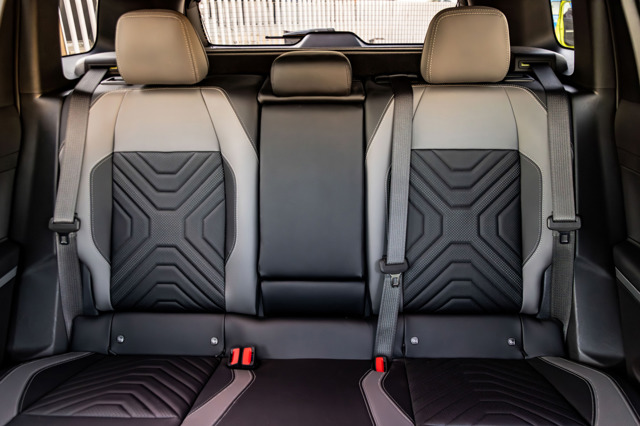
You can fold the rear bench down in a 40/20/40 split to open up a lot more space. Exactly how much, Jeep hasn't confirmed yet, but we'd imagine it is very similar to the 1645 litres you get in a Vauxhall Grandland Electric when configured the same way.
Jeep likes to boast about the 34 litres of storage space in the rest of the cabin, although 2.5 litres of that is a shelf above the glovebox, which doesn't have any netting to stop items making a bid for freedom if the driving becomes a bit 'spirited'. It doesn't seem like a very useful feature.
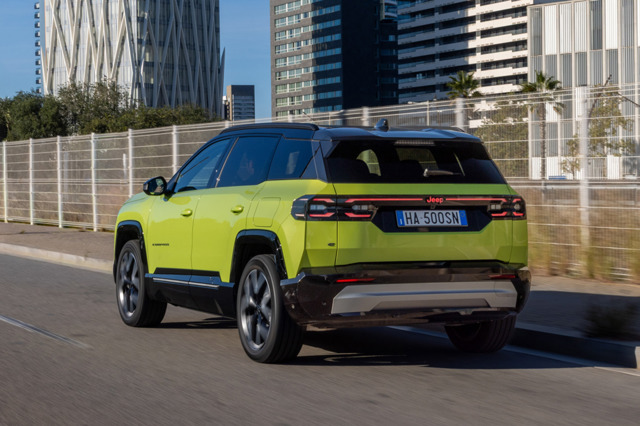
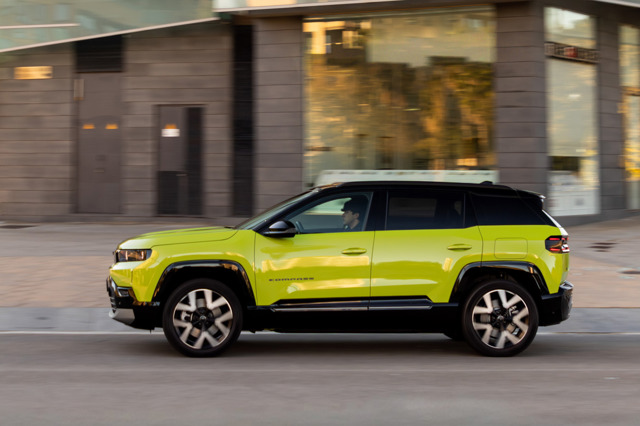
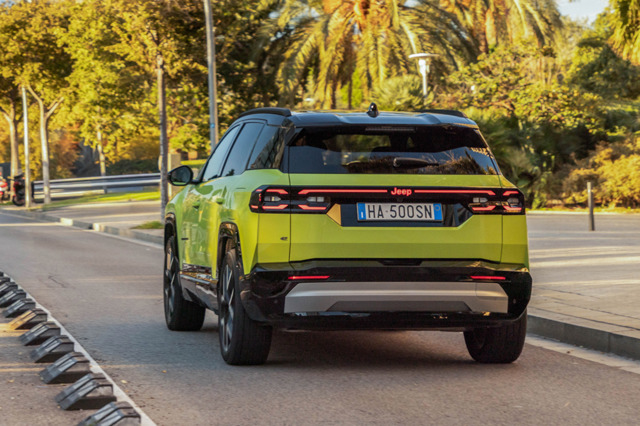
The roofline slopes quite significantly towards the rear, but you'd need to be especially tall for headroom to be a problem. All but the tallest of rear-seat occupants should be happy with the legroom, too, which has been increased by some 55mm compared to the previous-generation Jeep Compass.
Jeep Compass Full-Electric 2026: Quality and finish
We were disappointed by the Jeep Compass in this regard. It is, of course, far better than the old one, whose cabin bordered on being nasty in places, but a lot of the materials feel cheaper than they do in the car's platform mates, including the Citroen C5 Aircross and Peugeot e-3008. And it's not like either of those are particularly lofty starting points.
The plastic surrounding the front USB-C ports looks cheap, as does the bit of red trim underneath the drive selector. And while we appreciate Jeep trying something a bit different with the rubber floor mats and their topographical map aesthetic, it looks more like they've ended up swollen from some bizarre manufacturing error on first glance.
Jeep Compass Full-Electric 2026: Infotainment
You might think a 16.0-inch infotainment system is going to be massive, but the Jeep's system is in an ultra-widescreen format and you lose the outer edges, because they permanently display the temperature controls for the two climate zones.
You're still left with a decent amount of screen in the middle and the touchscreen itself is effective in terms of responsiveness. The only problem is that the processing going on behind all that isn't in as much of a hurry, with certain operations (changing the map size, for instance) taking an age.
On the subject of navigation, during our first test with the car, we found ourselves missing a few turnings because it isn't terribly clear where the system is trying to send you, not helped by the fact that the arrow on the screen is always a bit behind where the car actually is. You're better off ignoring it and using something like Google Maps or Waze via the wireless Apple CarPlay and Android Auto connectivity.
Jeep Compass Full-Electric value for money
Jeep Compass Full-Electric 2026: Prices
So far, we only know that the loaded-up Jeep Compass Full-Electric First Edition is £39,200 before the government grant - which we're expecting the car to be eligible for - is taken off. That puts it roughly in line with a range-topping Citroen e-C5 Aircross Max and higher spec versions of the Skoda Elroq but a fair bit below the Peugeot e-3008.
It might start to make less financial sense if you're more interested in the dual-motor version of the car, though. Given that it's paired with a larger battery as well, we're expecting it to be quite expensive.
As is the case with all EVs, the Jeep Compass Full-Electric will have a Benefit in Kind (BiK) tax rate of only 3%, making it very affordable as a company car. Meanwhile, if you're willing to hang on for a while, you'll likely also be able to save a fair bit of cash by getting a pre-registered or lightly used example, with many EVs currently suffering from steep initial depreciation.
Jeep Compass Full-Electric 2026: Reliability and running costs
Opting for the Jeep Compass Full-Electric over the petrol version won't save you from paying vehicle excise duty (VED), better known as car tax. The EV exemption is no more, so it's the same £195 for the electric Compass as any other car.
What's more, EVs are also now liable for the government's premium car tax supplement and the First Edition looks perilously close to the £40,000 threshold. A few options might push it over.
In better news, it can still be seriously cheap to run an EV if you can charge at home as much as possible. Even if you're paying the UK average rate of electricity, it will cost you less than £20 to fully 'brim' the smaller battery (£25 for the bigger one) and you can slash that figure if you're able to get on a variable tariff and only charge during off-peak hours.
Insurance groups are yet to be confirmed, but we're expecting them to be quite high, especially for the dual-motor version.
The warranty meanwhile is a bare minimum arrangement at three years and 60,000 miles. And before you get too excited about the separate eight years and 100,000 miles of cover for the high-voltage battery, we should point out that this is a legal requirement for EVs.
Reliability might be a bit of a worry when you consider that Jeep placed second from last in that part of the HonestJohn.co.uk Satisfaction Index, but it's hard to say how the Jeep Compass might pan out, being on such a new platform.
Satisfaction Index
 What is your car like to live with?
We need your help with our latest Satisfaction Index, so that we can help others make a smarter car buying decision. What's it like to live with your car? Love it? Loath it? We want to know. Let us know about your car - it will only take a few minutes and you could be helping thousands of others.
Help us with the Honest John Satisfaction Index nowJeep Compass Full-Electric models and specs
The Jeep Compass Full-Electric's trim level is in little unusual, in that your choice of trim levels is dictated by your chosen motor layout. Single-motor cars are restricted to the Summit, Altitude and for a limited time, First Edition (the only version initially available), while for dual-motor versions you'll be picking between Overland and Upland.
So far, only Altitude and First Edition equipment levels have been confirmed. They broadly mirror what you get in Altitude and First Edition versions of the mild-hybrid Compass, with the main difference being wheel sizes.
The Jeep Compass Full-Electric Altitude comes with the following equipment fitted as standard:
- 19-inch alloy wheels
- LED headlamps
- Front/rear parking sensors
- Heated, electrically adjustable and folding door mirrors
- Keyless entry and starting
- Dual-zone climate control
- 16-inch infotainment touchscreen
- 10.25-inch digital instrument cluster
- Wireless Apple CarPlay/Android Auto
- Adaptive cruise control
- Electrically operated tailgate
Upgrading to the Jeep Compass Full-Electric First Edition builds on the above with:
- 20-inch alloy wheels
- LED matrix headlamps
- Illuminated grille
- Dark-tinted rear windows
- Heated front seats
- Heated steering wheel
- Electrically operated tailgate
