
Honda Civic IMA Hybrid (2003 – 2005) Review
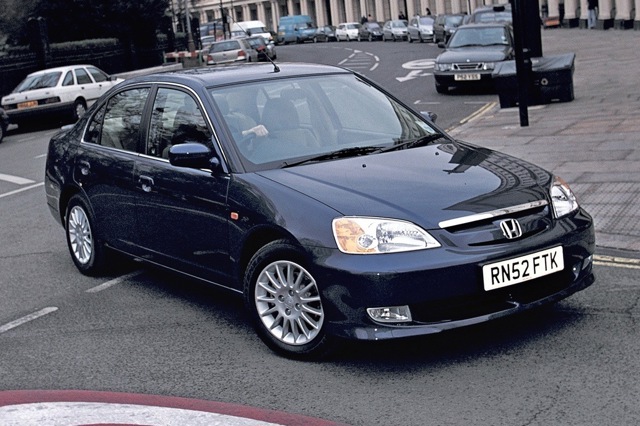

Honda Civic IMA Hybrid (2003 – 2005) Verdict

 Excellent fuel economy that can still exceed 50mpg in everyday driving. Proven Honda reliability and durable petrol engine. Comfortable, easy-to-drive family saloon. Simpler hybrid system than many modern alternatives.
 Hybrid battery replacement can be costly if required. Rare model means some IMA-specific parts can be difficult to source. Performance is modest, especially on faster roads. Boot space reduced by the battery pack and rear seats don't fold.
Find out more about the Honda Civic IMA Hybrid (2003 – 2005)
The Honda Civic IMA was one of the first hybrid cars to go on sale in the UK, arriving several years before hybrid technology became mainstream.
Based on the seventh-generation Civic saloon, it combined Honda's familiar reliability with an innovative petrol-electric drivetrain that promised diesel-like fuel economy without the noise, vibration or concerns over particulate filters that would emerge years later.
Unlike the Toyota Prius, the Civic IMA used Honda's simpler Integrated Motor Assist system. Rather than driving the car on electricity alone, the electric motor supported the 1.3-litre petrol engine during acceleration while recovering energy under braking.
The result was a car capable of more than 60mpg in official tests, with low emissions and impressively smooth operation.
Today, the Civic IMA is a rare sight on British roads, largely because relatively few were sold. That makes it an interesting used buy for drivers looking for dependable, low-cost transport rather than cutting-edge hybrid technology.
Values remain modest and most surviving examples have been owned by enthusiastic drivers who appreciated the car's economy and reliability.
Age is now the biggest challenge. The newest cars are over 20 years old, so condition matters far more than mileage. The hybrid battery is the biggest consideration, although many have proved remarkably durable if regularly used.
Buyers should also look for evidence of routine servicing, check that the IMA warning light stays off and ensure the battery charges and assists correctly during a test drive.
While newer hybrids are more efficient and refined, the Civic IMA still makes sense for buyers seeking an inexpensive, dependable family saloon with impressively low running costs. Find a well-maintained example and it remains an excellent alternative to an ageing diesel.
Reviews for Honda Civic IMA Hybrid (2003 – 2005)'s top 3 rivals
.jpg?width=240&height=160&rmode=crop)

.jpg?width=240&height=160&rmode=crop)
.jpg?width=240&height=160&rmode=crop)
Honda Civic IMA Hybrid (2003 – 2005) handling and engines
The Civic IMA is powered by a 1.3-litre petrol engine paired with Honda's Integrated Motor Assist electric motor, producing a combined 90PS.
Unlike full hybrids, the electric motor never powers the car independently. Instead, it boosts acceleration, smooths engine operation and recovers energy under braking before storing it in the battery pack.
A five-speed manual gearbox was offered in some markets, but UK cars were fitted with a continuously variable automatic transmission (CVT). It's well suited to the hybrid drivetrain, prioritising economy and smoothness over outright performance.
Acceleration is leisurely, with 0-62mph taking around 12.5 seconds, but around town the electric assistance makes the car feel more responsive than the figures suggest.
The Civic is comfortable and predictable to drive, with light steering and secure handling. It's happiest cruising or tackling urban traffic, where the hybrid system delivers its biggest fuel-saving benefits. Ride quality is good and refinement is impressive, although the CVT can cause the engine to drone under hard acceleration.
When buying, check that the CVT operates smoothly without hesitation or judder, as regular fluid changes are essential.
The IMA battery should charge and discharge consistently, with no warning lights displayed. A replacement battery can be expensive, so any signs of poor battery performance should be investigated before purchase.
Honda Civic IMA Hybrid (2003 – 2005) interior
The Civic IMA shares its cabin with the regular Civic saloon, offering a straightforward, durable interior rather than the futuristic styling that arrived with its successor. Controls are logically laid out, visibility is excellent and build quality is typical Honda, meaning many interiors still feel remarkably solid after two decades.
Front occupants enjoy supportive seats and plenty of adjustment, while rear passengers have decent legroom for a compact family car. The Civic's upright shape also makes getting in and out easy, particularly for older drivers.
The main compromise comes in the boot. The hybrid battery is mounted behind the rear seats, reducing luggage capacity compared with conventional Civics and preventing the rear seat back from folding. If you regularly carry bulky loads, a standard Civic hatchback is a more practical choice.
Equipment levels were generous for the time, with climate control, electric windows, remote central locking, alloy wheels and a CD player fitted to most UK cars. Some examples also feature cruise control and leather trim.
When inspecting a used example, ensure every electrical feature works correctly, particularly the climate control and dashboard displays. Interior trim is generally hard wearing, so excessive wear may suggest neglect. A stamped service book and evidence of regular maintenance are much more important than low mileage on a car of this age.
Model History
March 2003
Logical development of the Insight in the Japanese/American Civic 4-door body, offering 5 seats and plenty of luggage capacity in same bodyshell as Thai Honda Civic 4-door.
Power unit is the 1,339cc i-DSI chain cam engine from the Jazz uprated to 92bhp and 115lb ft torque. This is married to a 10kW electric motor. The combination gives torque equivalent to a 1.6 litre engine, 104mph top speed, 0-60 in around 14 seconds and 57.6mpg combined.
5-speed manual rather than auto. Big advantage in London was that it was exempt from Congestion Tax.
January 2004
Launched at price of £15,013, with a £1,000 Powershift grant confirmed until March/ Further advantages include: Group 8 insurance, £70 VED, 12% BIK tax. Has standard 3 year 90,000 mile Honda warranty. plus a special 8 year 100,000 mile guarantee on the hybrid powertrain, including the niclkle metal hydride battery pack.
What to watch out for
High cost of engine servicing. Valve/cam clearances cannot be checked without removing the exhaust manifold, adding £80 to the cost of a service. 2nd annual service can cost £430 including a new set of front pads.
11-05-2011:DO NOT JUMP START. Hybrids should be trickled charged, not jump started (bulletin from Toyota how to do it correctly). If a recovery agent connects jump leads directly to either hybrid battery and than to his battery the sudden charge can damage circuits with in the hybrid system (not necessarily the ECU). It seems that not all recovery companies are familiar with the correct jump start process . Damage can be caused which will not be apparent at the time.
03-04-2017:Owner of 13 year old 115,000 mile Honda Civic IMA reports it has been basically reliable and an enjoyable car to own, but recently I've been struck down by the braking system. Had 2 new calipers which weren't too bad as they're the same as most other Civics. However afterwards the handbrake wouldn't hold. Handbrake cables are specific to the IMA and aren't available from Honda or anywhere else in the UK, managed to get some for £100 from Germany. However following this the brake pedal bite was very low, so a master cylinder was required. Again, specific to the IMA, and not available in the UK for less than £500. Ordering from abroad isn't too bad thanks to ebay, amazon etc. (These parts are freely available for the Honda Civic saloon on which the IMA is based, which was sold in RHD form in Japan, Australia and Thailand.)
