
Ferrari 12Cilindri Spider review: price, mpg and boot space

Ferrari 12Cilindri Spider Verdict

 Fabulous engine. Perfect performance and handling harmony. Effortless long-haul cruising.
 Touch-sensitive steering wheel buttons are a pain. Engine sound is a tad muted. Eye-wateringly expensive.
Find out more about the Ferrari 12Cilindri Spider
Few will ever see a Ferrari 12Cilindri Spider in the wild, let alone have the opportunity to drive one. Consequently, the real-world relevance of one of the world’s most expensive and powerful two-seater convertibles is understandably called into question. Yet its existence is to be celebrated — find out why with our full Ferrari 12Cilindri Spider review.
The ‘Old Man’, Enzo Ferrari himself, always said that his company’s V12 engine defined the brand. He also said that when you buy one of his cars you pay for the engine and get the rest for free. On both counts, that’s never more so than here with the Ferrari 12Cilindri Spider.
Discounting the outrageous Cosworth-built V12 in the Gordon Murray Automotive T.50 — all 300 examples of which have already been snapped-up — the gloriously sonorous 6.5-litre offering under the Ferrari’s bonnet is the only remaining naturally aspirated twelve-cylinder engined production car left.
No turbocharging. No supercharging. No electric motor hybridisation. Just 830PS of good old-fashioned oomph. Strictly speaking, this means that the Ferrari 12Cilindri Spider has no rivals, but in this review we will relax the purism a little.
Broadening that scope means its alternatives include the Aston Martin Vanquish — not yet available in Volante convertible guise — and the Bentley Continental GTC Speed Convertible, which is now a V8-engined plug-in hybrid after its old W12 engine gave way to emissions legislation.
Also on the list is the McLaren 750S Spider even thouugh it's far more of a sports car than a gran turismo in the Ferrari’s mould.
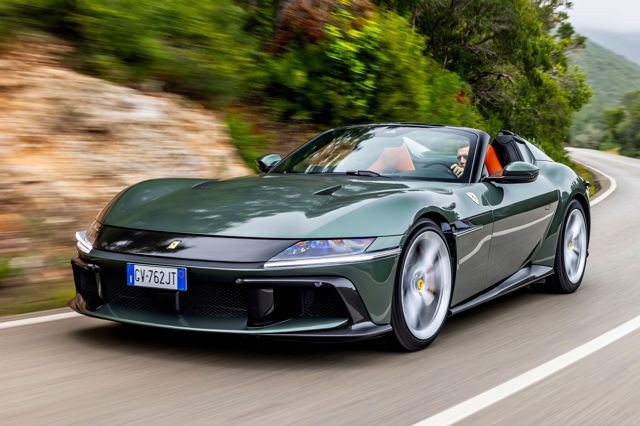
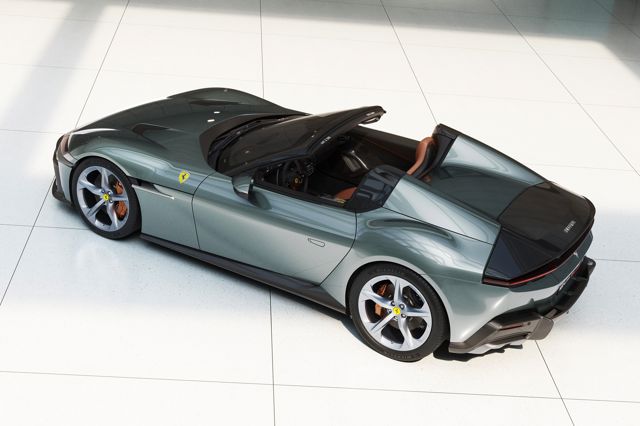
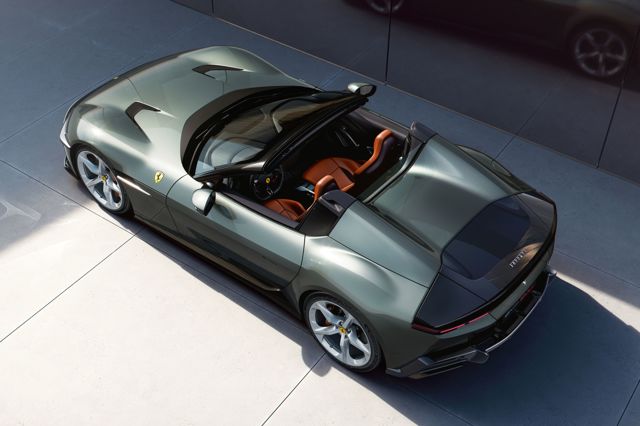
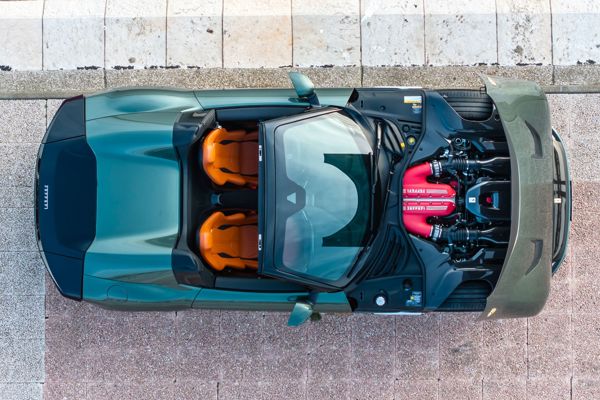
Unlike its smaller sibling, the Ferrari Roma Spider, the 12Cilindri Spider has a folding hard-top instead of a fabric lid. According to its designers that’s because ‘it looks like it’s designed to go into space’, and you won’t find a multi-layered canvas hood on an inter-galactic craft.
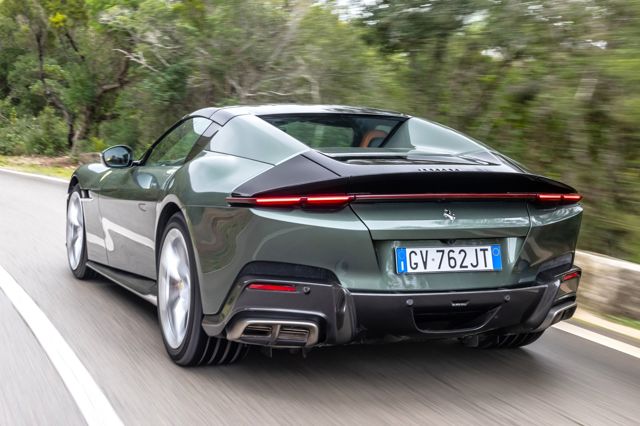
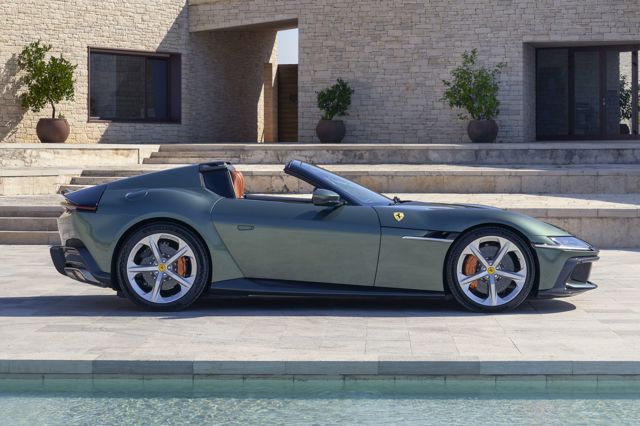
In side profile, the Spider emulates the 12Cilindri coupe’s sloping fastback roofline with a pair of buttresses, beneath and between which the roof is quickly hidden at the push of a button. Neat, but it comes at the expense of 70 litres of boot space in the 12Cilindri Spider.
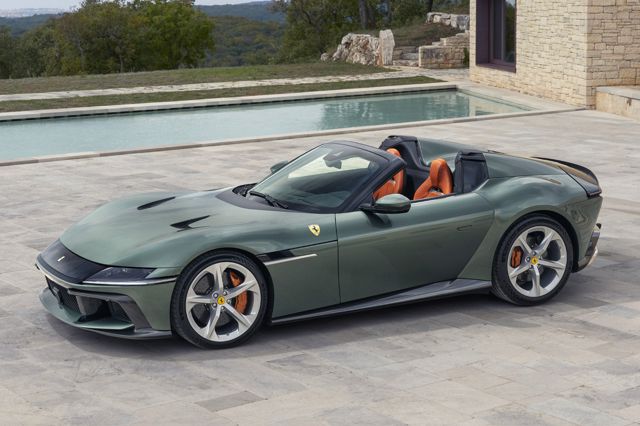
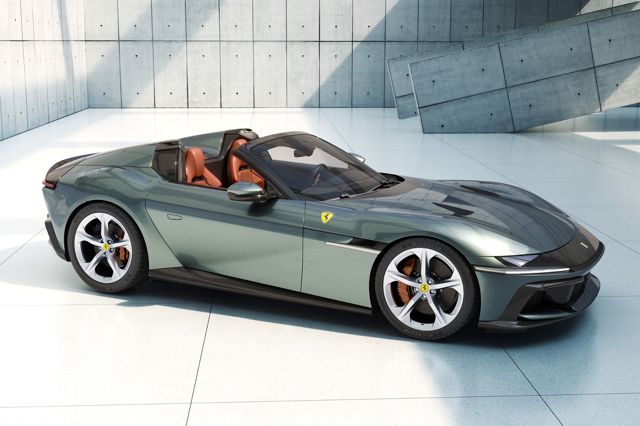
We can’t recall ever driving anything that attracts as much attention as this Ferrari such is its spectacular road presence. Its sharp lines are modern yet clearly referential to the fabulous Ferrari 365 GTB/4, often known simply as Daytona, without being unnecessarily retro.
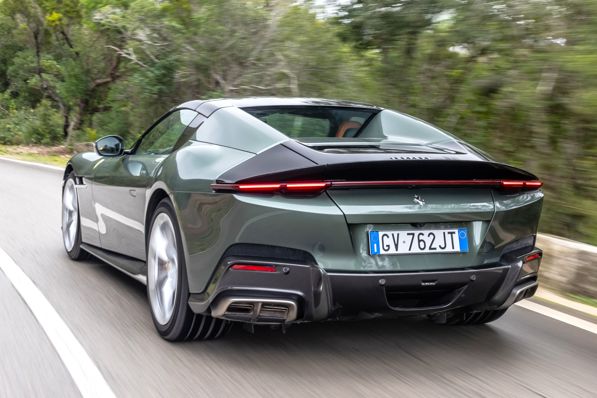
There’s a great deal of aerodynamic trickery going on for the 12Cilindri, yet a pleasing absence of shape-spoiling wings and vanes. Two large winglet panels built flush into the outer corners of the black section of bodywork at the rear rise quickly under heavy braking or hard cornering to generate more downforce over the rear wheels.
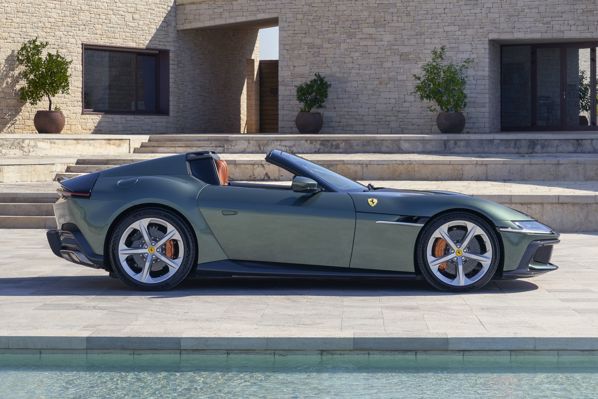
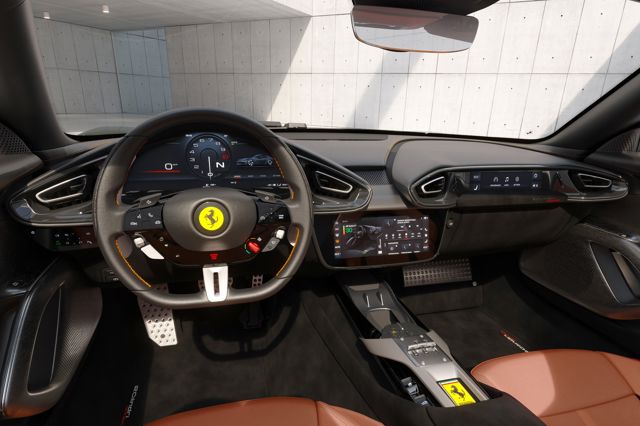
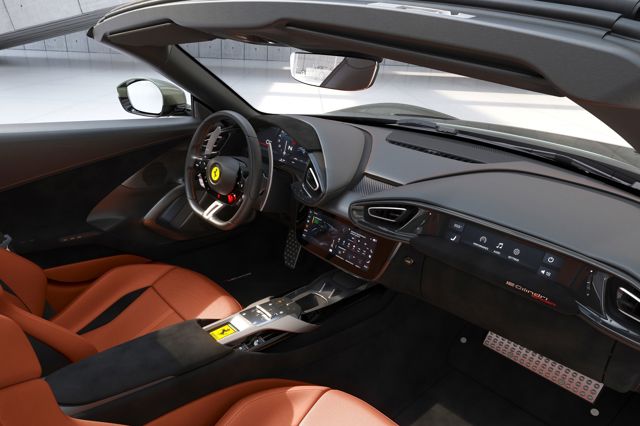
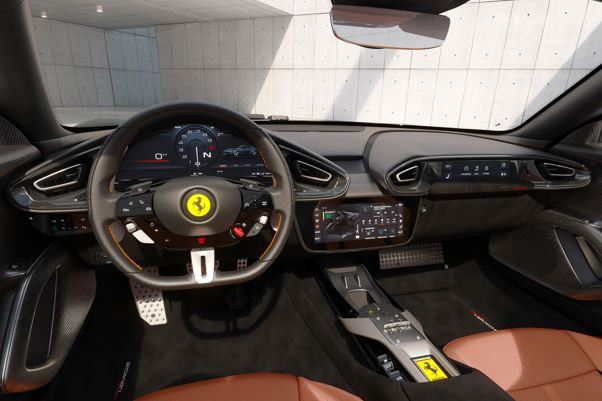
On board, its two-seater cabin is neat, elegant and pleasingly fuss-free — the Spider’s folding roof mechanism necessitates the deletion of the coupe version’s token rear seats. It’s an exquisite interior, with a lack of physical buttons on the dashboard and the haptic steering wheel touchpads being our primary gripes.
Performance-wise the Ferrari 12Cilindri Spider rockets from nothing to 62mph in just under three seconds and reaches 124mph in a smidge over eight. Find a suitably unrestricted section of autobahn and 211mph is possible.
The boring stuff? Combined fuel economy of sub-18mpg means you’ll become a very familiar face at your local filling station while and CO2 emissions of 360g/km plonk it in the priciest company car tax band. Let’s face it, both could be worse.
Talking of price, to get behind the wheel of the Ferrari 12Cilindri Spider you will need a minimum of £370k before options. And it’s highly unusual — and not recommended — to purchase a Ferrari without going wild with the jamboree of extras. A word of warning as restraint will be required to keep the total cost below half a million pounds.
That trifling matter aside, the Ferrari 12Cilindri Spider emphatically demonstrates that the company has thoroughly mastered the art of producing machines that are every bit as happy to potter as they are to plunder.
We usually breathe a huge sigh of relief when returning a car of this ilk with limb and licence intact. On this occasion, we almost wept.
Reviews for Ferrari 12Cilindri Spider's top 3 rivals


Ferrari 12Cilindri Spider handling and engines
Ferrari 12Cilindri Spider 2026: Handling and ride quality
On the move, what first strikes you isn’t the Ferrari 12Cilindri Spider’s blistering pace but its fabulous ride quality. It combines smooth, supple, relaxed progress with the constant tingle of road surface information through both steering wheel and seat of the pants just as you want and expect from a car such as this.
Its bumpy road suspension setting is a real bonus on UK highways, too. It takes the edge of the harsher elements of the ride that are occasionally inevitable on our bombed-out boulevards.
Left in fully automatic mode, the gearchange is as smooth as a freshly-buttered banister, creaming through both up- and down-changes with the seamless urgency appropriate to one of the world’s great high-performance GT cars.
When the road starts to wind, you barely need to dial down the power at all. The Ferrari’s steering is fabulous —fast, beautifully weighted and full of feel.
Four-wheel steering is standard for the 12Cilindri Spider, with some clever tricks technology included in its arsenal. The rear wheels can subtly toe-inwards to help stability under braking and can even be steered individually where circumstances demand it to maintain the Ferrari’s balance.
For a big, fast car it feels incredibly wieldy and deliciously poised, adding superb response on turn-in to wonderful balance and mighty traction, even in the wet.
Its brakes are also outstanding. Operated via Ferrari’s first drive-by-wire system they are wonderfully tactile and reassuring, right from the first touch of the pedal through to the enormous stopping power you find at the meat of its travel.
Perhaps the 12Cilindri Spider’s most reassuring element of all is the latest evolution of Ferrari’s Side Slip Control system. It’s always there — unless you select the raciest of driving modes — to guide you through the onset of a rear wheel slide.
It’s always daunting to push a car this fast — and this expensive — towards the limits of its grip, but dry or wet, the Slide Slip Control system makes it about as risk-free an exercise as is possible.
Especially in the dry, when you feel emboldened to lean harder and harder on the rear tyres as you rocket out of corners, confident in the knowledge that the 12Cilindri Spider’s electronic wizardry is far less foolish than the driver…
Roof-off driving is essentially all of the above, with knobs on. The diminutive rear screen defaults in the half-raised position to optimise airflow and minimise buffeting — at all but the more outlandish speeds, toupees remain largely untroubled.
As ever with top-down motoring, the presence of wind in the hair does tend to instinctively slow proceedings. Just don’t expect to hear a deal more from the engine with nothing between you and the sky.
For less than warm days the roof has a compromise setting where the lid can remain in situ with the rear screen lowered. Snug, with a whiff of extra exhaust melody. For mile after joyous mile.
Ferrari 12Cilindri Spider 2026: Engines
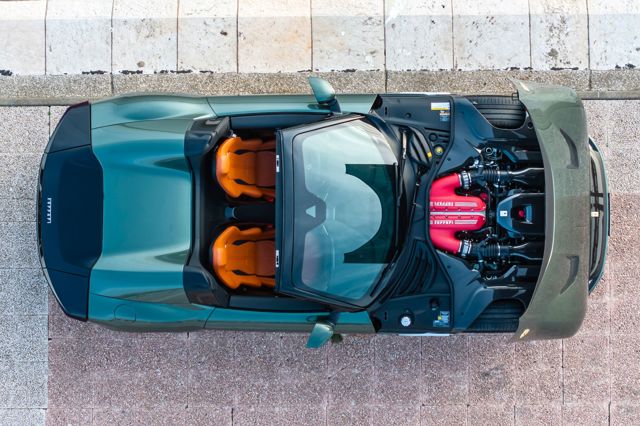
Snugged entirely behind the front wheel positions under the Ferrari 12Cilindri Spider’s clamshell bonnet is a masterpiece of mechanical engineering.
No turbocharging, supercharging or hybridisation — a naturally aspirated, 6496cc V12 which delivers 830PS at an almighty 9250rpm and 678Nm of torque at 7250rpm.
Powering the rear wheels via an 8-speed dual-clutch automatic gearbox, this scorches the Ferrari from a standstill to 62mph in just 2.95 seconds, with 124mph achieved in only 8.2 seconds. As academic as it is, the top speed is quoted at 211mph.
Select manual gear changes and perhaps a racier driving mode, brace yourself and floor it… The response is astonishing — this is an incredibly fast car. The road ahead is inhaled by the windscreen at a rate that seems scarcely credible. As the satisfying, felt-but-not-heard click of the manual paddles grabs you gear after gear, there’s simply no let-up in its brutal acceleration.
Ferrari has actually calmed the 12Cilindri Spider’s engine responses in third and fourth gears to make progress more linear, but you wouldn’t know it. Not least because this Ferrari simply doesn’t sound hyper in the manner of some cars of this ilk.
Its V12 is deliciously sonorous at all times, certainly, but you’ll need to be knocking on the door of 9000rpm for it to really shoulder its way out of the background and set the hairs on the nape of your neck trooping the colour.
Some may bemoan the absence of a relentless snarl — you can blame extremely trick catalytic converters fitted to mollify ever-tightening American and Chinese emissions regulations for that. In truth it makes the 12Cilindri Spider far easier to live with as a grand tourer, and no less blindingly quick.
Ferrari 12Cilindri Spider 2026: Safety
As is typically the case for low-volume, high-performance and expensive cars the Ferrari 12Cilindi Spider has not been subjected to a crash-testing assessment by the experts at Euro NCAP.
That’s not to suggest that safety isn’t a key consideration both in the 12Cilindri Spider’s engineering or use by the customer.
The Ferrari prioritises driver confidence through advanced technology, featuring standard Advanced Driver-Assistance Systems (ADAS) such as Automatic Emergency Braking, Lane-Departure Warning and Adaptive Cruise Control, all managed via an intuitive button.
Those are alongside structural improvements including increased rigidity and Rear-Wheel Steering for enhanced stability, making it a more forgiving yet dynamically capable grand tourer than its predecessors.
Ferrari 12Cilindri Spider interior

Ferrari 12Cilindri Spider 2026: Practicality
Decked-out in optional 'Daytona'-aping leather upholstery, the Ferrari 12Cilindri Spider’s seats are a perfect meld of comfort and support. They lack the aggressive bolstering that necessitates buttock-bruising negotiation to get in and out of as found in many cars this fast, yet they still hold their lucky occupants snuggly in place.
The driving position is excellent — low, perfectly in line with the controls and roomy — and all-round visibility superb. The view astern between the rear wing buttresses is fabulously unimpaired.
While the 12Cilindri Spider’s steering wheel is a delight to wield, it’s a busy affair housing controls for the indicators, headlights, wipers, driving modes and other functions besides, too many of which are haptic touch buttons rather than traditional switches.
Indeed, the only driving-related function controlled from the central touchscreen is the nose lift when dealing with speedbumps and multi-storey car parks.
There is no rear bench seat as found in the 12Cilindri coupe — for the Spider that space dedicated to the roof folding mechanism. It can be snugged-away electrically in just 14 seconds, at speeds up to 28mph, while the small wind-deflecting screen between the buttresses can be lowered with the roof up or down.
Naturally, this Ferrari is not a car you would choose if practicality was one of your main requirements. It’s a good job as well, as the loadspace in the Spider’s tail only offers a 200-litre volume, a 70-litre capacity reduction compared with its coupe twin.
Storage space within the cabin is somewhat limited in scope and practicality. The centre armrest cubby, glovebox and door pockets are all small by any standards, but who cares when there is a tailor-made slot for the gleaming minor monolith that is the Ferrari’s key?
Ferrari 12Cilindri Spider 2026: Quality and finish
Build quality on-board the Ferrari 12Cilindri Spider is very good. It’s also quite understated, lacking the flamboyance that discos-up the Lamborghini Revuelto’s cabin.
Elements of flair here are more referential — a nod to aficionados of the marque who will appreciate the historical touches. That includes the optional leather upholstery striping in homage to its great 12-cylinder forebear, the Ferrari 365 GTB/4, nicknamed 'Daytona'.
It’s true that the air vents within the outer tips of the instrument binnacles for both driver and passenger lack the visual and tactile appeal of the howitzer nozzles you will find in the Ferrari F8 Tributo, but this is all in keeping with the more laid-back appeal of the 12Cilindri Spider’s cockpit. Here you will potentially spend more time continent crushing rather than just popping out for a damned good hoon.
Hence, presumably, the central rev counter’s skin on the display screen defaults to a muted black here instead of Ferrari’s more customary shouty yellow. That said, choosing an alternative colour is but a few menu settings away.
Given the breadth of choice of personalisation options available for the 12Cilindri Spider — including installing an F1 car’s-worth of carbon fibre décor, even in little dark corners that only you and your bank manager will therefore know exist — much of what you can see and touch is hand-assembled.
On older Ferraris this wasn’t always the hallmark of quality typically associated with the term, but these days it’s a reflection of the craftsmanship involved.
The 12Cilindri Spider’s folding metal top deserves special mention here for both quality and finish. In place, so tight, shudder-free and painstakingly detailed is the entire mechanism that the unwary could be forgiven for not even realising this wasn’t the fixed-roof coupe. Praise indeed.
Ferrari 12Cilindri Spider 2026: Infotainment
Those twin binnacles have something of the Cyclon Raider from Battlestar Galactica in their proportional rise out of the Ferrari 12Cilindri Spider’s dashboard.
Both sides house digital display screens, yet even with the switch from analogue technology it’s the central rev counter which dominates the driver’s cluster. What you choose to display on the outer portions is down to driver preference, but it can include mapping and audio information to minimise time spent with your eyes off the road.
Sadly the the haptic touch steering wheel pads makes scrolling through to the screen options a somewhat trying experience. No amount of practice will shed the wish that Ferrari would return to a more physical approach to its helm-mounted knobs and switches. Happily, we gather the company is considering this…
Mercifully, the tactile little manettino driving mode switch remains. We assume it will prove too much to ask for the return of a fully analogue rev counter?
That second dashboard screen contains enough information to keep your passenger both involved in proceedings and — upon glimpsing its digital speedometer flickering numbers faster than the timing clocks at an international athletics event — yelling at you to slow down.
Set lower down on the dashboard is the central multimedia touchscreen, used for all manner of in-car functions, including the climate control settings, unfortunately.
It links to your smartphone using Android Auto and Apple CarPlay connectivity for ease of dealing with infotainment, including mapping. Ferrari pragmatically hasn’t installed a native navigation system, sensibly reckoning that owners who have forked-out a third of a million pounds for a car will have a phone more than capable of doing a better job.
Ferrari 12Cilindri Spider value for money

Ferrari 12Cilindri Spider 2026: Prices
In the real world which most of us occupy, the notion of spending at least £369,245 on a Ferrari 12Cilindri Spider could not be construed as being value for money in any sense of the phrase.
This ignores the fact that 12Cilindri Spider customers don’t live in the same world, where having sufficient capital is a given. At that point desire dictates value for money and it’s entirely understandable how it could be craved so deeply.
We say ‘at least £369,245’ because it must be nigh-on impossible to get the thing off the forecourt for that figure, not least because of its baffling array of optional extras — those are explored in the Specifications section below.
Suffice it to say here that even if you don’t go for the rafts of carbon fibre that constitute quite a chunk of the typical extra value fitted to most 12Cilindri Spiders, you are unlikely to escape with a wallet anything less than £400,000 lighter.
Then again, at this rarefied end of the market all cars have telephone number prices. Still only available as a coupe — albeit for not much longer — the Aston Martin Vanquish starts at £335,545, which makes the Bentley Continental GTC Speed Convertible seem like a bargain in this esteemed company at £259,665. McLaren’s 750S Spider is similarly less costly than the Ferrari at £274,705.
Ferrari 12Cilindri Spider 2026: Reliability and running costs
Running costs for the Ferrari 12Cilindri Spider are very high — if you were expecting otherwise, point your nose in the direction of South America and inhale deeply. The coffee, obviously…
You can expect big bills for unexpected issues or non-routine wear, requiring deep pockets — which you must have to have bought the 12Cilindri Spider in the first place.
Consumption of fuel is high due to the 6.5-litre, V12 Ferrari engine’s thirst. Official WLTP Combined cycle figures suggest an average of 17.8mpg. Driven gently at a steady 60mph or so, you will have a good chance of beating that — but that isn’t why you bought the 12Cilindri Spider.
First-year VED Car Tax costs will also be high in the first year (£5490 at 2025/26 rates) before falling back to the same £195 standard rate levied on all cars. The Ferrari’s very comfortably beyond the £40,000 Expensive Car Supplement threshold so expect an additional £425 bill for that from years two through six of ownership.
With CO2 emissions of 360g/km the 12Cilindri Spider is unlikely to appeal as a company car choice — unless you also own the company concerned — placed as it is in the highest Benefit-in-Kind (BiK) band.
Some significant cost-mitigation is provided by Ferrari’s Genuine Maintenance program. It’s a seven-year complimentary routine servicing package covering all scheduled maintenance, plus a four-year warranty which is extendable for around £6000 per annum, make those initial years much more reasonable.
Satisfaction Index
 What is your car like to live with?
We need your help with our latest Satisfaction Index, so that we can help others make a smarter car buying decision. What's it like to live with your car? Love it? Loath it? We want to know. Let us know about your car - it will only take a few minutes and you could be helping thousands of others.
Help us with the Honest John Satisfaction Index nowFerrari 12Cilindri Spider models and specs
There is no line-up of different derivatives within the Ferrari 12Cilindri Spider range — an essentially nameless trim level is the sole version.
As generously appointed as it is, almost all Ferraris are specified new with extra-cost options, some of which are highlighted below.
Standard equipment for the Ferrari 12Cilindri Spider briefly includes:
- 21-inch alloy wheels
- Automatic LED head and tail lights
- Automatic adaptive main beam
- Electrically folding roof
- Active aerodynamic bodywork
- 10.25-inch multimedia touchscreen
- 15.6-inch digital cockpit display screen
- 8.8-inch passenger display screen
- Android Auto and Apple CarPlay wireless smartphone connectivity
- 15-speaker, 1600W Burmester sound system
- Wireless smartphone charging pad
- Electrically adjustable seats
- Leather upholstery
- Dual-zone climate-controlled air conditioning
- Adaptive cruise control
- Seven-year maintenance program
Among the plethora of Ferrari 12Cilindri Spider extra-cost options to choose from are:
- Airbrushed Ferrari racing shield front wing emblems
- Protective paintwork film
- Carbon fibre exterior, interior and engine bay finishes
- ‘Daytona’-style striped leather seat upholstery
- Two-tone leather interior
- Alcantara faux-suede carpets
