
BMW 5 Series Touring Review: Price, mpg and boot space
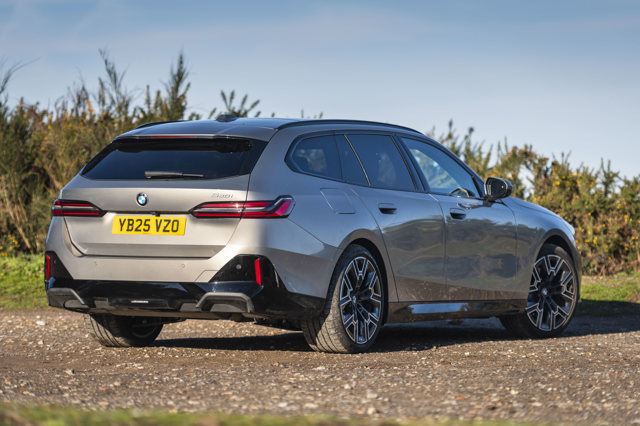

BMW 5 Series Touring Verdict

 All of the 5 Series Saloon's virtues with much more practicality.
 Not as sharp to drive as its predecessors. iDrive infotainment system struggles with volume of tech.
Find out more about the BMW 5 Series Touring
Large estate cars aren't the money-spinners for car manufacturers they once were, with many consumers preferring their practicality to be high-rise with an ever-broadening assortment of SUVs. Even Volvo, the brand arguably more associated with upmarket wagons than any other, is leaving the arena. Yet among the few which remain is the latest generation of one of the very best cars on sale — find out exactly how good it is with our full BMW 5 Series Touring review.
In retrospect it seems strange that it took almost two decades for the company's management to figure out that an estate-bodied version of the BMW 5 Series saloon would be a good idea, with neither of the first two generations having a Touring spin-off.
It wasn’t until the third-generation (E34) 5 Series that the fundamental issue of saloon impracticality was solved — and here in the UK we didn’t get the original BMW 5 Series Touring until 1992, 19 years after the first iteration of the saloon's launch.
While there is much to love about the shape and old-school prestige of a traditional saloon, such as the 5 Series, their lack of flexibility limits their appeal. With the estate version, you’re not simply gaining practicality — the BMW 5 Series Touring isn’t simply the pinnacle of the 5 Series experience, it’s one of the best cars on sale today, at any price.
Not that the 5 Series Touring is the only choice available, although the pool of alternatives has shrunk in recent years. Its two perennial challengers remain in the guises of the Audi A6 Avant and the Mercedes E-Class Estate.
Production of the Volvo V90 has concluded but there remains a number of brand new models available from stock for the time being.
Dropping a couple of notches in terms of price and prestige is a pair of capable wagons that are very closely related to one another — the Skoda Superb Estate and the Volkswagen Passat Estate, the latter now being the only body style of Passat on sale.
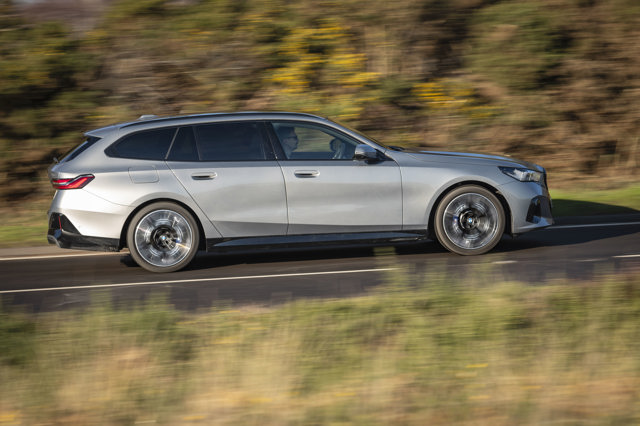
For a £2250 premium over the equivalent saloon, the BMW 5 Series Touring gets you not only 50 extra litres of boot capacity with all seats in use, but additional usability thanks to the enormous tailgate used to access it. Fold over its 40/20/40-split rear bench and it essentially becomes an upmarket van — again, something that the saloon can’t match.
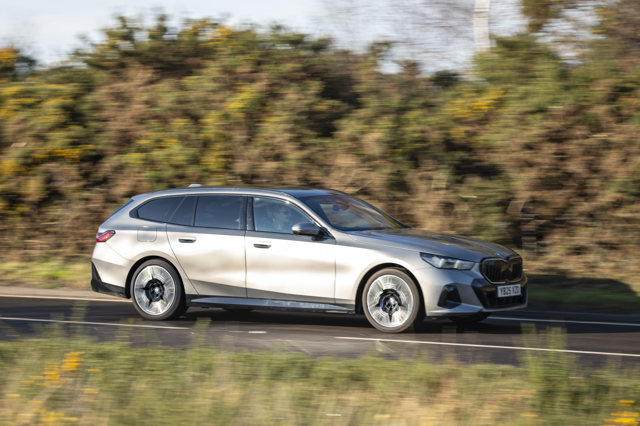
Owing to its extra rear bulk, the 5 Series Touring is also heavier, but not to the extent that it affects handling or ride quality in any noticeable way. Its roofline also tapers downwards far less towards the back meaning rear headroom is improved.
Aside from those things, the Touring is basically as per the saloon — same engines, same levels of standard equipment, same optional extras and the same overarching sense of being a supremely refined and high-quality car. It’s outstanding.
The 5 Series Touring has superbly smooth ride quality, top-notch refinement and a general sense that it’s really a more practical version of a luxury limousine. Think of it more as a scaled-down BMW 7 Series rather than a larger 3 Series Touring. It’s still fun to steer in that way all BMWs tend to be — sharp turn-in and a rear-wheel drive feel — but things are altogether softer now.
The range starts with the petrol 520i Touring, through a couple of plug-in hybrids and ends with the BMW M5 Touring — a supercar estate, in essence. Sadly there’s no diesel engine availability, which feels like a significant loss because its blend of high torque and high efficiency made its predecessor a fantastic load lugger.
Every BMW 5 Series Touring gets some degree of electric power. The 520i is a mild hybrid, meaning a small motor assists the engine to save fuel, while the 530e and 550e xDrive plug-in hybrids are both very powerful and efficient.
They’re mainly aimed at company car drivers looking for a tax break, but the excellent pulling power of the electric motor makes them especially good when the car is full of people and luggage. There’s also the fully electric BMW i5 Touring with greater savings, both for company car drivers and private buyers alike.
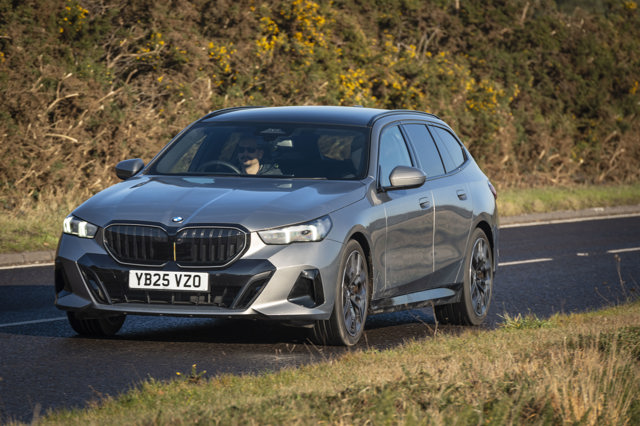
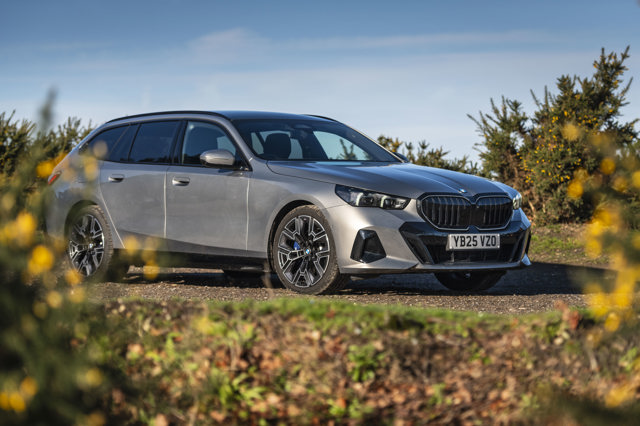
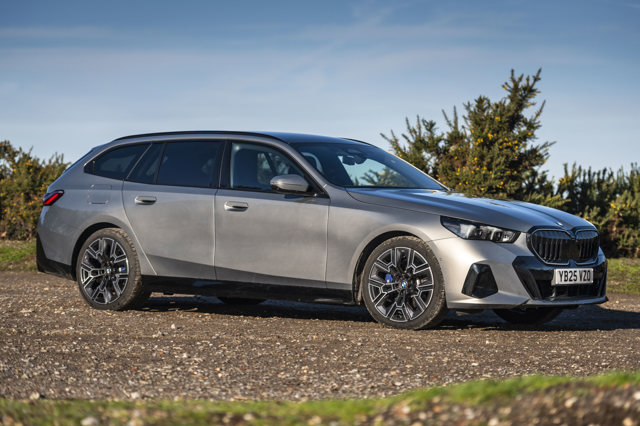
M Sport is now the basic trim level choice now, meaning nobody has to put up with the apparent ignominy of having an SE-specification 5 Series Touring, with smaller wheels and no all-important M badges hither and thither.
The only usability gripe that the 5 Series really has is with its iDrive multimedia system. It feels complicated because the car is stuffed with so much technology that BMW is fighting a losing battle trying to make it all readily accessible. Be prepared to invest plenty of time learning all of its functions.
Overall, the BMW 5 Series Touring is one of the most impressive cars money can buy, at any price.
BMW 5 Series Touring Plug-in Hybrid: Range and charging times
| BMW 530e Touring | 54-60 miles |
| BMW 550e xDrive Touring | 51-55 miles |
As per the brand's historic norm, the BMW 530e Touring is rear-wheel drive and has an electric driving range of up to 60 miles. Due to its greater performance and having greater levels of traction courtesy of its xDrive all-wheel drive system, the 550e Touring goes less far on battery power alone, with an official maximum of 55 miles.
Rather than quoting the typical UK domestic residence's 7.4kW AC charge rate, BMW references times when using an 11kW AC supply, as you might find with a public destination charger at hotel or shopping centre.
With an 11kW time of 2 hours 15 minutes for a 0-100% recharge, we estimate that you can add an extra 60-90 minutes doing the same at home via a wallbox.
Using public DC rapid chargers isn't possible for PHEV-equipped 5 Series Tourings.
Reviews for BMW 5 Series Touring's top 3 rivals

BMW 5 Series Touring handling and engines
BMW 5 Series Touring 2026: Handling and ride quality
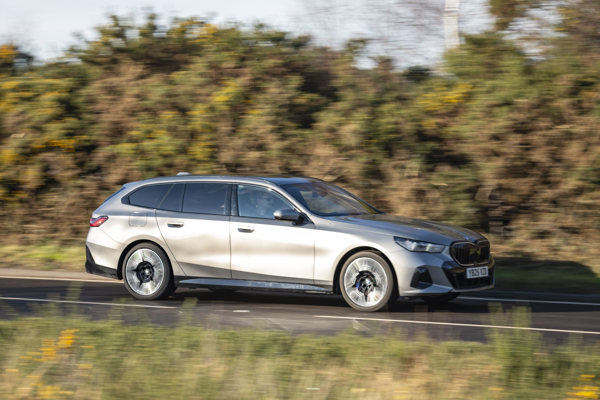
Comfort rather than sportiness is where the current BMW 5 Series Touring has been nudged towards. In doing so it’s sacrificed a bit of dynamic sharpness, with lighter steering, a more supple ride and overall it comes across more as a big, quiet cruiser than a tightly wound wagon. This relaxed, long-legged character suits the kind of driving most owners regularly experience.
Yet behind the wheel you soon realise that the 5 Series Touring still has real dynamic depth and a surprising amount of engagement. As ever with BMW — and with its estate rivals — your experience depends heavily on the engine and suspension you have chosen.
Even the standard setup, which is firmish because it’s branded M Sport, never strays into harshness. Tourings equipped with adaptive suspension are the best choice, but it’s not a cheap option. In its Comfort setting it soaks up the road's imperfections with finesse, while still keeping the body tidy and controlled.
Rear-wheel steering is another option that can noticeably shape how the BMW feels. It tightens up the front end at low speeds and makes this 5060mm-long car feel far more agile than you expect.
That overall size could so easily have been a recipe for a car that’s great on the motorway but dull the moment you get onto a twisty B-road, yet BMW has pulled off something pretty clever. Push the 5 Series Touring harder and it suddenly comes alive, revealing well-balanced handling characteristics that are genuinely enjoyable.
Flick it into Sport mode and the steering weights-up nicely, body control tightens and the BMW seemingly shrinks around you, rather than feeling like something you need to wrestle with. The throttle feels alert whichever engine you’ve chosen, the brakes are progressive and confidence-inspiring and everything works together to give you a real sense of precision.
It’s brilliant, the ideal blend of soothing executive express one minute and unexpectedly sharp sports estate the next.
BMW 5 Series Touring 2026: Engines
Having embraced the trend for hybridisation and killing off diesel power in the process, all BMW 5 Series Tourings are petrol powered with differing degrees of electrical assistance.
Starting point for the range is the mild hybrid-assisted 520i Touring, propelled by a turbocharged 2.0-litre, four-cylinder engine and a small electric motor. Its outputs are 190PS and 310Nm of torque ensuring it's not slow — the 0-62mph dash takes 7.8 seconds, running on to a top speed of 138mph.
For private buyers, the 520i is the most sensible pick. It's much cheaper to buy, very quiet and smooth, has a lovely eight-speed automatic gearbox as standard and is nicer to drive for more of the time than the PHEVs because it’s simpler.
Of the two plug-in hybrids which is likely to be the most popular with company car drivers, it's the cheaper 530e Touring which takes the honours. It uses the same engine as the 520i but with a far beefier electric motor, ramping power up to 299PS and torque to 450Nm.
Its top speed is marginally lower at 137mph although it can be driven in electric-only mode at up to 87mph, while the 0-62mph sprint requires just 6.4 seconds.
Sitting atop the range, M5 Touring aside, is the 550e xDrive Touring with all-wheel drive in place of the cheaper models' rear-wheel drive arrangement.
The same electric motor as in the 530e is employed here, albeit working in unison with a 3.0-litre, six-cylinder turbocharged engine for even more performance thanks to 489PS and 700Nm. Its electric top speed remains unchanged with an overall top speed is capped at 155mph. That 0-62mph benchmark? Just 4.4 seconds.
As ever with PHEVs, how they perform is hinged on how well you look after your battery's charge. With a sufficient amount of electricity, both the 530e and the 550e are efficient and powerful, switching smoothy between petrol power and full-electric or a combination of both.
On the other hand, power and efficiency both decrease significantly when the battery is drained, because they offer little more than dead weight into the mix. This setup also makes the PHEVs much more efficient when used as short-distance runabouts than when performing long motorway runs.
BMW 5 Series Touring 2026: Safety
The BMW 5 Series Touring received five-star rating when it was crash-tested by Euro NCAP in 2023. Its individual scores were excellent — 89% for adult occupant safety, 85% for children, 86% for vulnerable road users and 78% for safety assistance features.
BMW has done a great job of keeping the safety systems of the 5 Series Touring generally useful and unobtrusive. Its attention- and tiredness-monitoring alert systems seem to kick in only if you actually are being inattentive or tired, unlike many of these systems, while its lane-keeping technology isn’t constantly bouncing the car between lane markings.
We’re not fans of the semi-autonomous driving system that automatically slows the car when it detects it's approaching a roundabout or an area with a lower speed limit. In practice it feels like the car has a mind of its own. Thankfully this can be switched off.
Not all 5 Series Touring safety features are standard, though. Pre-crash steering assistance which help you avoid a collision, lane-keeping with adaptive cruise control and 360-degree parking cameras are all optional, sadly.
BMW 5 Series Touring 2026: Towing
The lack of a diesel option for the BMW 5 Series Touring is a loss, especially for towers. The last generation’s 520d Touring had a braked trailer capacity of 2000kg is matched only by the expensive 550e xDrive Touring here. Ouch.
Both the 520i Touring and the 530e Touring have plenty of torque and because they’re heavy cars, they’re good for adhering to the 85% rule — that you should only tow something up to 85% of the weight of the car. Their official maximum capacities are both 1800kg of braked trailer.
BMW 5 Series Touring interior

BMW 5 Series Touring 2026: Practicality
Improved practicality is of course the main reason you’ll pay more for the BMW 5 Series Touring over the saloon-shaped equivalent, but it’s a price well worth paying.
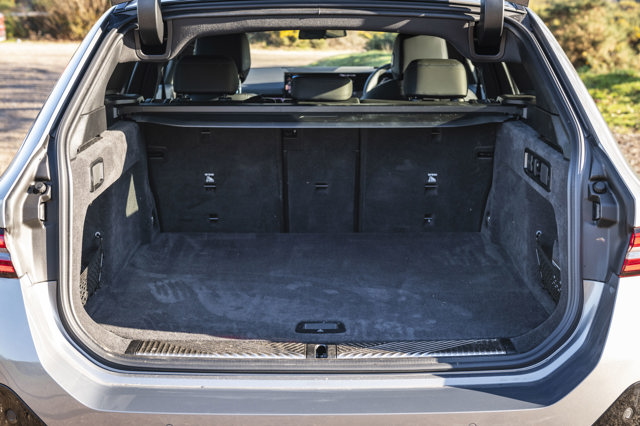
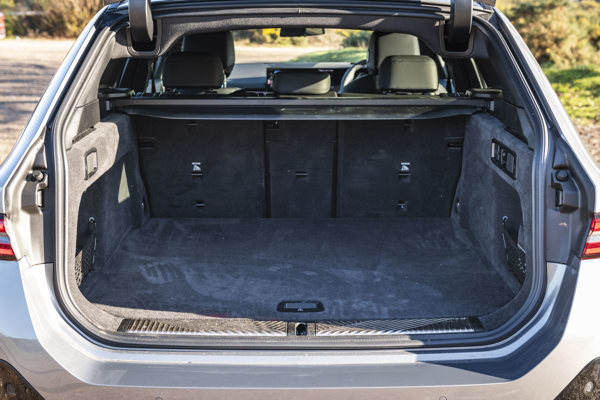
It’s not just the extra 50 litres of boot volume you get, which brings the seats-up capacity to 570 litres for all 5 Series Tourings, it’s everything else that comes with it.
There's the large, electrically operated tailgate to access the boot, which has much more useful straight-sided walls that incorporate netted pockets and a loading floor that's flush with the sill complete with extra storage space beneath.
Handles located in the boot's side walls drop the 40/20/40-split rear seatbacks, which lie almost flat, so you lower them without rushing around to the side doors while you're mid-load. Doing so provides a 1700-litre capacity when loaded to the roof height.
Unlike in the previous-generation 5 Series Touring there’s no loss of boot space caused by the plug-in hybrid variants' high-voltage batteries.
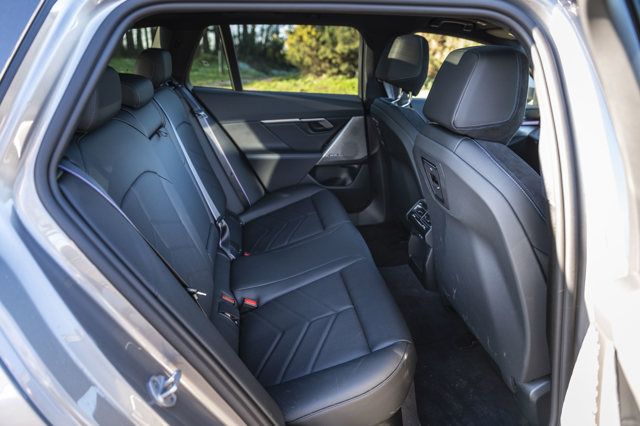
Thanks to the Touring's roofline being more horizontal for a greater proportion of its length than the saloon's is, along with far more glazing, rear seat headroom is more generous and it generally feels airier. Overall cabin space is excellent, with loads of knee room in the back.
An adult could use its middle rear seat position at a push — its rarely comfortable sitting three-abreast in the back of a car, but the 5 Series Touring is much more accommodating than most this side of an MPV with individual rear seats.
There’s plenty of small item storage, including a decent centre console box between the front seats and a wireless charging pad for your smartphone. The door pockets have mouldings for a big bottle — a nice touch if you do a lot of motorway driving.
BMW 5 Series Touring 2026: Quality and finish
The BMW 5 Series Touring has a cabin that looks absolutely top rate — and feels it, too.
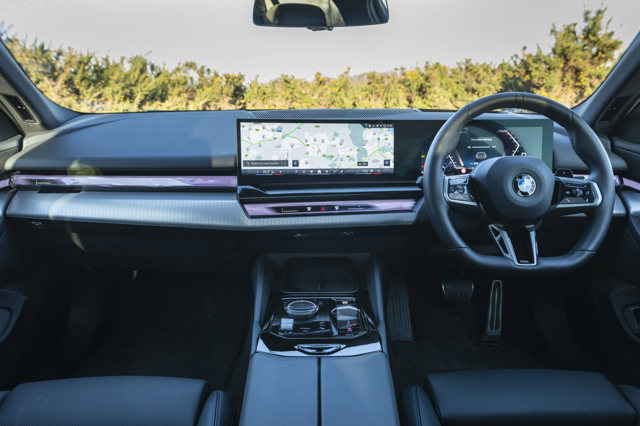
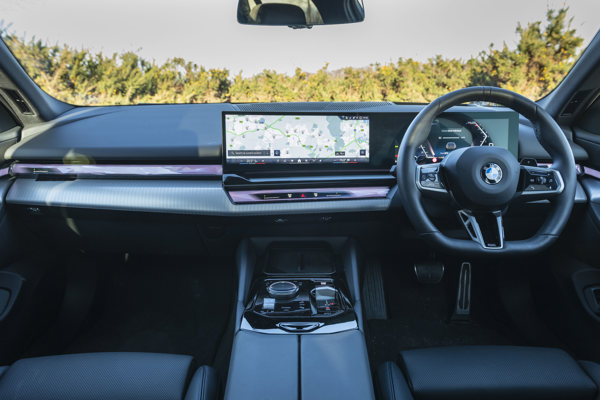
Its door pockets aren’t made from soft-touch plastics, but you’ll likely care about that only for the exact length of time you spend squeezing them. The dashboard is focused on a curved twin-screen display, albeit not in the same way that a Tesla is focused on its screen. There’s much more to it than that.
Based on the whole ‘apartment on wheels’ vibe the firm introduced with the BMW iX, it’s truly delightful. The padded leather dashboard incorporates lighting strips designed to look like crystal. They're stunning, with loads of colours to choose from, plus they’re also integrated into various safety and comfort features.
For instance, the ones in the doors double as blind-spot warning indicators, while strips illuminating the dash glow blue or red accordingly as you adjust the climate control temperature settings.
It’s all an appealing contrast to the straight-laced feel of the Audi A6 Avant and feels of a better material quality than the Mercedes E-Class Estate's interior.
BMW 5 Series Touring 2026: Infotainment
A big part of the BMW 5 Series Touring’s charm lies in its infotainment system, which remains one of the most intuitive modern setups on the market. What's taken a step backwards is the user-friendliness of its once-lauded iDrive method of operating, but that’s primarily because it’s now juggling so many features.
Anyone coming from the previous-generation 5 Series Touring, with its neat row of physical shortcut buttons and proper climate control knobs, may initially find this new layout bewildering. The same goes for the latest steering wheel controls. Spend time learning its functionality and everything will — quite literally — click into place.
Wireless smartphone mirroring is included as standard, meaning you can sidestep much of BMW’s own software in everyday use in favour of Android Auto or Apple CarPlay familiarity. Whatever you choose to interact with, the iDrive system gives your three ways to do so — the centre console's rotary controller, the touchscreen or voice commands. All three work well.
One of the more curious quirks of the BMW 5 Series Touring is its approach to driving modes. Instead of the usual Eco, Comfort and Sport trio, BMW has ventured into stranger territory.
Co-created with composer Hans Zimmer, modes such as Relax and Expressive add ambient soundscapes that change and adapt with acceleration and braking. Relax mode especially is especially weird and disconcerting, invoking a sensation that's the opposite of relaxation.
BMW 5 Series Touring value for money
BMW 5 Series Touring 2026: Prices
A starting price of £54,535 for the 520i M Sport puts the BMW 5 Series Touring right in the same cost ballpark as the Audi A6 Avant, which starts at just £200 more, yet significantly undercuts the Mercedes E-Class Estate, priced from £59,720.
There's a significant leap to the plug-in hybrid versions with the 530e Touring starting at £61,905 rising to £79,075 for the 550e xDrive Touring.
None of these cars are cheap, but you might be tempted to think of the BMW in the way that things used to be — basic, until you hit the extra-cost options list. That’s not the case these days.
What used to be the highest equipment grade — M Sport — is now the baseline, including all manner of equipment you would expect. M Sport Pro adds further kit, including an illuminated grille, for £3000 extra on each version.
BMW 5 Series Touring 2026: Reliability and running costs
In 520i guise the BMW 5 Series Touring has an official WLTP Combined cycle fuel economy of up to 46.3mpg, a figure that isn't that far removed of what's possible to achieve with it in the real-world.
Those official tests tend to favour plug-in hybrids, making them appear extraordinarily fuel efficient as much of it is undertaken with a battery which starts at 100% charge. That's been rectified to some degree with a more realistic testing method, but so far only one of the BMWs has been subjected to it.
Reflecting the old method, the 530e Touring has an official figure of 403.5mpg, while the more recent test of the 550e xDrive Touring yields a best of 94.2mpg. Still high, but closer to being achievable by those who keep their PHEV's battery topped up.
PHEVs typically have lower CO2 emissions, which are one of the factors used to determine company car drivers' Benefit-in-Kind (BiK) taxation bands, along with electric driving range. These metrics see the 530e in the 9% band but the 550e is at the far pricier 18% level. For reference, all electric BMW i5 Tourings are in the 3% band.
The 520i M Sport Pro Touring, with a P11d value of £56,940 is in the 34% tax band and will cost around £18,000 more in BiK across three years than the 530e M Sport Touring with a P11d value of £61,740. Madness.
There’s only £10 difference in what you’ll pay in VED car over five years for all three engine choices as PHEVs are now only discounted for the first year. There's no escpaing the additional Expensive Car Premium, payable in years two to six of ownership and currently priced at £425 per annum.
Residual values are strong, meaning lease rates are attractive and you can keep your costs down even more by adding a maintenance package. Servicing costs for a 5 Series Touring are relatively pricey, especially the PHEVs, although you can pay BMW £1200 to cover all of them for up to five years or 62,000 miles.
Satisfaction Index
 What is your car like to live with?
We need your help with our latest Satisfaction Index, so that we can help others make a smarter car buying decision. What's it like to live with your car? Love it? Loath it? We want to know. Let us know about your car - it will only take a few minutes and you could be helping thousands of others.
Help us with the Honest John Satisfaction Index nowBMW 5 Series Touring models and specs
Two trim levels are available for the BMW 5 Series Touring line-up — M Sport and M Sport Pro.
Standard kit for the BMW 5 Series M Sport Touring includes:
- 19-inch M Sport bi-colour alloy wheels
- M Sport suspension
- M Sport brakes with blue calipers
- Automatic LED head and tail lights
- Electrically operated tailgate
- Front and rear parking sensors
- Reversing camera
- Front Sports seats
- M Sport leather-wrapped steering wheel
- BMW Live Cockpit Plus with Curved Display iDrive Multimedia system
- Integrated navigation system
- Backlit BMW Interaction Bar
- Wireless smartphone charging tray
- Automatic air conditioning with 2-zone control
- Through-loading system with 40/20/40-split rear seat backrest
- BMW My Modes — driving modes
- Cruise Control with brake function
Extra gear for the BMW 5 Series M Sport Pro Touring comprises:
- 20-inch M Sport black alloy wheels
- Uprated M Sport brakes
- High-gloss Shadowline dechromed exterior details
- BMW Iconic Glow exterior package, including grille
- M Sport seat belts
- Anthracite interior headlining
- Blinds for rear windows
