
Why can't I buy a petrol car? The truth behind dealer rationing & the 2026 ZEV mandate
| Written by: David Ross | Last updated: 26th February 2026 |
If you’ve been told you can't buy a petrol car in 2026, you aren't alone. Thousands of buyers are being told there are no cars available, leading many to believe the 2030 ban has arrived early. The truth is that petrol cars are still legal — but manufacturers are intentionally hiding them to hit EV targets.
In 2026, a strange phenomenon has taken over UK car showrooms. You might walk into a dealership with the cash ready for a new petrol hatchback, only to be told there is a 12-month wait — while an equivalent electric version is available for delivery next week.
It isn't a factory strike or a parts shortage. The truth is much more calculated. We are currently in a "supply squeeze" driven not by what customers want, but by the 2026 ZEV Mandate. Manufacturers now face a stark choice: hit a 33% electric sales target or pay a £12,000 fine for every "extra" petrol car they sell.
To avoid these multi-million pound penalties, some of the UK’s biggest brands are now rationing petrol stock — effectively hiding cars in ports to keep their registration numbers in check. At Honest John, we believe you should buy the car that fits your life, not a manufacturer’s spreadsheet.
Here are the three "market traps" currently facing new car buyers:
|
What is in this guide?
- ⚖️ Why can't I find a petrol car in showrooms? The ZEV Mandate explained.
- 🛑 Is it true that manufacturers are 'banning' their own petrol cars?
- ⏳ Why your petrol car order might be delayed until next year
- 🗓️ When will I be actually banned from buying a petrol car?
- 📈 The depreciation flip: Why used petrol cars are suddenly worth more
- 🌡️ Manufacturer pressure gauge: who is rationing stock?
- ❓ Frequently asked questions
2026 ZEV Mandate Pressure Gauge: Will you get the car you want?
| Brand | Pressure Level | Dealer behaviour to watch for |
| Tesla, BYD, Polestar | None | 100% EV. No rationing issues. Often have immediate stock. |
| BMW, MG, Volvo | Low | Strong EV sales mean they have credits to spare. Petrol and hybrid models should be easy to find. |
| Kia, Hyundai, VW | Moderate | Nudging buyers toward EVs with big discounts, but generally meeting targets through sheer volume of EV models. |
| Ford, Stellantis (Vauxhall, Peugeot, Citroen, Alfa Romeo, Fiat, DS) | High | Rationing Risk: We've seen reports of "order pauses" on petrol models. Expect high pressure to switch to an EV equivalent. |
| Toyota, Mazda, Honda | Critical | Supply Squeeze: Huge demand for their hybrids is clashing with lower EV sales. Expect long lead times for non-EVs and higher list prices. |
| Dacia | Surprising | Despite being petrol-heavy, parent company Renault is trading EV credits to keep Dacia's affordable petrol cars on sale. |
Why can't I find a petrol car in showrooms? The ZEV Mandate explained
At its simplest, the Zero Emission Vehicle (ZEV) Mandate is a legal requirement for car manufacturers to sell a specific percentage of electric cars every year. It is a strict quota system backed by heavy financial penalties.
Is there a ban on petrol cars in 2026?
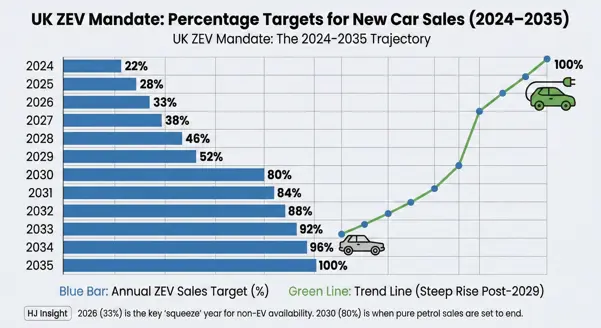
In 2024, the mandate started at 22%. By 2026, that figure has climbed to 33%. This means that for every 100 cars a manufacturer registers in the UK this year, at least 33 of them must be zero-emission (essentially battery-electric).
How the "credit" system works
The government issues allowances to manufacturers. If a brand sells more than 33% EVs, they earn surplus credits. If they sell fewer, they have three choices
- Trade: Buy surplus credits from an EV-only brand like Tesla or Polestar (this is why Tesla makes billions without selling a single petrol car).
- Bank: Use "saved" credits from previous years when they over-performed.
- Pay the fine: This is the nuclear option. For every petrol or hybrid car sold above their allowance, the manufacturer must pay a £12,000 fine.
Why this is a squeeze in 2026?
The problem in 2026 is that while the mandate target has jumped to 33%, consumer demand for EVs hasn't quite kept pace. This creates a supply gap. If a manufacturer like Ford or Toyota has a popular petrol hybrid that everyone wants, but their electric models are sitting in showrooms, they have to stop delivering the petrol cars.
If they don't, they risk a multi-million pound fine at the end of the year.
Is it true that manufacturers are 'banning' their own petrol cars?
No quite, but if you feel like you’re being "nudged" towards an electric car you didn’t ask for, you aren’t imagining it. In 2026, the car industry has adopted a tactic known as "supply management" — also known in the industry as rationing.
Manufacturers are currently walking a financial tightrope. Because they face a £12,000 fine for every petrol car sold above their government-mandated quota, they have developed several ways to slow down the sale of traditional engines.
1. The port parking tactic
One of the most common sights in 2026 is thousands of brand-new petrol and hybrid cars sitting in UK "buffer" compounds at ports like Bristol and Sheerness. These cars are built and ready for customers, but manufacturers are intentionally delaying their arrival at dealerships. By holding them back, they ensure the car isn't registered until a later month or even the next year, keeping their current EV sales percentage artificially high.
2. Artificial price hikes
Have you noticed that the price gap between a petrol car and its EV equivalent is shrinking? This isn't always because EVs are getting cheaper, it's because petrol cars are being made more expensive. Some brands are adding a "shadow tax" to the list price of petrol models. This extra profit is then used to fund massive £8000 – £10,000 discounts on their electric models to "buy" the sales they need to hit the ZEV target.
3. The extended lead time bluff
We have heard from dozens of readers who have been told that a petrol SUV has a 14-month waiting list, while the electric version can be on their drive in seven days. In many cases, the factory is perfectly capable of building the petrol car sooner. The delay is a "quota hold" — the manufacturer simply doesn't want to register any more petrol cars this quarter because they’ve already reached their limit.
4. Withdrawal of nearly new stock
Traditionally, dealers pre-register petrol cars to hit monthly targets, leading to a healthy supply of cheaper nearly-new cars. In 2026, this has almost stopped for petrol models. Manufacturers are now strictly forbidding dealers from pre-registering anything with an internal combustion engine, meaning the affordable 6-month-old petrol car is becoming a thing of the past.
Why your petrol car order might be delayed until next year
If you’ve been told your new petrol car won’t arrive until 2027, you might assume there is a shortage of microchips or a shipping strike. In reality, the delay is likely happening on a spreadsheet in a corporate head office.
In 2026, the car market is governed by quarterly quotas. To avoid the catastrophic fines associated with the ZEV Mandate, manufacturers are having to manage their sales mix with surgical precision. Here is how that affects your delivery date:
The registration trap
A car is only counted toward a manufacturer's ZEV target when it is registered with the DVLA, not when you sign the order form. If a brand has already reached its allowance of petrol registrations for the current quarter, they will intentionally push your delivery date into the next three-month block — or even into the next year — to ensure the car counts toward a future quota.
The EV first production line
Manufacturers are increasingly prioritising the production of electric vehicles over internal combustion engine cars. If a factory has a limited supply of a shared component — such as a specific safety sensor or infotainment screen — they will divert those parts to the EV production line first. Why? Because every EV sold unlocks the ability to sell two or three more petrol cars without triggering a fine.
Holding fields and buffer stock
You may have seen headlines about car graveyards at UK airfields or ports. These aren't unsold cars — many are petrol models that have already been built and assigned to customers. They are being held in "buffer stock" because the manufacturer has already hit its 2026 petrol limit. Delivering that car to you today would cost the manufacturer £12,000 in government penalties, so they wait until the clock resets on January 1st.

When will I officially not be able to buy a petrol car?
There is a huge amount of misinformation circulating in 2026 regarding what the UK government is actually banning. Many are under the impression that they won’t be able to buy anything with an exhaust pipe after 2030.
The reality is more nuanced — and for those not ready to make the jump to a full Electric Vehicle (EV), there is a significant stay of execution for hybrid technology.
The 2030 deadline: Pure petrol and diesel
From 1 January 2030, the sale of brand-new cars powered solely by a petrol or diesel engine will be prohibited. If the car does not have some form of electrified assistance (a battery and a motor), it cannot be sold. This marks the end of the road for traditional pure internal combustion engines.
The 2035 loophole: Hybrids and PHEVs
Here is the part that often gets missed: Full Hybrids (HEV) and Plug-in Hybrids (PHEV) have been granted an extra five years. As long as a car is capable of driving a "significant distance" on electric power alone (a definition the government finalised in 2025), it can remain on sale until 2035.
What can you buy right now?
In 2026, you effectively have three choices if you want to stay away from pure EVs.
- Mild Hybrids (MHEV): These use a small battery to assist the engine but cannot drive on electricity alone. Under current 2026 rules, most MHEVs will be treated as "pure" petrol cars and sales banned in 2030.
- Full Hybrids (HEV): Cars like the Toyota Corolla or Honda Civic. They self-charge and can drive short distances (usually at low speeds) on electric power. These are safe to buy new until 2035.
- Plug-in Hybrids (PHEV): These have larger batteries you can plug in, typically offering 30–50 miles of range. These are the "cleanest" hybrids and are the primary focus of the 2035 extension.
Will I be able to drive my petrol car after 2030?
Yes. The ban only applies to the sale of new cars. You will still be able to buy and sell used petrol, diesel, and hybrid cars, and you will still be able to buy fuel at the pumps. However, Honest John expects to see "pollution taxes" (like ULEZ) expand and the resale value of non-compliant cars to soften as we approach the 2030s.
Still confused about the difference? Read our 2026 guide: Hybrid vs Plug-in Hybrid vs Mild Hybrid – which one is right for you?
Why your 2022 petrol car is suddenly gold dust
Because new petrol cars are being rationed, we are seeing a 'depreciation flip' in 2026. While used EV values are fluctuating due to tech leaps, high-quality Euro 6 petrol cars and self-charging hybrids (like the Toyota Corolla) are holding their value better than ever. If you have a clean, low-mileage petrol car, don't let a dealer low-ball you on a part-ex — it's exactly what the market is desperate for right now.
The depreciation flip: Why used petrol cars are suddenly worth more
In the world of car buying, we’ve always been told that as soon as you drive a new car off the forecourt, its value drops like a stone. But in 2026, the ZEV Mandate has turned this logic on its head.
We are currently seeing a "depreciation flip." While used electric car prices have seen sharp corrections — dropping by as much as 10% year-on-year in 2026 — the value of used petrol and hybrid cars is doing something remarkable: staying put and in some cases even rising.
The pandemic gap meets the ZEV squeeze
Two major factors are driving this price surge. First, there is a massive supply shortage of middle-aged cars. During the pandemic years (2020–2022), millions of new cars were never built due to chip shortages. In 2026, that gap has moved through the market, meaning there are 30% fewer 5-year-old cars available than usual.
Second, because new petrol cars are being rationed by manufacturers to meet EV quotas, buyers who aren't ready to go electric are flooding the used market. High demand and low supply mean that if you own a 2022–2025 petrol car, you are sitting on gold dust.
Why 2022–2025 models are the sweet spot
Cars registered between 2022 and 2025 are particularly valuable in today's market for three reasons:
- ULEZ compliance: They are all Euro 6 compliant, meaning they can drive in any Clean Air Zone without charge.
- Modern tech: They still feature the latest safety kit and Apple CarPlay/Android Auto, making them a viable alternative to a brand-new car.
- No rationing drama: You can buy them today and drive them home tomorrow — no 12-month wait required.
Honest John advice: Is now the time to sell?
If you have been thinking about trading in your petrol car, now is the time to act. We are seeing independent dealers and car supermarkets paying over the odds for clean, low-mileage petrol stock because they simply cannot get enough new cars to sell.
However, don't just take the first part-exchange offer you get. Because the market is moving so fast, some of the traditional valuation books are lagging behind the real-world prices.
Get at least three quotes — one from a main dealer, one from an online car-buying service and one from a local independent. You might be surprised to find your car is worth £1000 to £2000 more than it was six months ago.
Want to see what your car is worth? Use our 2026 Valuation Tool to get a real-time price for your petrol or hybrid car
How to spot if a dealer is "rationing" you
"The EV-only discount": If you are offered £8000 off an EV but full list price for a petrol model, you are being nudged to help them hit their quota.
"Long lead-time" excuses: If a salesperson says a standard petrol hatch has a 12-month wait, but an EV is available today, it’s likely a quota issue, not a factory issue.
"Pre-reg" unavailability: Look at the nearly new stock. If there are dozens of delivery-mileage EVs but zero petrol cars, the manufacturer is restricting the registration of combustion engines.
Honest John’s buying strategy: How to beat the ZEV supply squeeze
If a dealer tells you there is a 12-month wait for a petrol car but an EV is available next week, don't just take their word for it.
- Check other dealers: Some large dealer groups have un-rationed stock that hasn't been registered yet.
- Look for pre-reg petrols: Manufacturers sometimes register their own petrol cars in the first month of a quarter before the quota tightens.
- The credit loophole: Brands like Suzuki are effectively buying their way out of the mandate by paying other brands for credits. This means you might pay a few hundred pounds more for the car, but you won't be rationed.
2026 ZEV Mandate & petrol supply: Your questions answered
Why can’t I order a new Ford petrol car today?
You can, but you may be told there is a 12-month wait. This is rarely a factory issue and more likely a quota hold. Because brands like Ford have high demand for petrol models (like the Puma and Focus) but need to hit a 33% EV sales target, they are intentionally slowing down petrol registrations. By pushing your delivery into 2027, the manufacturer avoids a £12,000 fine for exceeding their 2026 petrol allowance.
Is the 2030 petrol car ban already in place?
No. It is still perfectly legal to buy and drive a new petrol, diesel, or hybrid car in 2026. The ban on the sale of pure petrol and diesel cars doesn't start until 1 January 2030. The confusion arises because manufacturers are rationing supply now to meet yearly ZEV Mandate increments. You aren't being stopped by the law — you're being stopped by a manufacturer's spreadsheet.
Why is the electric version cheaper than the petrol car I want?
In 2026, we are seeing a phenomenon called "price gapping." To hit their 33% electric target, some manufacturers are adding a "shadow tax" to petrol models to make them less attractive, while using that extra profit to fund £10,000 discounts on their EVs. You aren't just paying for the car — you are effectively paying the manufacturer's government fine for them so they can nudge you into the electric version.
Will I be able to buy petrol at the pumps after 2030?
Yes. The 2030 ban only applies to the sale of brand-new pure combustion cars. There will be millions of petrol and hybrid cars on UK roads for decades to come, and petrol stations will continue to operate. However, Honest John expects fuel duty and pollution taxes (like expanded ULEZ) to increase as the government tries to accelerate the switch to electric.
Is it actually illegal to buy a petrol car in 2026?
No. It is perfectly legal to buy a new petrol, diesel, or hybrid car. The "ban" you are hearing about doesn't start until 2030 (for pure petrol/diesel) and 2035 (for hybrids). The current issue is availability, not legality. Manufacturers are limiting how many they sell to avoid government fines, but they are still very much for sale.
Why is the dealer telling me there is a "national shortage" of petrol models?
In most cases, this is a quota shortage rather than a parts shortage. Because 33% of a brand's sales must be electric in 2026, they may have already sold their allowance of petrol cars for the month or quarter. The cars often exist in shipping compounds, but the manufacturer won't let the dealer register them until their EV sales catch up.
Will my 2026 petrol car be worth anything in three years?
Actually, it might be worth more than usual. Because new petrol cars are being rationed, the supply of used petrol cars is shrinking. Honest John data suggests that high-quality, Euro 6 petrol and hybrid cars are holding their value better than EVs in 2026 due to huge demand from buyers who aren't ready to plug in.
Can I avoid the ZEV rationing by buying a hybrid?
Only partially. While full hybrids (HEV) and plug-ins (PHEV) are better for your long-term resale value (as they can be sold new until 2035), they still count as non-ZEV vehicles under the 2026 mandate. This means they are subject to the same rationing and quotas as a standard petrol car.
What is the £12,000 fine I keep hearing about?
This is the penalty a manufacturer must pay to the UK government for every petrol, diesel, or hybrid car they sell above their permitted 2026 quota. It is a massive financial "stick" designed to force them to discount their EVs and make petrol cars harder to get.
Is it true that some 26 plate cars have automatic speed limiters?
Yes. As of July 2024, all new cars sold in the UK must be fitted with Intelligent Speed Assistance (ISA). If you buy a new 26 plate car in March, it will likely chime or reduce engine power if you exceed the speed limit. You can switch it off, but it will default to 'on' every time you start the engine.
